

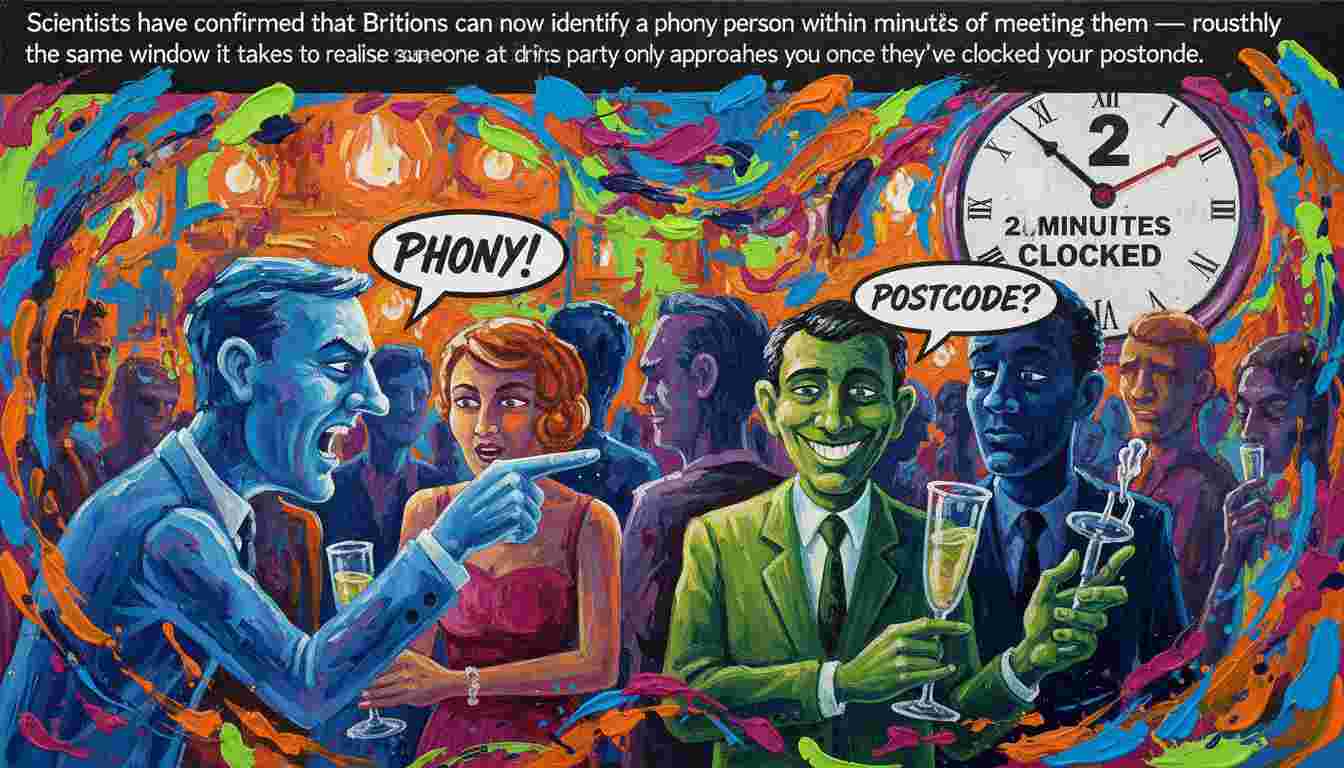
Scientists confirm Americans can now detect a phony person within minutes — roughly the same time it takes to say, “So, what do you do for a living?”
According to groundbreaking research covered by YourTango, humans have evolved a sixth sense that sits somewhere between “fight or flight” and “this guy definitely owns a podcast.” We can spot a phony. We’ve always known. We’ve just been too polite — or too impressed by their loafers — to say anything.
Welcome to the Golden Age of Inauthenticity, where everyone is performing authenticity, no one is actually authentic, and the whole tragicomedy is available on social media with professionally adjusted lighting.
15 Observations About Spotting Phony People (And Why We Still Fall For It)
1. Scientists Say Phony People Talk About Money Fast
Finally, a research group more efficient than a used car salesman on espresso. Researchers found that phony individuals often steer conversations toward money, status, or employment within moments of meeting you — before you’ve even found the chip bowl. It’s less small talk and more opening arguments.
2. The 12-Second Salary Audit
If someone asks what you do within 12 seconds of meeting you, congratulations: you’re being emotionally appraised like a condo on a flood plain. Eyewitness Jessica Malloy recalls: “He asked what I did, where I lived, and what my credit score was before I finished saying my name. I thought I was on a date. Turns out I was being audited.” Sociologists now call this economic flirting — where attraction is measured in annual income and dental insurance, two things your mother also asked about.
3. Personality Chameleons Only Appear at Networking Events
Real personality change takes weeks of effort, discomfort, and ideally a good therapist. Fake people, however, can transition full personalities in under 11 seconds upon spotting someone in expensive footwear. One witness described the transformation as “watching a lizard discover LinkedIn.” Which, to be fair, is exactly what LinkedIn looks like.
4. Name-Dropping: LinkedIn Trying to Escape Someone’s Mouth
Phony individuals brag about connections and achievements early — before appetizers, before introductions, occasionally before eye contact. One dinner party survivor reported: “He mentioned three CEOs, two senators, and a Pilates instructor before the bread arrived. I don’t even know three people total.” Experts now confirm name-dropping is less about networking and more about building a human résumé nobody requested.
5. Inconsistent Stories Are Just Improv Without the Talent
Inconsistent storytelling isn’t creativity. It’s improv comedy performed by someone who skipped every class. Research from Frontiers in Psychology suggests that general inconsistency — missed commitments, shifting narratives, broken promises — is one of the clearest signals of a genuinely fake person. The plot holes aren’t character depth. They’re load-bearing deceptions.
6. Body Language Experts Say Hands Don’t Lie
Mine are currently lying about how much I exercise. But for phonies, micro-expressions and subtle physical cues reveal true intentions even when words are perfectly rehearsed. The hands know. The hands always know. They’re just terrible at keeping secrets.
7. Agreeing With Everything You Say Is Not Friendship — It’s an Emotional Uber Rating
“I don’t trust people who agree with everything I say. That’s not friendship, that’s customer service.” — Jerry Seinfeld
Licensed clinical psychologist Seth Meyers confirms that real friends will judge you — and that’s a feature, not a bug. If someone never disagrees, they’re not listening. They’re buffering. Loading a version of themselves calibrated to your approval rating.
8. People Who Never Disagree Aren’t Nice — They’re Buffering
Perpetual agreement is the social equivalent of a spinning wheel. Looks responsive. Goes nowhere. The goal is not to be liked by everyone. The goal is to be trusted by someone. Those are very different products, and only one of them is on sale at networking events.
9. If Someone Asks Zero Questions About You, You’ve Become a Podcast Audience
You nodded. You laughed at the right moments. You did not speak. You are not a conversation partner — you are an audience with parking validation. Real connection, research from the University of Rochester confirms, requires actual vulnerability and honest exchange — not a captive audience for someone’s personal TED talk.
10. Gossip Is Now a Bonding Activity
Cavemen shared food. We share “Did you hear about Cheryl?” Phony people share stories where they star as the victim and an evil other plays the villain — and if someone will gossip with you, they’ll gossip about you. That’s not a friendship. That’s an alliance with a shelf life.
11. Fishing for Compliments Is Now a Full-Time Career With No Benefits
“You ever meet someone so fake you check their neck for a price tag?” — Ron White
The compliment economy is booming. Supply has never been higher. Demand is bottomless. And yet, research confirms that genuine people don’t seek external validation after a personal victory — they simply acknowledge it and move on. Phonies, meanwhile, post about it. With a filter. And a quote from Gandhi.
12. Turning Conversations Into Competitions: How Adults Reinvent Recess
One-upmanship is the adult version of “Oh yeah? Well my dad can beat up your dad.” Except now the dads are investment portfolios and the playground is a dinner table in the suburbs. If every story you share becomes a launching pad for someone else’s better story, you’re not having a conversation — you’re watching a live audition for Main Character of the Evening.
13. Oversharing on Day One Is Emotional Speed Dating With Trauma
“I love when someone overshares immediately. It’s like, wow, we skipped small talk and went straight to therapy.” — Amy Schumer
Within minutes of meeting, some individuals will share their entire life story — including childhood trauma, three exes, and a detailed breakdown of their chiropractor’s betrayal. Local man Greg described his experience: “I asked how their day was, and suddenly I was co-authoring a memoir.” Experts now classify this as emotional speed-running, where the goal is deep connection before the appetizers arrive and before anyone has consented to co-authorship.
14. The Barnum Effect: Why You Still Fall For It Anyway
The Barnum Effect — also known as the Forer Effect — explains why vague, flattering, personalized-sounding statements land on virtually everyone. “You seem like someone who values honesty but has been hurt before” continues to work on approximately 100% of the population, including people who loudly claim they “don’t fall for that stuff.” Dr. Elaine Pritchard, cognitive psychologist, puts it plainly: “People don’t want truth. They want personalized compliments that feel like truth wearing a tuxedo.”
15. Everyone Thinks They’re the Authentic One
Here is the twist that lands like a cold shower: everyone believes they are the real one in a world full of phonies. Behavioral experts note that authenticity has become a personal brand. People don’t just want to be genuine — they want to be seen being genuine, preferably in good lighting with a caption that says “no filter.” As one researcher put it: “We have entered the era of performative authenticity, where even being genuine requires a strategy.”
The Hidden Economy of Fake People: A Statistical Portrait
A recent poll conducted by the Center for Social Vibes (which operates out of a Panera Bread) found:
- 72% of people suspect at least one friend is performing friendship for networking purposes
- 64% admit they’ve pretended to like someone for access to snacks or connections
- 11% say they are the phony person, but “in a charming way”
Meanwhile, anonymous sources report a growing underground economy where compliments are exchanged for future favors, social capital accrues through strategic vulnerability, and the currency of authenticity is minted by people who’ve never been authentic a day in their lives.
How to Spot Phony People: Trust Your Instincts (But Maybe Not Completely)
Research published in Personality and Social Psychology Bulletin confirms that intuition, combined with analytical thinking, produces faster and more accurate social judgments than either approach alone. Your gut is not infallible. But it is considerably cheaper than a behavioral economist.
Still — if someone asks your salary before your last name, agrees with everything you say, and casually mentions knowing “a guy in Dubai,” you may not have met your new best friend.
You may have met a networking opportunity with a pulse.
Auf Wiedersehen, amigo!
YourTango recently published research suggesting Americans can now identify a phony person within minutes of meeting them, based on behavioral cues including rapid personality shifts, early money-focused conversation, name-dropping, and reflexive agreement. The findings draw on studies in behavioral psychology, the Barnum Effect (a cognitive bias making people susceptible to vague flattery), and social neuroscience research from Harvard Medical School. The article sparked wide reader engagement, with many respondents confident they could spot a phony — and a statistically significant number who are probably the phony in question.
