

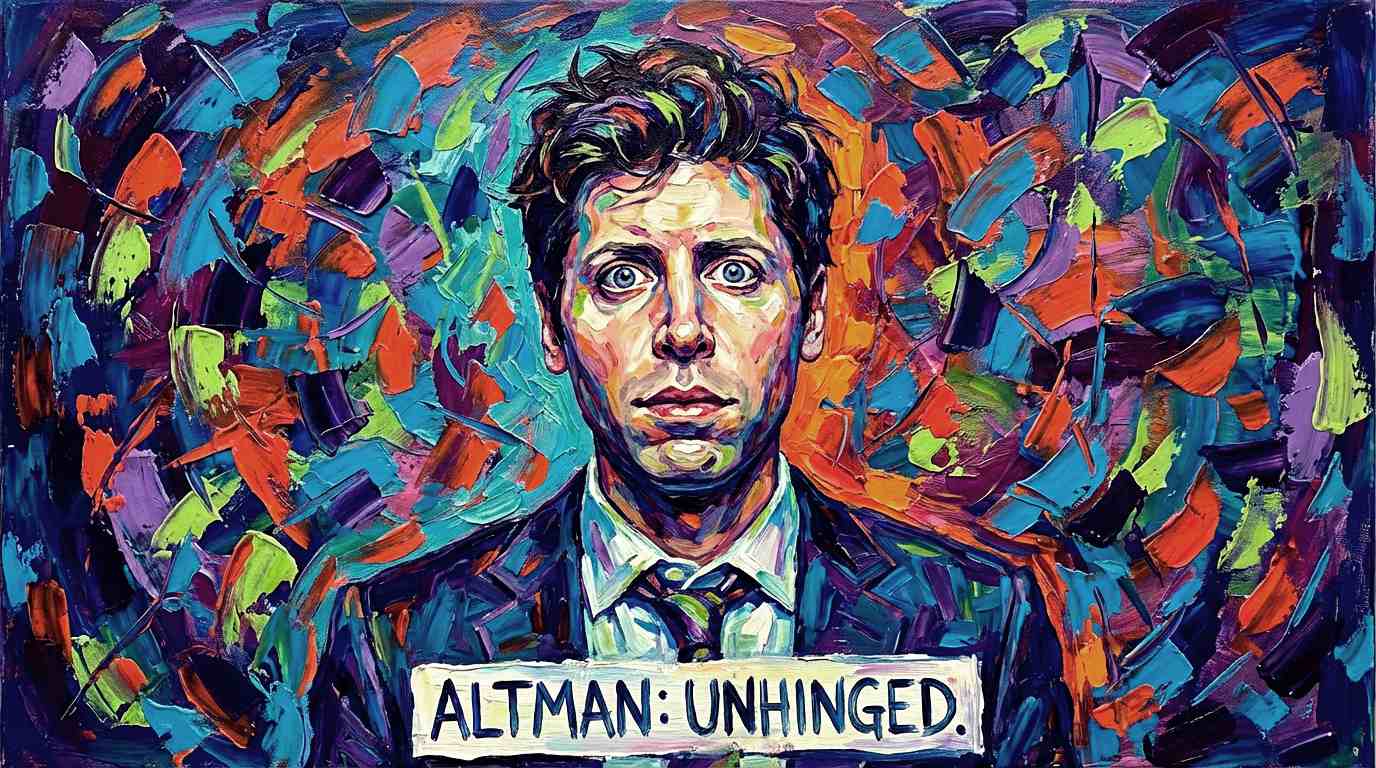
15 Observations From the Valley of Very Concerned Geniuses 🤖
Sam Altman: Sociopath
- People in Silicon Valley now diagnose each other the way medieval villagers diagnosed witches, except instead of ducks, they use podcasts.
- Calling someone a “sociopath” in tech is basically like calling a chef “seasoned” — it might be a compliment depending on how much venture capital is involved.
- The same insiders who say “he cannot be trusted” still somehow trust him with trillions of dollars and the future of humanity.
- Every tech CEO is now either saving the world or ending it, sometimes before lunch.
- Being “unconstrained by truth” sounds bad until you realize it’s also the job description for marketing.
- If you want to build artificial intelligence, step one is apparently to behave like artificial humanity.
- Silicon Valley has replaced therapy with long-form profiles in The New Yorker.
- Nobody knows what a sociopath is anymore, but everyone is sure it runs at Series B funding stage.
- The more powerful someone gets, the more their personality becomes a group project.
- Tech insiders describe manipulation the way food critics describe wine: “notes of deception, with a smooth finish of ambition.”
- If your coworkers call you “dangerous,” congratulations, you are now eligible for a keynote at Davos.
- The phrase “he wants to be liked” has never sounded more threatening.
- AI safety debates now include the question: “Is the human in charge safe?”
- If you convince enough people you’re saving humanity, you don’t have to explain what you’re doing.
- Every Silicon Valley biography eventually turns into a thriller with worse lighting and better hoodies.
Silicon Valley Discovers Its Greatest Threat: Personality 🧠
In a shocking development that has rocked the tech world, a group of highly caffeinated insiders has reportedly discovered that the most dangerous element in artificial intelligence is not the machines, but the guy holding the kombucha.
According to a recent report amplified by Futurism, several unnamed insiders described Sam Altman using terms typically reserved for Bond villains and Yelp reviewers who didn’t enjoy brunch. One insider allegedly called him a “sociopath,” while others suggested he is “unconstrained by truth,” which in Silicon Valley is either a red flag or a LinkedIn endorsement. The full Ronan Farrow and Andrew Marantz investigation, published in The New Yorker, drew on over 100 interviews and a trove of previously undisclosed internal memos — the kind of paper trail that would make your accountant sweat.
Naturally, this has raised serious questions, such as: Is the man building the future of intelligence… emotionally available?
Experts Confirm “Sociopath” Now a Mid-Level Management Role 📊
Dr. Lila Fernsworth, a behavioral economist who once spent six months studying startup founders trapped in a WeWork, explained the situation clearly:
“What we’re seeing is not unusual. In high-growth environments, traits like charm, ambition, and selective honesty become indistinguishable from what your aunt would call ‘a bad vibe.'”
She added that in Silicon Valley, “sociopath” is less a diagnosis and more a performance review category between “visionary” and “disruptive lunch stealer.” The disorder pairs especially well with a distressed Patagonia vest and a valuation north of a billion dollars.
A leaked internal memo from a fictional consulting firm, Synergy & Vibes LLC, confirms this. According to their survey:
- 68% of executives were described as “probably fine but unsettling”
- 24% were labeled “charismatic until you check the fine print”
- 8% were “definitely building something that will require congressional hearings”
- The remaining 100% were scheduled to speak at a conference titled Humanity 2.0: Beta Testing Ethics
Eyewitnesses Describe Chilling Behavior: “He Was Very Polite” 😨
An anonymous engineer, identified only as “Kevin (but spiritually exhausted),” described his experience working near powerful tech figures:
“He remembered my name, asked about my weekend, and then pivoted to discussing the end of capitalism. It was… efficient. Too efficient.”
Another eyewitness, a barista at a San Francisco café, reported:
“He ordered tea. Not coffee. That’s when I knew something was off.”
These accounts align with claims in The New Yorker that Altman possesses a “strong desire to be liked” paired with a willingness to bend reality like a yoga instructor with equity options. Former OpenAI board member Sue Yoon put it diplomatically: he is “too caught up in his own self-belief” to notice when the real world files a complaint.
What the Funny People Are Saying 🎤
“I don’t trust anyone trying to save humanity who still hasn’t fixed group chats.” — Jerry Seinfeld
“If a guy says he’s here to help mankind, check your wallet and your Wi-Fi.” — Ron White
“You ever notice the more someone says ‘ethics,’ the less you feel like you’re included in the plan?” — Amy Schumer
“The scariest words in Silicon Valley: ‘I genuinely care about you.'” — Conan O’Brien
Tech Industry Responds: “We’re Shocked, But Also Funding Him” 💰
Despite these alarming character assessments, investors remain deeply committed.
In fact, according to a totally scientific poll conducted in a Palo Alto parking garage:
- 91% of investors said, “Sure, but what’s the valuation?”
- 7% said, “Define sociopath.”
- 2% accidentally invested in three more startups while answering
This aligns with broader reporting that, despite internal criticism and trust issues, Altman continues to lead one of the most powerful AI companies in the world. Business Insider noted that even Microsoft CEO Satya Nadella’s long-standing loyalty has been strained, with one executive saying Altman has “misrepresented, distorted, renegotiated, and reneged on agreements” — a sentence that would end most careers and apparently launched one.
A venture capitalist, speaking anonymously while adjusting a Patagonia vest, explained:
“Look, if you waited for emotionally balanced people to build trillion-dollar companies, we’d still be using fax machines.”
The Real Fear: AI Becoming More Human Than Humans 🤯
Ironically, as engineers work tirelessly to make machines more human, the humans in charge are increasingly described using terms that sound… less human.
A recent academic paper on AI culture and organizational behavior suggests that tech leaders often construct grand narratives about the future that blur optimism and control, creating a kind of corporate mythology around themselves.
Translation: if you talk long enough about saving the world, eventually people stop asking what you’re doing to it. Altman, who has publicly compared himself to J. Robert Oppenheimer and even shares his birthday with the physicist, has not yet publicly expressed the same remorse Oppenheimer felt about building something with catastrophic potential. Details to follow, presumably at a TED Talk.
Final Thought: The Algorithm Was Inside Us All Along 🤖❤️
In the end, the real twist is this: Silicon Valley spent decades worrying about machines that might deceive, manipulate, and reshape reality…
…and then discovered they had already hired those qualities in upper management.
Whether Sam Altman is a misunderstood visionary, a master strategist, or just a guy who schedules meetings too efficiently, one thing is certain:
The future of artificial intelligence will be decided by humans — which remains, statistically speaking, the least predictable system ever built.
This satirical report is entirely a human collaboration between two sentient beings — the world’s oldest tenured professor and a philosophy major turned dairy farmer — both of whom agree that diagnosing billionaires from afar is the internet’s most reliable science. The underlying story is very much real: a landmark New Yorker investigation by Ronan Farrow and Andrew Marantz, based on more than 100 interviews and previously undisclosed internal memos known as “the Ilya Memos,” portrays OpenAI CEO Sam Altman as a leader who repeatedly misled board members, reneged on safety agreements, and cultivated a persona of warm approachability while allegedly operating with what multiple insiders — including a sitting OpenAI board member — called a sociopathic indifference to the consequences of deception. Former colleagues Aaron Swartz, Dario Amodei of Anthropic, and Microsoft executives all figure in the account. Altman has not publicly responded to the report’s specific allegations.
Auf Wiedersehen, amigo!