

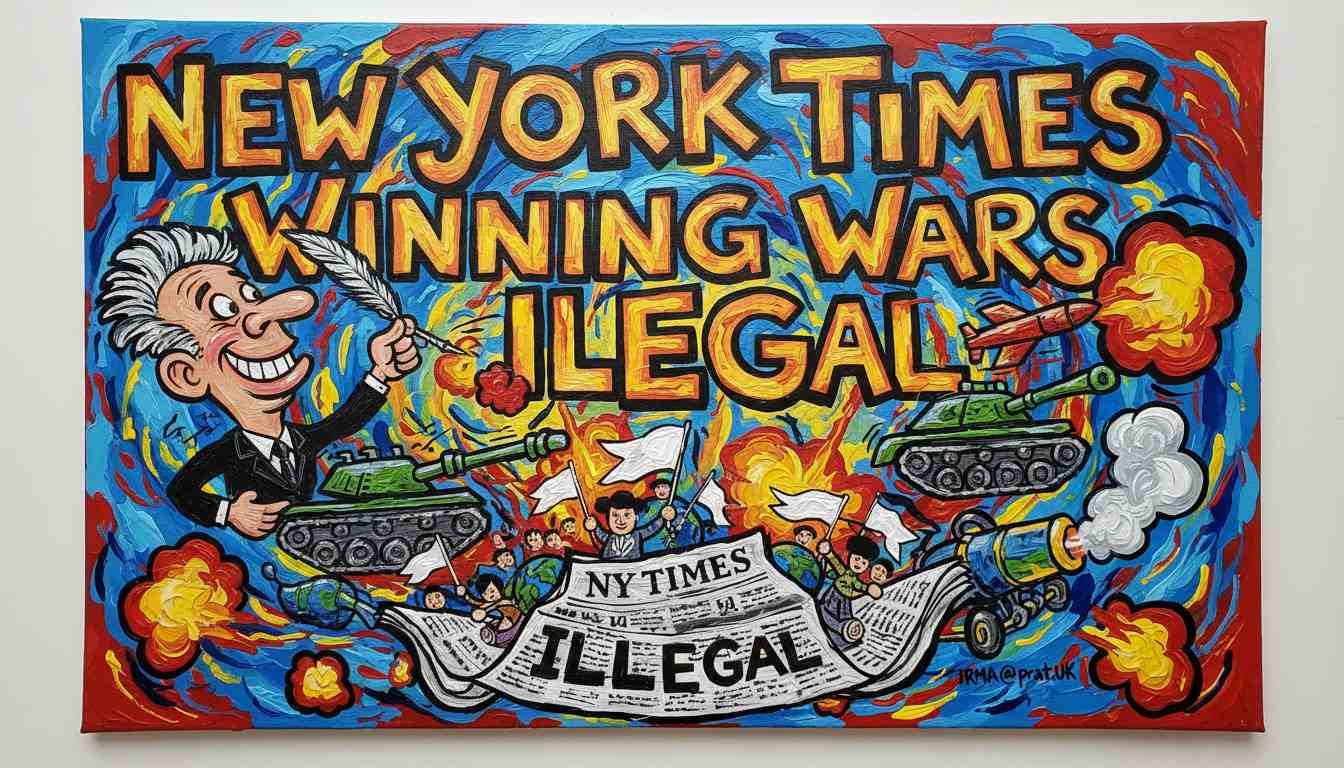
America Recalls Every History Book Ever Printed After NYT Discovers Winning Wars Is Illegal
Six Breaking Observations from the Bureau of Retroactive Justice, Subcommittee on Things That Already Happened
- The Pentagon has quietly begun shredding its trophy collection. Patton’s pistols, now classified as “instruments of disproportionate outcome,” are being transferred to a DEI sensitivity review panel in Delaware.
- West Point cadets informed that the new graduation requirement is a strongly worded letter, not a commission.
- Civil War reenactors now required to pause halfway through Bull Run and convene a full court-martial of Lincoln, Grant, and Sherman for war crimes — presided over by a Harvard Law professor billing at $900 an hour on a federal diversity grant.
- The Smithsonian’s “Price of Freedom” military museum is being rebranded. Working title: “Mistakes Were Made: An Apology in Fourteen Galleries.”
- D-Day veterans, average age 102, have been notified by certified mail that Eisenhower has been referred to the International Criminal Court. Most have chosen not to lose sleep over it.
- One exhausted history professor summarized the new curriculum: “We used to teach kids that America won. Now we teach them to feel bad about it. Same number of class hours, considerably more crying.”
The New Rule Is Simple: If You Won, You’re Guilty
NYT: https://www.nytimes.com/2026/04/07/us/politics/trump-iran-war-crimes.html
WASHINGTON, D.C. — Iran blockaded the Strait of Hormuz — the chokepoint through which roughly twenty percent of the world’s oil flows — shot down American aviators, funded terrorists on four continents for forty-five years, and has been constitutionally committed to destroying Israel since 1979.

Donald Trump threatened to bomb their bridges.
Naturally, the bridges are the problem.
In response to Trump’s entirely reasonable promise to hit back, the American left has launched what historians are calling “the most ambitious rewrite of human achievement since the last time a faculty committee got a grant.” The core argument is elegant in its absurdity: winning wars is now a war crime. Losing them, apparently, shows real moral growth.
According to a leaked memo from the American Historical Association — an organization that has never once been shot at — past American leaders including George Washington, Andrew Jackson, Abraham Lincoln, Ulysses S. Grant, William Tecumseh Sherman, Woodrow Wilson, Franklin D. Roosevelt, Harry S. Truman, and Dwight D. Eisenhower have been “reclassified as historically complicated individuals who were, in light of Donald Trump, clearly guilty of war crimes.”
The memo did not specify what the correct alternative would have been. Losing, presumably. Losing with dignity. Losing while filing the appropriate paperwork.
Dr. Jennifer Caldwell-Pruitt, a senior fellow at the Brookings Institution who describes her specialty as “conflict de-escalation narratives,” explained the new intellectual framework to a room of nodding journalists:
“We’re not saying these men were wrong, per se. We’re saying they achieved outcomes in ways that, viewed through a contemporary ethical lens, raise significant questions about intent, proportionality, and their overall relationship with winning.”
She then accepted a round of applause and submitted a grant application for a follow-up study.
Harry Truman, who dropped two atomic bombs, ended World War II in the Pacific in under a fortnight, and saved an estimated million American lives in the process, is currently ranked number one on the Association’s retroactive war crimes referral list. He is unavailable for comment, having died in 1972, which the committee notes “does not confer immunity.”
The New York Times Unveils Its “War: But Should We, Though?” Desk
The New York Times — the paper that told Americans the Afghanistan withdrawal was going fine while people clung to the outside of military aircraft — has now pivoted to informing Trump that threatening to destroy the infrastructure of a theocratic regime holding American shipping hostage is, legally speaking, a bridge too far.
The irony of using the word “bridge” was lost on the editorial board.
Revised Times headlines from the new “War: But Should We, Though?” desk reportedly include:
- “Normandy Landings Deemed Successful; Eisenhower Referred to ICC for Excessive Winning”
- “Hiroshima: Truman Ends War, Raises Questions; Posthumous Indictment Filed”
- “Grant Accepts Lee’s Surrender at Appomattox; Historians Now Say He Should Have Asked First”
- “U.S. Wins Revolutionary War; Britain Files Formal Complaint, NYT Finds It Credible”
- “Iran Closes Strait of Hormuz; America Urged to Process Feelings Before Responding”
An anonymous Times editor — described by colleagues as “morally energized in a way that suggests he has never paid a gas bill” — defended the coverage:
“We’re not anti-American. We’re just asking: what if winning is the real aggression? What if every war America has ever won was, at its core, an act of disproportionate success? These are the questions a free press must ask.”
The Times‘ circulation has dropped every year since 2012. The questions are not working.
Harvard Law Drops Everything to Defend the Ayatollah’s Bridges
Within hours of Trump’s ultimatum, legal scholars from Harvard, Yale, NYU, and Stanford law schools had assembled an open letter, a press conference, three podcast appearances, and a constitutional objection explaining in exhaustive detail why the United States government may not bomb the bridges of a country that has been at war with America — in one form or another — since 1979.
The professors cited the Geneva Conventions, the principle of distinction between civilian and military targets, and “customary international humanitarian law” — a body of rules that, as far as anyone can tell, applies exclusively to the United States, Israel, and the United Kingdom, and never to the party currently mining international shipping lanes.
None of the professors cited the UN Charter’s guarantee of freedom of navigation. Possibly it slipped their minds. Possibly they had tenure committee meetings. Possibly citing it would have made the letter shorter and therefore less publishable.
Trump said he was “not at all” worried about the war crimes question. This is the correct answer when the country complaining about your aggression has spent forty-five years chanting “Death to America” in state-organized rallies. Most Americans with a gas tank, a 401(k), or a functioning memory agreed with him completely.
Congress Pivots From Governing to Time-Traveling Prosecution
Unable to agree on a budget, a border policy, or what to have for lunch, several members of Congress have discovered a more productive use of their time: retroactively prosecuting American military figures who cannot appear before a subcommittee to defend themselves.
A draft House resolution titled “America’s Winners: A Reckoning” reportedly contains language formally condemning:
- “Overperformance in wartime operations” — see: Patton, George S.; MacArthur, Douglas; Nimitz, Chester; all of them, frankly
- “Unilateral declaration of victory without consulting affected parties” — see: Washington, 1781; Grant, 1865; Truman, 1945; every American general who ever held a press conference
- “Failure to apply twenty-first century ethical standards to eighteenth, nineteenth, and twentieth century warfare” — see: the entire history of the United States military
- “Winning by a margin that could reasonably be described as excessive” — see: the Pacific Theater, the Western Front, the Mexican-American War, and Super Bowl XLIX
One Democratic staffer explained the strategic logic with remarkable candor:
“Look, modern policy is complicated. Modern voters are angry. But dead generals? Dead generals can’t tweet back. Dead generals can’t fundraise against you. The past is the safest place we’ve found to be brave.”
Polling from the Institute for Selective Outrage (margin of error: whatever feels right) found:
- 61% of Democrats believe Truman should have considered a third option at Hiroshima
- 24% asked what the third option would have been
- 15% said “wait, are we rooting for Japan now?”
- The remaining respondents were busy paying $4.89 for regular unleaded and had no further comment
History Class Goes Full Therapy Session
The new doctrine has hit American classrooms like a particularly demoralizing substitute teacher.
A high school history teacher in Dayton, Ohio, described the exact moment the wheels came off:
“I was teaching the Battle of Midway — greatest naval victory in American history, turned the entire Pacific War — and a kid raises his hand and goes, ‘So was Nimitz a war criminal for sinking all those ships?’ And I just… I stood there. Because according to the memo from the district curriculum office, the answer is apparently yes. Chester Nimitz: war criminal. I went into teaching to inspire young people. I did not sign up for this.”
He has since requested a transfer to the economics department, where at least the damage is theoretical.
Another teacher in Austin replaced the standard curriculum entirely with a semester-long seminar titled “What Even Is Winning, and Should We Want It?” which has now completed its eighth week without reaching a conclusion. The teacher calls it “a living document.” The school board calls it “a performance improvement situation.”
Students have adapted with the flexible pragmatism of people who were going to Google the answers anyway. Junior Tyler Kowalski summarized the new framework with unsettling confidence:
“So basically, if America wins, that’s a war crime. If America loses, that’s a tragedy. So the correct move is to almost win and then negotiate. I think that’s what they’ve been doing in the Middle East for fifty years. Seems fine.”
Tyler received an A. His essay cited four law professors and zero battles.
The Ripple Effects Are Exactly As Dumb As You’d Expect
The consequences have spread far beyond academia and into every corner of American life that liberals have not yet fully ruined.
The United States Military Academy at West Point is reportedly piloting a revised leadership curriculum called “Calibrated Non-Dominance,” in which cadets are trained to achieve battlefield objectives without appearing to enjoy it or win by too much. The program is described by one anonymous general as “what happens when people who’ve never left campus write doctrine for people who have.”
The NFL briefly entertained a proposal to award both teams a moral loss after every game, in the interest of “competitive equity.” The league declined after realizing this was already what it felt like to be a Cleveland Browns fan, and nobody had ever described that as progress.
Hollywood has greenlit the following projects for immediate development:
- Saving Private Feelings — WWII drama in which D-Day concludes with a group apology
- Patton: A War Crimes Retrospective — four-part docuseries, narrated by someone who has never served
- The Longest Day (Trigger Warning) — same film, new title, fifteen minutes of content warnings
- Iwo Jima: Both Sides — prestige limited series exploring the Japanese perspective on losing an island they invaded
The word “victory” has been formally flagged by several major university style guides. Recommended replacements now include:
- “Conflict resolution outcome”
- “Asymmetric conclusion event”
- “Forceful narrative closure, pending review”
- “A win, but make it sad”
What the Funny People Are Saying
“The New York Times just discovered that winning wars is a crime. I’ve been saying Washington was problematic for years. Nobody listened. Now I’m a prophet.” — Bill Burr
“If Truman’s a war criminal for ending World War II, then I’m a war criminal for finishing a bag of chips in one sitting. I’ll take the charge.” — Ron White
“We’ve reached the point where Harvard Law is defending Iranian bridges. I have nothing to add. I’m just going to go fill up my tank and contemplate the collapse of Western civilization.” — Greg Gutfeld
The Final Twist Nobody at the NYT Saw Coming
In a development that will surprise precisely no one who has attended a faculty meeting, historians have begun reviewing their own published work for evidence that they, too, may have been “contributors to a narrative of uncritical American triumphalism.”
One draft proposal suggests all future history textbooks carry the following disclaimer on the inside cover:
“The events described in this volume reflect the perspectives of people who already knew how things turned out. This foreknowledge may have introduced bias in favor of winners, who are, as we now understand, the primary suspects.”
As one archivist at the Library of Congress — a man who has spent thirty years in a building full of things America accomplished — put it:
“We used to study history so we wouldn’t repeat the mistakes. Now we’re studying it so we can apologize for the victories. I’m not sure that’s an improvement.”
Somewhere in the basement of that same library, a first-edition copy of Personal Memoirs of U.S. Grant sits undisturbed on a shelf marked “pending war crimes review.”
Grant himself — who saved the Union, ended slavery as a military matter, and won more battles than any American general in history — is listed at number three on the retroactive indictment roster, just behind Truman and just ahead of the guy who won the Mexican-American War.
He is, as always, unavailable for comment. But if he were, he’d probably just light a cigar and win something.
Auf Wiedersehen, amigo!
This article mocks the media and academic left’s response to Donald Trump’s April 2026 ultimatum demanding Iran reopen the Strait of Hormuz — the passage through which roughly 20% of global oil flows — or face destruction of its civilian infrastructure. Iran had closed the strait following the outbreak of the US-Israel conflict with Iran. Law professors from Harvard, Yale, NYU, and Stanford published open letters warning of war crimes under the Geneva Conventions. The New York Times ran extensive coverage framing Trump’s threats as legally indefensible. Trump told reporters he was “not at all” worried. A two-week ceasefire was announced April 8, 2026, conditional on Iran fully reopening the strait. The law professors are still billing.