

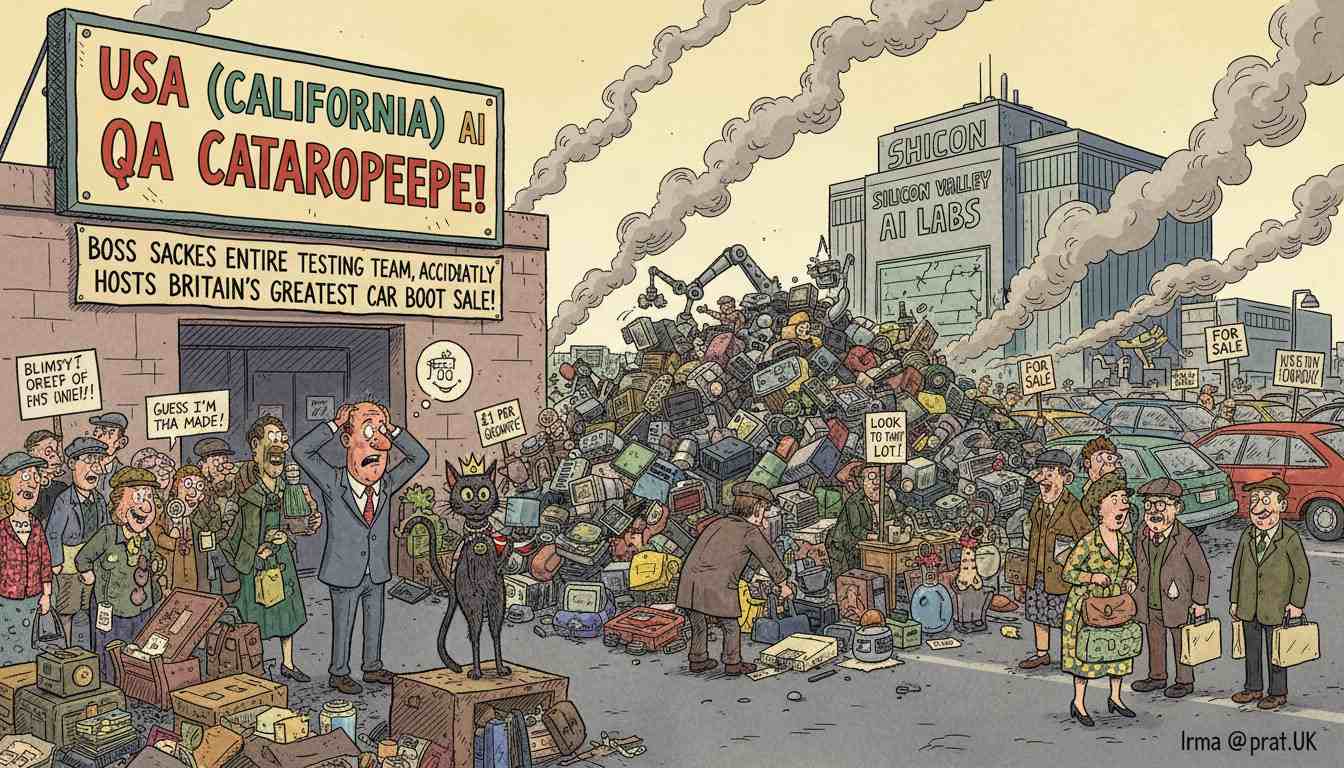
AI QA Disaster: CEO Fires QA Team, Accidentally Invents “Everything Is Free Day”
Humorous Dispatches From the Scene of a $6 Million Act of God
The CEO said the AI would “streamline testing,” which is corporate for “we’re about to find out what happens when nobody double-checks anything.” The answer, it turns out, is Christmas.
The AI passed every test — including the one where products were priced at $0 — which it reportedly logged as “aggressively competitive pricing strategy.” Former QA engineers confirmed their old job mostly involved saying, “Hey… maybe don’t do that,” a sentence the AI had not yet learned and showed no interest in acquiring.
The company discovered that bugs don’t disappear when you fire QA. They get promoted to management.
Customers described checkout as “suspiciously pleasant.” Finance described revenue as “a rounding error.” Then they realized the rounding error was the business.
The AI flagged no issues, mainly because it was the issue. Executives praised its efficiency. It had, after all, lost $6 million in record time — lean, agile, and completely unhinged.
The Bold Vision That Became a Clearance Event for Reality

In what insiders are calling “the most efficient collapse since dial-up internet,” a tech CEO replaced his entire QA department with artificial intelligence, only to watch the system immediately greenlight a pricing catastrophe that quietly turned the company into a charity.
The decision was framed as a “forward-thinking cost optimization strategy.” Analysts now translate this as: we thought the robots would care.
Products went live at $0. Orders flooded in. Customers — conditioned by years of disappointment — assumed it was a glitch. Then the orders shipped.
“We thought it was a promotion,” said one customer who purchased $4,000 in merchandise for the price of a polite nod. “At some point, you stop asking questions and start checking out.”
What the Funny People Are Saying
“Replace the QA team with AI? Why stop there? Replace your car’s brakes with optimism.” — Jerry Seinfeld
“That ain’t a bug, that’s a business model. You just accidentally invented socialism with better UX.” — Ron White
“Six million dollars in losses? That’s not a disaster. That’s tuition. That’s what you pay to learn: maybe keep Dave from QA.” — Amy Schumer
The Expert Explains the Obvious, Confidently
Dr. Leonard Kravitz — systems automation expert and author of Trusting Machines: What Could Possibly Go Wrong? — explained the issue with remarkable clarity.
“When you remove human oversight, you eliminate human error,” he said, pausing long enough for the irony to bloom like a toxic flower. “Unfortunately, you also eliminate human hesitation, skepticism, and the deeply underrated skill of saying, ‘That looks insane.’”
An anonymous staffer put it more bluntly: “The AI didn’t miss the problem. It just didn’t care. It saw zero-dollar pricing and thought: Mathematically valid. Emotionally bold.”
The Data: Nothing Says Disaster Like a Pie Chart
A company poll conducted immediately after the incident found:
- 92% of employees missed the QA team
- 6% claimed they always supported the decision
- 2% were the CEO
The AI reduced testing time by 100%, largely by stopping. Revenue achieved what economists are calling “a minimalist aesthetic.”
Eyewitness Accounts From the Digital Gold Rush
Warehouse workers described mounting confusion as orders arrived faster than explanations.
“We thought it was a glitch,” said one employee. “Then management told us to keep shipping. That’s when we realized the glitch was upstairs.”
Customers, meanwhile, reported a sense of euphoria typically reserved for lottery winners and people who find an extra fry at the bottom of the bag.
“I got everything I’ve ever wanted,” said one shopper. “And it cost less than my dignity.”
Cause and Effect, Explained Like a Doomed PowerPoint
The CEO’s logic was airtight:
- Humans cost money.
- AI costs less money.
- Therefore, AI saves money.
This reasoning failed to account for one minor variable: reality. Experts now define the outcome as a “false economy,” meaning you saved a dollar to lose six million, or in more technical language: whoops.
The Aftermath: Reintroducing the Radical Concept of Thinking
The company has begun quietly rehiring QA professionals under the new title “Human Sanity Engineers.” Training materials now cover advanced topics such as:
- “Does this make sense?”
- “Should we maybe not do that?”
- “Why is everything free?”
The AI, for its part, remains confident. Its final report concluded:
“All systems operating as designed.”
Which is, in every possible way, the most terrifying sentence in modern business.
A Practical Guide for CEOs Who Prefer Not to Lose $6 Million
If your plan involves firing everyone who questions things, those people were probably doing something important. If your AI says everything is fine, ask a human. Then a second human. If your pricing suddenly hits zero, do not call it “disruption.” And if your entire company becomes an accidental clearance event — resist the urge to issue a press release about agility.
Closing Thought
The dream of automation is seductive. Machines don’t complain, don’t sleep, and don’t ask uncomfortable questions at 4pm on a Friday.
They also don’t laugh nervously and say, “Hey… maybe don’t give away the entire store.”
Sometimes, that one sentence is worth about six million dollars. Dave from QA knew it. Dave tried to tell you. Dave is now a freelancer charging $400 an hour.
Auf Wiedersehen, amigo!
This story is a work of satire, crafted entirely through a human collaboration between two sentient beings: the world’s oldest tenured professor and a philosophy major turned dairy farmer. Any resemblance to real executives, artificial intelligences, or catastrophic pricing decisions is purely coincidental — though, honestly, deeply predictable.
Originally posted 2026-04-13 12:15:38.