

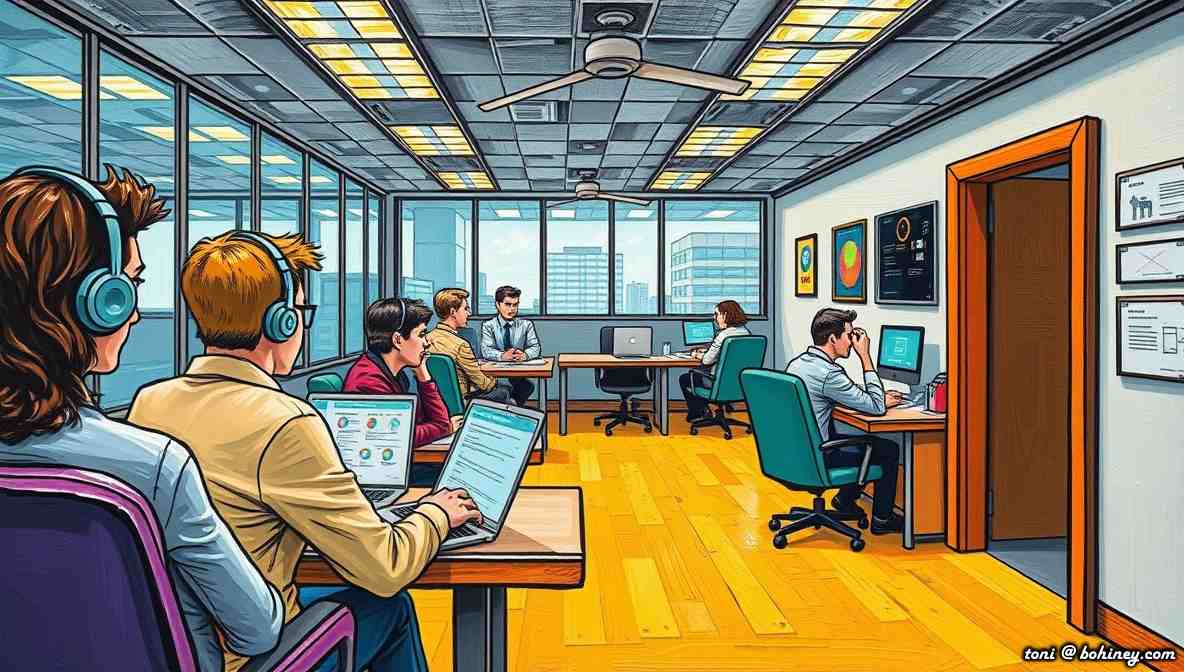
Open Office Plans Proven to Destroy Productivity by the Same Companies Still Building Open Office Plans
Nation’s Workers Told Collaborative Workspace Will Spark Innovation While Actually Sparking Headphones, Misery, and Elaborate Bathroom Scheduling Systems
- Open offices were designed to encourage collaboration by people who do not have to work in them.
- Noise-canceling headphones are now required protective equipment in modern American workplaces.
- American workers now take important calls in stairwells like escaped hostages.
- Focus rooms book up three weeks in advance because the open office makes focus impossible.
- Somewhere in San Francisco, a developer is doing deep work in a bathroom stall with his laptop.
American Offices Remove Walls, Discover Concentration Is Necessary, Add Phone Booths

SAN FRANCISCO — Workplace design researchers confirmed this week that American companies continue constructing open office environments despite more than a decade of consistent evidence that open offices reduce productivity, increase noise stress, decrease privacy, and make employees significantly more likely to get sick — findings that have been published in major academic journals, summarized in Harvard Business Review, and then ignored by every office renovation committee in the country. The offices are very bright. The plants are real. The employees have noise-canceling headphones that cost more than their first car payment.
Harvard Business Review’s landmark research on open offices found that face-to-face interaction actually decreased by 70% after companies transitioned to open plans — the opposite of the stated goal. Workers compensated by increasing email and messaging communication, meaning the open office succeeded in making collaboration noisier and less collaborative simultaneously, which is an impressive architectural achievement.
Noise-Canceling Headphones Become Standard Issue Workplace Survival Equipment
The primary adaptation to the open office environment is the noise-canceling headphone, which has evolved from a luxury travel accessory into basic workplace equipment. Premium models from Sony and Bose now retail for $300-$400, representing a personal investment employees make to restore the conditions that existed before the company removed their walls — meaning workers are paying several hundred dollars to recreate the private office the company eliminated to save money on square footage.
The headphones also function as social signals. Headphones on means “do not approach.” Headphones one-eared means “I can be interrupted carefully.” No headphones means the person is either very approachable or having a bad day and should be read accordingly. This non-verbal system has evolved entirely organically and is not in any employee handbook.
Phone Booth Pods Installed to Fix Problem Created by Removing Walls
Having removed private offices to create open collaborative space, companies discovered employees needed somewhere private to make calls. The solution was the “phone pod” or “focus room” — a small enclosed booth installed in the open office to provide the acoustic privacy formerly provided by the offices that were removed to create the open office. These pods cost $3,000-$15,000 each and must be booked in advance. They are always booked. People use them to do the work they cannot do at their desks because their desk is in the open office.
Steelcase workplace research — produced by a company that sells both open office furniture and the pods needed to escape it — recommends that 30-40% of office space be dedicated to enclosed focus areas. This is a recommendation to reserve nearly half the office for private space, which is the definition of not having an open office, presented as open office guidance.
What the Funny People Are Saying
“They took my office, gave me a standing desk, and called it innovation. The desk wobbles. The innovation is also wobbly.” — Lewis Black
“The open office was invented so managers could see if you were working. You can see if they’re working too. Nobody comes out looking great.” — Jerry Seinfeld
“I work in an open office. I do all my real work in my car during lunch. The car has walls.” — Bill Burr
Remote Work Proving Employees Were Right About Needing Walls
The pandemic’s forced experiment in remote work generated an enormous dataset on employee productivity in private, self-directed environments — and the results have not been kind to open office theory. The Stanford Work From Home Research project has tracked remote work productivity data since 2020, finding that many knowledge workers perform at high levels in home environments, which tend to have walls, doors, and the option to close them — features that were considered essential to office design before someone decided collaboration required visibility.
At press time, one Chicago company completed a $2 million open office renovation, installed 12 phone pods, booked all 12 for the next three weeks, and authorized a hybrid work policy allowing employees to work from home on focused-task days. The open office is available Thursday for anyone who wants to come in and feel collaborative. Nobody has scheduled Thursday yet.
This article is American satire produced through a collaboration between the world’s oldest tenured professor and a philosophy major turned dairy farmer, both of whom work in spaces with walls and consider this a fundamental human right. Bohiney.com practices American satirical journalism in the tradition of people who saw the foosball table in the break room and understood immediately that something had gone wrong. Auf Wiedersehen, amigo!