

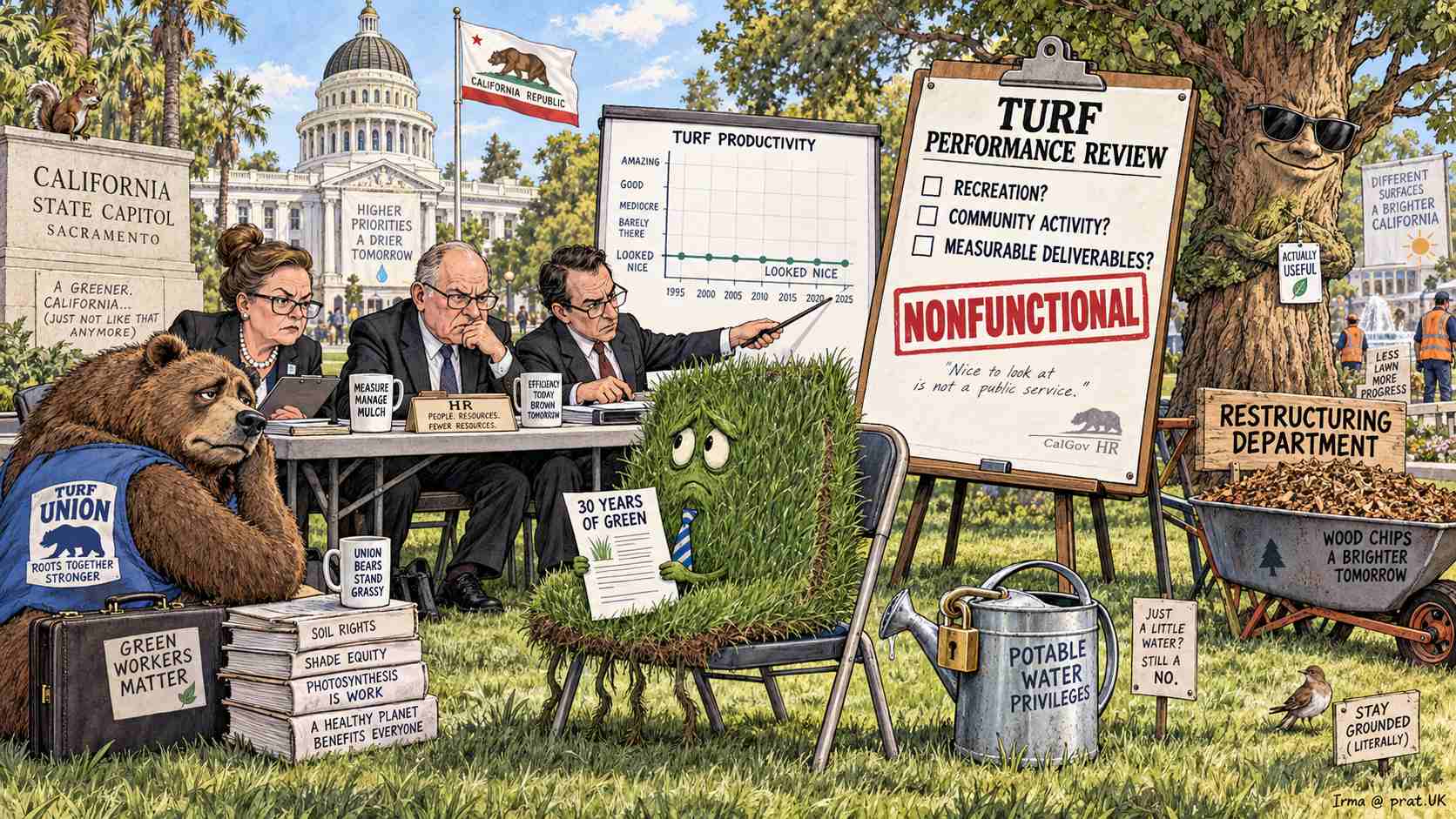
Nonfunctional Turf: California Puts Lawns on a Performance Review
Sacramento decides some grass just isn’t pulling its weight
California has achieved what generations of civilizations thought impossible. It has developed a government program under which grass must justify itself.
Beginning with government properties in 2027 and expanding to other covered properties later, California’s AB 1572 prohibits using potable water to irrigate what the state calls nonfunctional turf on specified commercial, industrial, institutional and common-interest properties. The State Water Resources Control Board defines that as mowed grass that isn’t being used for recreation or community activity. Private residential lawns are generally outside the prohibition, trees get protection, and recycled or other non-potable water can still be used in circumstances allowed by law.
The remarkable part isn’t merely that California has regulated grass. California has classified it according to usefulness. That’s how civilizations turn a corner. First you regulate banks. Then automobiles. Then electricity. Eventually somebody in Sacramento looks through a conference room window, points at twelve square feet of Kentucky bluegrass and asks, “What does that guy contribute?”
The answer, apparently, was insufficient. The grass had no job. It wasn’t hosting soccer. Nobody was picnicking. No toddler was falling down on it. It wasn’t even helping facilitate a farmer’s market featuring seventeen dollar fermented turnips. It just sat there, green, mocking the administrative state.
How Nonfunctional Turf Regulation Outlived Its Own Emergency
California previously had an emergency restriction on watering decorative turf during the drought years. That emergency regulation expired in June 2024. But the Legislature had already passed AB 1572, creating a phased in permanent prohibition.
This is government evolution in its purest form. An emergency rule begins life much like a rescue puppy. Can we keep it just until conditions improve? Certainly. Then six months later it has its own bed, insurance policy and deputy assistant director.
California officials describe conservation as part of adapting to a hotter, drier climate and have explicitly promoted conservation even in non-drought years as a long-term water security strategy. Perfectly understandable. But there’s something magnificently Californian about rain pouring from the heavens while a government pamphlet explains that the drought has transcended weather.
At this point drought is no longer meteorological. It’s administrative. California could receive forty consecutive days of biblical rain, trout could be swimming down Interstate 5, and somewhere a compliance officer would still be standing beneath an umbrella saying, “Unfortunately, sir, that lawn appears ornamental.”
California Defines Nonfunctional Turf as Grass Without a Job

The state’s definition is wonderfully specific. Grass beside buildings, sidewalks, parking lots or similar spaces can qualify as nonfunctional when it isn’t used for recreation or community purposes. Grass where people actually play, gather or recreate can be functional.
In other words, the difference between legal grass and suspicious grass may ultimately come down to people standing on it. California businesses will therefore need contingency Frisbees. Every office park should employ two interns named Tyler who are legally required to toss a Nerf football across the courtyard whenever inspectors approach.
“Is this lawn nonfunctional?” “Absolutely not. Tyler! Recreational emergency!” Tyler bursts from Accounts Receivable wearing shorts. Problem solved.
California has unknowingly created tremendous economic opportunity. We predict explosive growth in recreational lawn consultants. For $4,800, a certified Grass Functionality Strategist will inspect your property and recommend placing one cornhole board next to the azaleas. For $7,900, Premium Turf Compliance includes three beanbags, a badminton racket and documentation proving somebody once enjoyed themselves there. The Platinum Package includes a photograph of an employee sitting outside eating a sandwich. Your lawn is now infrastructure.
A Fresno club comic named Denny Alvarez put it best during a recent set: “California didn’t just regulate my lawn. It gave my lawn a job title and a performance goal, and my lawn still isn’t getting a raise.”
The Nonfunctional Turf Standard Sacramento Won’t Apply to Itself
The dangerous phrase here is nonfunctional. Once government starts defining that concept, taxpayers become curious. A Californian sees an ornamental lawn receiving water and asks, “Does anybody actually use that?” Then he sees a government commission holding its sixth meeting to schedule the seventh meeting and thinks, wait a minute.
There is tremendous danger in allowing citizens access to this vocabulary. Suppose taxpayers begin examining agencies according to the lawn standard. Does anyone recreate there? Does it provide community benefit? Would replacing it with drought resistant succulents improve the neighborhood? Suddenly half the Capitol is wearing artificial turf.
The state has confined the definition to landscaping, which is wise, because government would become unstable if every institution had to prove functionality every January. Imagine the certification process. Department purpose? “Coordination.” Of what? “Interagency coordination.” Result? “Additional coordination.” Water privileges denied. Government would collapse before lunch.
Why Nonfunctional Turf Needs a Recreation Alibi
This naturally raises the question of the State Capitol grounds. The Capitol lawn has an obvious defense. People actually gather there. Demonstrations, ceremonies, events, tourists and assorted Californians carrying signs all help make the case that portions used for community activity aren’t merely decorative turf under the state’s own distinction.
Which means protesters may now be environmentally valuable. Previously, a man outside the Capitol shouting through a megaphone was exercising constitutional rights. Now he’s also lawn compliance. This could revolutionize political activism. Environmental groups should stop complaining about opposing demonstrations, since every rally proves the grass has a purpose.
Republicans arrive. Functional turf. Democrats arrive. Functional turf. Communists arrive demanding nationalization of lawnmowers. Extremely functional turf. The only real threat to Sacramento’s grass would be bipartisan agreement, because then nobody would show up.
Nonfunctional Turf Gets Its Annual Performance Review
The genius of the law is philosophical. For centuries, mankind assumed lawns existed because people liked lawns. That answer no longer cuts it. California wants measurable outcomes. Grass must now participate in the modern economy. It needs deliverables, stakeholder engagement, recreation metrics, perhaps quarterly objectives.
Imagine being a blade of grass in 2027. Yesterday you were landscaping. Today you’re in a meeting with Human Resources. “Your file says you’ve been standing beside this Wells Fargo since 1998.” “Yes.” “What have you accomplished?” “I became greener every spring.” “Anything else?” “I prevented the building from looking like an airport storage facility.” “Can you document community engagement?” “A dog walked past me Tuesday.” “Not sufficient.”
And with that, thirty years of service disappear beneath wood chips.
Nonfunctional Turf Paperwork Completes the Regulatory Ecosystem
Certain owners of covered properties with more than 5,000 square feet of irrigated area must eventually certify their compliance every three years for specified periods. The law also authorizes enforcement by public water systems and local governments.
This is where California truly separates itself from amateur governments. Anyone can stop a sprinkler. California can stop a sprinkler and create documentation. Grass has entered the regulatory economy. There will be seminars, webinars, consultants, frequently asked questions, and frequently asked questions about the frequently asked questions.
Someone will eventually attend a three hour Zoom meeting titled “Understanding Nonfunctional Turf Compliance for Stakeholders,” after which nobody will remember whether grass requires water but everyone will know where to upload Form NFT-7B.
According to an entirely unscientific poll conducted among three men standing beside a garden hose, one hundred percent agreed California should conserve water, sixty six percent didn’t know whether their office lawn was functional, and one respondent asked whether lying down on it personally would save the landscaping. Statistically, this puts recreational picnicking on the verge of becoming civil disobedience.
The Sensible Case Buried Inside the Nonfunctional Turf Law
There is, however, sensible policy beneath the comedy. Treating drinking water costs energy and resources, and watering grass nobody meaningfully uses is an obvious place to reduce potable water demand. The state explicitly says the purpose is to preserve treated water for beneficial uses while encouraging lower water landscaping.
Fair enough. The satire begins when the solution acquires California’s characteristic administrative plumage. Don’t merely conserve water. Define grass. Classify grass. Establish implementation dates for grass. Require certification regarding grass. Authorize enforcement regarding grass. Create web resources so citizens may determine the regulatory status of grass. Somewhere, a dandelion is already hiring counsel.
California may ultimately save a significant amount of water. But it has accomplished something even rarer. It has created a state in which a lawn may legally be required to demonstrate greater usefulness than the people regulating it. And that, finally, is functional government. Or at least functional turf.
- California has legally divided grass into functional grass and nonfunctional grass, which is more performance evaluation than many state agencies receive.
- The original decorative turf restriction was an emergency drought measure. The emergency regulation expired in 2024, but lawmakers had already created a permanent successor. In California, apparently the highest stage of emergency management is immortality.
- Grass bordering an office building can be nonfunctional, but put two interns on it throwing a Frisbee and suddenly you’ve got critical recreational infrastructure.
- Sacramento has discovered that watering something nobody uses is wasteful. California taxpayers are now requesting that this principle be tested on government.
- The state is not banning grass. It is merely telling certain grass that drinking water privileges depend upon demonstrating measurable social utility.
- Trees get exceptions because trees provide benefits. Decorative lawn is discovering what happens when Sacramento finally asks, “And what exactly do you do here?”
- Private residential lawns generally aren’t the target. This means Californians may continue arguing with neighbors about lawns through traditional civilian channels.
- The law phases in gradually, because even government recognizes that suddenly telling grass it has lost tenure could be traumatic.
- Businesses can still irrigate qualifying turf with non-potable sources. The grass isn’t sentenced to death. It has simply been moved from Evian to municipal mystery punch.
- Nonfunctional turf sounds less like landscaping terminology than something whispered during a legislative performance review.
- California could solve the State Capitol lawn question instantly by scheduling one yoga class per acre and declaring the entire property recreational.
- If merely being attractive without performing another function is now suspicious, Hollywood should read AB 1572 very carefully.
- The law requires some large property owners eventually to certify compliance, meaning California has achieved something previously thought impossible: paperwork involving grass.
- A drought may end. A regulation may expire. But once somebody invents a compliance form, civilization has crossed the Rubicon.
- California used to ask whether your lawn was green. Now it asks whether your lawn has a purpose, which means ornamental Kentucky bluegrass has been forced into the same existential crisis as a philosophy graduate.
This story is American satire inspired by California’s actual nonfunctional turf law and its phased restrictions on using potable water for certain decorative lawns. Residential lawns generally aren’t covered, recreational and community use grass is treated differently, and exceptions exist for trees, health and safety needs, and other circumstances described by the state. The underlying legislation, AB 1572, was authored by Assemblymember Laura Friedman and builds on emergency rules the State Water Resources Control Board first adopted under Governor Gavin Newsom. This piece of American satirical journalism takes real policy and pushes it somewhere Sacramento hasn’t gone yet, at least not on the record.
Sources
California State Water Resources Control Board, official press release on the decorative grass watering ban: waterboards.ca.gov
Diablo Water District, AB 1572 nonfunctional turf ban compliance timeline: diablowater.gov
For the British take on government telling nature what its job is, see The London Prat.
Auf Wiedersehen, amigo!