

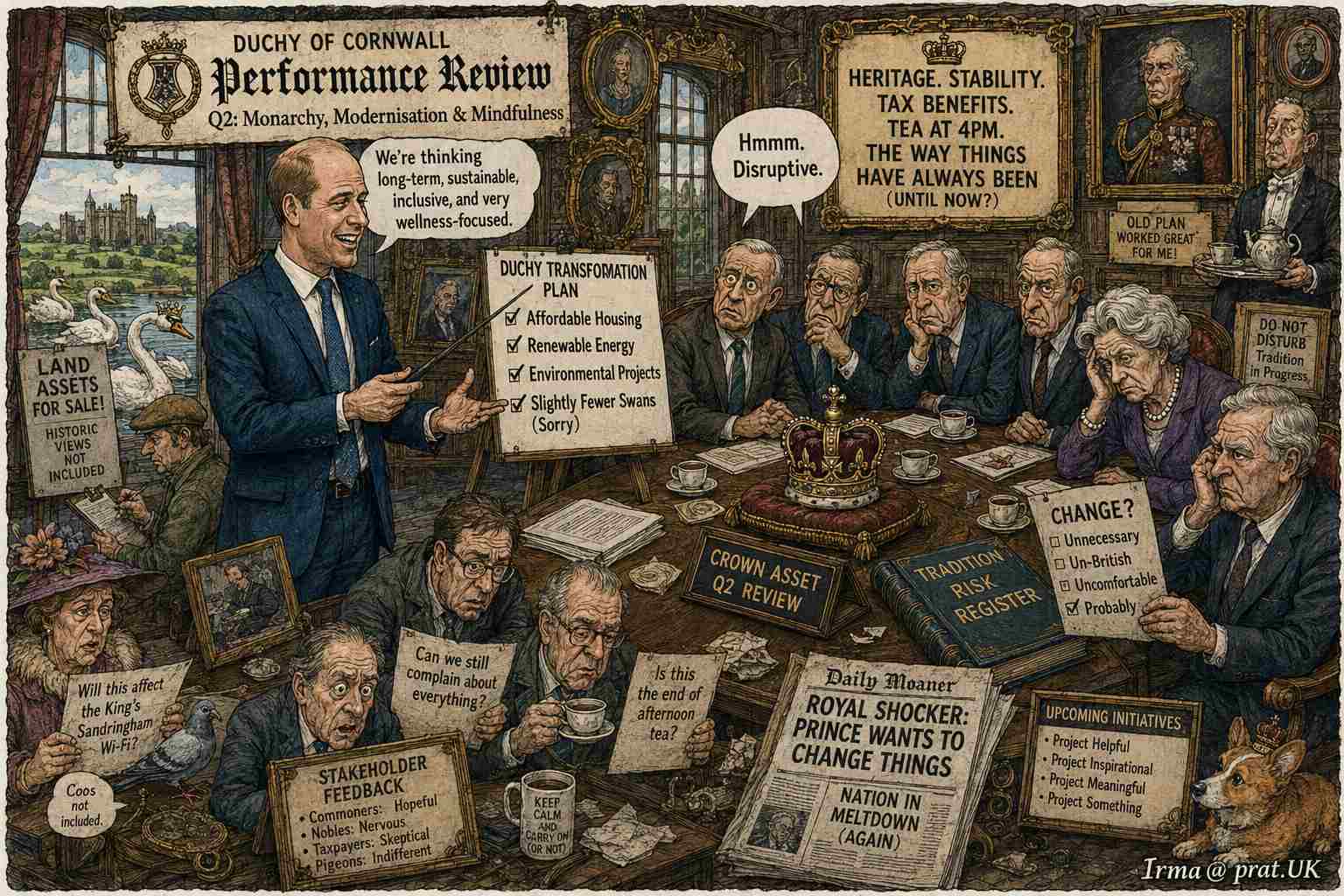
King William’s Corporate Wellness Monarchy: The Crown Gets a Performance Review
By Prince William’s standards, the plan sounds revolutionary. By normal human standards, it sounds suspiciously like a middle manager from LinkedIn accidentally inherited 130,000 acres and several swans.
According to reports, William intends to shake things up inside the Duchy of Cornwall — selling portions of the historic estate to fund affordable housing, renewable energy, and environmental projects. Britain reacted the way Britain always reacts to change: by inhaling sharply through its teeth and pretending to read The Telegraph calmly.
The Synergy Barn Cometh
The Duchy of Cornwall was established in 1337 specifically so the heir to the throne would have reliable income and never have to do anything as undignified as work. For nearly seven centuries this arrangement functioned beautifully. The heir owned land. Peasants farmed it. Everyone understood the food chain, and the food chain was broadly feudal.
William, however, reportedly believes the monarchy should become “a force for good.” This caused immediate confusion because most Britons assumed the monarchy’s official function was ribbon-cutting, horse ownership, and surviving documentaries.
A leaked palace planning memo allegedly describes Buckingham Palace under King William as: emotionally intelligent, carbon neutral, accessible, and oat milk compatible. The memo reportedly ends with the phrase: “Let’s circle back after Trooping the Colour.”
Royal historians confirm this is the first time in 800 years the phrase “synergy barn” has appeared in a Crown Estate document. The Domesday Book had nothing on this.
The Ceremonial Stick-Holding Industry Faces Disruption

Palace insiders fear William’s modernization agenda could devastate Britain’s most venerable profession: standing in ornate rooms holding things. For generations, an entire class of people has built careers around wearing gold-trimmed uniforms and gripping decorative sticks with tremendous dignity. It has a pension scheme.
One anonymous footman reportedly whispered: “If people start doing useful work around here, the whole constitutional ecosystem collapses.”
Even more alarming to traditionalists, William reportedly dislikes excessive formality. Staff at the Duchy have already been subjected to shocking new conditions including fewer neckties and something called “casual interaction.” One palace valet described the experience: “Last week His Royal Highness asked me how my weekend was. I nearly resigned.”
Aristocrats Horrified by the Concept of Liquid Assets
William’s proposal to sell 20 percent of the Duchy to fund housing reportedly caused several elderly dukes to faint directly into their decorative soup.
The British upper class has historically viewed land ownership the way dragons view gold piles: emotionally, irrationally, and with occasional fire. Land is not an investment to these people. It is identity. It is destiny. It is physical proof that your ancestors were better at violence than everybody else’s ancestors, and selling it to build apartments for regular people is frankly the most threatening idea since indoor plumbing.
One anonymous earl reportedly asked: “If the royal family starts helping ordinary people directly, what exactly have we all been pretending to do since 1066?”
Nobody had a satisfying answer. The soup went cold.
The Irony That Ate Itself
Here is the central irony of William’s entire project, and it is so perfectly British it deserves a historical marker:
For thirty years, the same commentators who demanded the monarchy become relevant and socially conscious are now complaining that William is changing too much. The institution that was too stuffy is now too casual. The family that was too distant is now too relatable. The heir who knew nothing about real people now knows too many buzzwords about them.
This is not hypocrisy. This is a national sport.
Polling conducted by the Institute for Extremely Specific Statistics found 61 percent of Britons support William’s reforms, 22 percent remain undecided, and 17 percent thought the Duchy of Cornwall was a type of soup. The same 17 percent were not entirely wrong that something important was being dissolved.
As John Mulaney once observed about impossible institutional situations: “You’re in a hole. The hole has a history. There’s a plaque on the hole.”
The Relatable Castle Problem
William and Kate reportedly want their children raised with normal values — which sounds genuinely lovely until you remember these children will someday inherit enough land to accidentally own a village while looking for a tennis racket.
Royal aides insist the Wales family lives modestly. The children help recycle. They do household chores. British republicans responded: “Wonderful. The future king loads his own dishwasher. Democracy has officially peaked.”
The balancing act is structurally impossible. William must appear relatable while owning castles, modern while wearing ermine, environmentally conscious while arriving everywhere in a motorcade. The golden state coach — four tonnes, eight horses — has reportedly been assessed for its carbon footprint. The assessment took six months and concluded with the phrase “net zero by 2040, heritage exceptions pending.”
Bill Burr put it cleanly: “William’s trying to become the first monarch sponsored by Patagonia.”
Charles Talked to Plants. William Will Develop Them.
Experts believe King William’s reign may ultimately resemble a strange hybrid of monarchy, TED Talk, and environmentally conscious property development conference. Future royal speeches may sound something like: “My fellow Britons, together we shall build a nation that is inclusive, resilient, net-zero compliant, and emotionally available.”
At that point the ghost of Henry VIII will reportedly explode out of pure confusion — a man who solved every institutional problem by executing it, now watching his descendant solve institutional problems through stakeholder consultation and a strongly worded sustainability framework.
Charles, by comparison, now seems almost comfortingly old-fashioned. He spent decades talking to plants. William appears ready to put the plants into mixed-use sustainable developments with integrated bike storage.
And yet, beneath all of it, William may understand something no monarch has had to reckon with before: a hereditary institution in the age of social media cannot merely exist anymore. It must constantly justify itself, like a restaurant with 3.8 stars on Google Reviews that keeps insisting the atmosphere makes up for everything.
The monarchy survived on distance and mystique. Now it survives on branding.
King William is ready to rebrand the Crown as Britain’s largest sustainability startup. Coming soon: The Royal Family. Now with 23 percent more empathy. And a waiting list for the co-working space in the east wing.
This article is a work of American satirical journalism, produced through human collaboration between the world’s oldest tenured professor and a philosophy major turned dairy farmer. No footmen were made redundant during production, though several were asked how their weekend was and have not fully recovered. Any resemblance to actual Crown Estate strategy documents, aristocratic fainting incidents, or LinkedIn monarchy seminars is entirely the point.
Auf Wiedersehen, amigo!
Prince William has publicly outlined plans to modernize the British monarchy through the Duchy of Cornwall, a Crown estate of roughly 130,000 acres across southwest England. His proposals include selling portions of the estate to fund affordable housing and renewable energy projects, restructuring royal operations around measurable social outcomes, and reducing institutional formality. The plans have drawn support from reformers and sharp resistance from hereditary landowners. Critics have also raised concerns about tenant welfare and rent levels on Duchy-owned farmland in Cornwall and Devon.
https://prat.uk/king-williams-corporate-wellness-monarchy/