

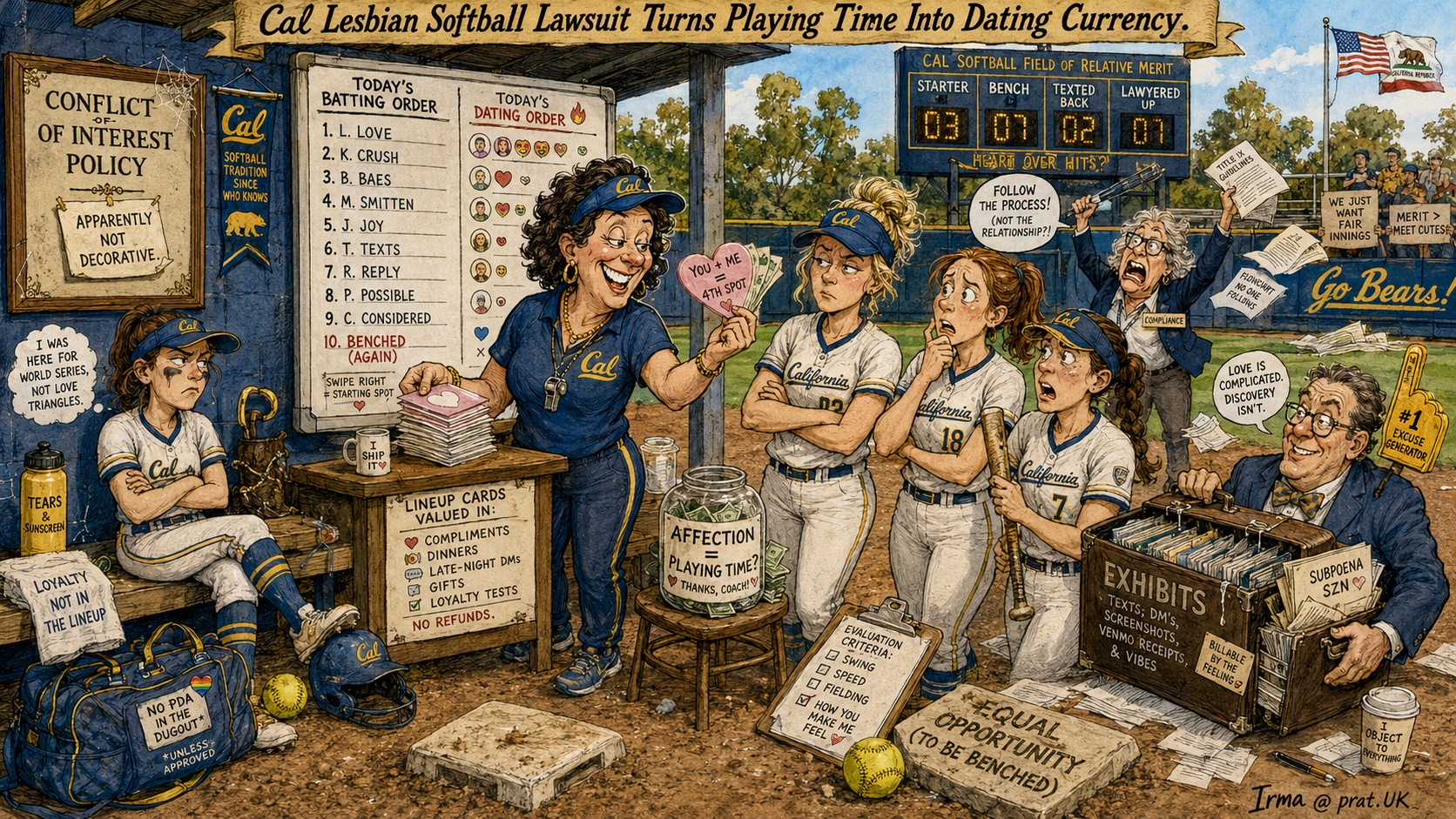
Cal Softball Lawsuit Turns Playing Time Into Dating Currency, and the Internet Immediately Reaches for the Oldest Joke It Owns
A former player alleges innings were handed out based on affection, Berkeley discovers its conflict of interest policy was never decorative, and half the commentary section decides the real story is who dates whom
College athletics may have finally invented a form of compensation more complicated than NIL: Name, Image and Like-Me-Back.
A former Cal softball player has sued former head coach Chelsea Spencer and the University of California Regents, alleging Spencer pressured her into a sexual relationship and retaliated by cutting her playing opportunities when the player tried to pull away. The complaint was filed in Alameda County Superior Court. Spencer has not admitted the allegations, and UC Berkeley has declined to comment on pending litigation.
The lawsuit describes something considerably more serious than an office romance gone sour. It alleges a coach held enormous influence over the athletic future of a student while simultaneously pursuing a personal relationship with her.
Which is why the satire almost writes itself. And why the internet immediately wrote the wrong one.
The Softball Stereotype Is the Laziest Take Available
Within roughly nine minutes of the story breaking, a significant portion of the commentary had located what it believed to be the punchline, and the punchline was a stereotype about women’s softball that has been in continuous circulation since roughly the Ford administration.
This is a remarkable achievement in comedic economy. Presented with a lawsuit alleging that a supervisor used institutional authority as romantic leverage, thousands of people looked directly past the abuse-of-power allegation and landed on a joke their uncle already told badly in 1997.
Why Orientation Is the Wrong Target and Authority Is the Right One
Here is the test. Swap the genders. Swap them again. Swap the sport. Now reread the allegation: a head coach allegedly controlled who pitched, allegedly pursued a player she controlled, and allegedly benched that player after the relationship ended.
Nothing about that changes. Not one comma.
Which means orientation was never load-bearing. It was decoration. The structural problem is that one person controlled the other person’s scholarship, roster spot, transfer prospects, recommendations, and professional ceiling. That is a workplace hierarchy wearing a visor.
Anybody whose analysis stops at the demographic has essentially reviewed a bank robbery by describing the getaway car’s paint job.
Berkeley’s Conflict of Interest Policy Was Not Decorative

Berkeley is an institution with enough policies to regulate the emotional well-being of a stapler. It already had one covering exactly this scenario.
The university’s conflict of interest policy on consensual relationships states that relationships involving someone who supervises, evaluates, advises, coaches, or otherwise influences another person’s educational opportunities create risks of exploitation, favoritism, and bias. Athletics personnel supervising student-athletes are specifically named. The policy even prescribes the remedy: the person in authority must immediately recuse herself from decisions and notify supervisors.
That is unusually clear for a University of California document.
Most university policies open with “Whereas the university recognizes the intersectionality of stakeholder-centered outcomes” and conclude that somebody should schedule a listening session. This one essentially says: do not date people whose careers you control.
Yet according to the complaint, Spencer allegedly began messaging the player frequently soon after her 2023 arrival. Reports describing the lawsuit say the player received personal messages, compliments, gifts, and money before the relationship became sexual. The suit contends the physical relationship was mutual in form but occurred inside a coach-athlete dynamic already shaped by rewards and consequences.
There is your sociology lecture. Power imbalance is what happens when one person says “I don’t want this anymore” and the other person can allegedly answer “Fine. Enjoy the bench.”
Coach Allegedly Cut Playing Time After Rejection, Introducing the Nation’s First Romantic Depth Chart
The most astonishing allegation concerns playing time. The lawsuit claims the player’s opportunities increased when she responded favorably to Spencer and decreased when she distanced herself.
Imagine explaining that to an analytics department.
ERA: 2.41. Strikeouts: 117. WHIP: 1.08. Response time to emotionally complicated text message: 43 minutes. Coach currently upset: red arrow down.
Baseball spent twenty years developing sabermetrics only to discover the ultimate performance metric may have been “did you text me back.”
Four Words That Do Not Require Legal Interpretation
According to reports on the complaint, the situation culminated before an April 2025 game against Florida State. The player allegedly said she would never speak to Spencer again. The response attributed to Spencer in the lawsuit was devastatingly concise: you’re not pitching.
Some sentences require elaborate legal parsing. That is not one of them. If accurate, it has all the subtlety of firing somebody the morning after they decline the boss’s invitation to Cabo.
A coach can bench an athlete for poor mechanics. For violating team rules. Because the matchup favors somebody else. But “she broke up with me before Florida State” should not appear on the clipboard between defensive shifts and bunt coverage.
That is not coaching strategy. That is Tinder with scholarships.
Cal Athletics Faces a Lawsuit and Promises to Review Every Policy It Apparently Already Had
The institutional portion may prove more consequential than the individual one. The lawsuit does not merely accuse Spencer. It alleges university personnel knew about concerns surrounding the relationship and failed to intervene adequately, and that people inside the softball program were aware of boundary issues well before the matter reached official attention.
Which raises the great question of modern institutional life: what is the purpose of having a policy if everybody needs a second policy explaining when to use the first one?
Universities have policies covering conflicts of interest. Policies explaining the policies. Offices administering the policies. Associate vice chancellors coordinating the offices. Websites describing the associate vice chancellors. PDFs informing students that the website exists. And eventually somebody walks into an attorney’s office and says none of it prevented anything.
The NCAA’s campus sexual violence policy similarly requires member institutions to maintain prevention education, reporting procedures, and accountability measures, with annual attestation of compliance. College athletics has therefore perfected the American regulatory miracle: everybody has signed a form confirming that everybody understands the forms. The humans remain a more complicated matter, as Title IX enforcement has demonstrated for five decades running.
Reports say a university investigation later concluded Spencer had engaged in an undisclosed sexual relationship violating Cal’s conflict of interest policy. She resigned in June 2025 after five seasons. Months earlier, in February 2025, she had received a three-year contract extension.
Nothing says institutional oversight like extending somebody’s contract shortly before investigating the circumstances of their departure. It is the athletic-administration equivalent of installing a smoke detector while the fire department is already parked outside.
Spencer told Berkeleyside, according to subsequent reports, that she had not been aware of the lawsuit and that the claims would be addressed through the appropriate legal process. The allegations remain allegations. A lawsuit tells one side of a contested dispute. Satire should mock absurdity without impersonating a courthouse.
Berkeley’s Simplified New Compliance Policy
The university does not need another 47-page handbook. It needs three sentences.
If you control someone’s playing time, do not date them. If you date them, stop controlling their playing time. And if several employees know both things are happening, somebody should mention it before the lawyers arrive.
That framework lacks the majestic administrative architecture expected at a major public university. It does possess one quality increasingly rare in academia. You can understand it.
The Broader Lesson for College Sports
NIL has already converted college athletics into a landscape of agents, collectives, transfer negotiations, and compensation disputes. The last thing student-athletes need is another invisible marketplace where personal attention becomes currency.
Playing time cannot become emotional leverage. Scholarships cannot become romantic bargaining chips. A coach’s authority does not evaporate at the edge of a private relationship because both parties are adults. Power does not stop being power merely because everybody has a smartphone.
Advocacy groups including the Women’s Sports Foundation have spent decades arguing that female athletes deserve the same structural protections as anyone else in a supervised environment. Those protections exist to govern the hierarchy, not the demographics of the people standing inside it.
College athletics asks extraordinary commitment from young athletes. They surrender enormous amounts of time, tolerate intense scrutiny, and structure their education around the demands of coaches. The minimum return should be a system where the difference between starting and sitting gets decided on the field.
Not in somebody’s text messages. And if Berkeley requires an interdisciplinary committee to discover that principle, sociology can lend them the textbook. The softball team already supplied the case study.
15 Humorous Observations From the Romantic Depth Chart
- College athletes apparently now need to ask whether coach’s decision refers to batting strategy or relationship status.
- NIL used to stand for Name, Image and Likeness. Under these allegations, somebody may need to add Texting Responsiveness.
- A softball depth chart traditionally lists pitcher, catcher, and shortstop. Person Currently Returning My Messages is not a recognized defensive position.
- Berkeley’s conflict of interest policy specifically mentions coaches and student-athletes, suggesting administrators anticipated the problem without expecting anyone to treat the policy as a scavenger hunt.
- The lawsuit alleges responsiveness affected playing opportunities, potentially creating the first sport where batting average matters less than average reply time.
- If a cheerful good morning text can alter the starting lineup, analytics departments will need very different software.
- Coaches are supposed to pick lineups on performance. Otherwise ESPN has to start listing Relationship Status: Questionable next to injury reports.
- Universities love the phrase power imbalance because it sounds scholarly right up until somebody asks why the people holding all the power never noticed it.
- The complaint alleges others in the program knew about boundary concerns, raising the timeless institutional question of how many administrators it takes to recognize the exact thing their own policies describe.
- Berkeley teaches sociology students about hierarchy, authority, and exploitation. Apparently the athletic department needed to audit the course.
- The policy requires the person in authority to recuse herself from decisions involving her partner. That is bureaucratic language for: you cannot date the pitcher and then decide whether the pitcher pitches.
- College sports have grown so complicated that athletes now require agents, accountants, nutritionists, academic advisers, and possibly a romantic conflict compliance coordinator.
- The alleged line delivered after a relationship dispute may someday appear in management textbooks under the chapter titled Things Supervisors Should Not Say During Breakups.
- If proven, Berkeley will have accomplished something extraordinary: converting a painfully obvious rule into a teachable moment costing lawyers hundreds of dollars per hour.
- Somewhere an NCAA compliance officer stares into the middle distance whispering that he thought the transfer portal was complicated.
Disclaimer
This is satire concerning allegations contained in pending civil litigation. Chelsea Spencer has not admitted the lawsuit’s allegations, the plaintiff’s claims have not been adjudicated, and UC Berkeley has declined to comment on the pending case. The humor targets alleged abuses of authority, conflicts of interest, institutional bureaucracy, and the commentators who mistook a demographic for a punchline. It does not target anyone’s sexual orientation, and no individual’s orientation is asserted here.
This story is entirely a human collaboration between two sentient beings: the world’s oldest tenured professor and a philosophy major turned dairy farmer. Neither has authority to set Cal’s pitching rotation, which is probably best for everybody.