

Landlord Discovers Birds Have No Credit Scores.
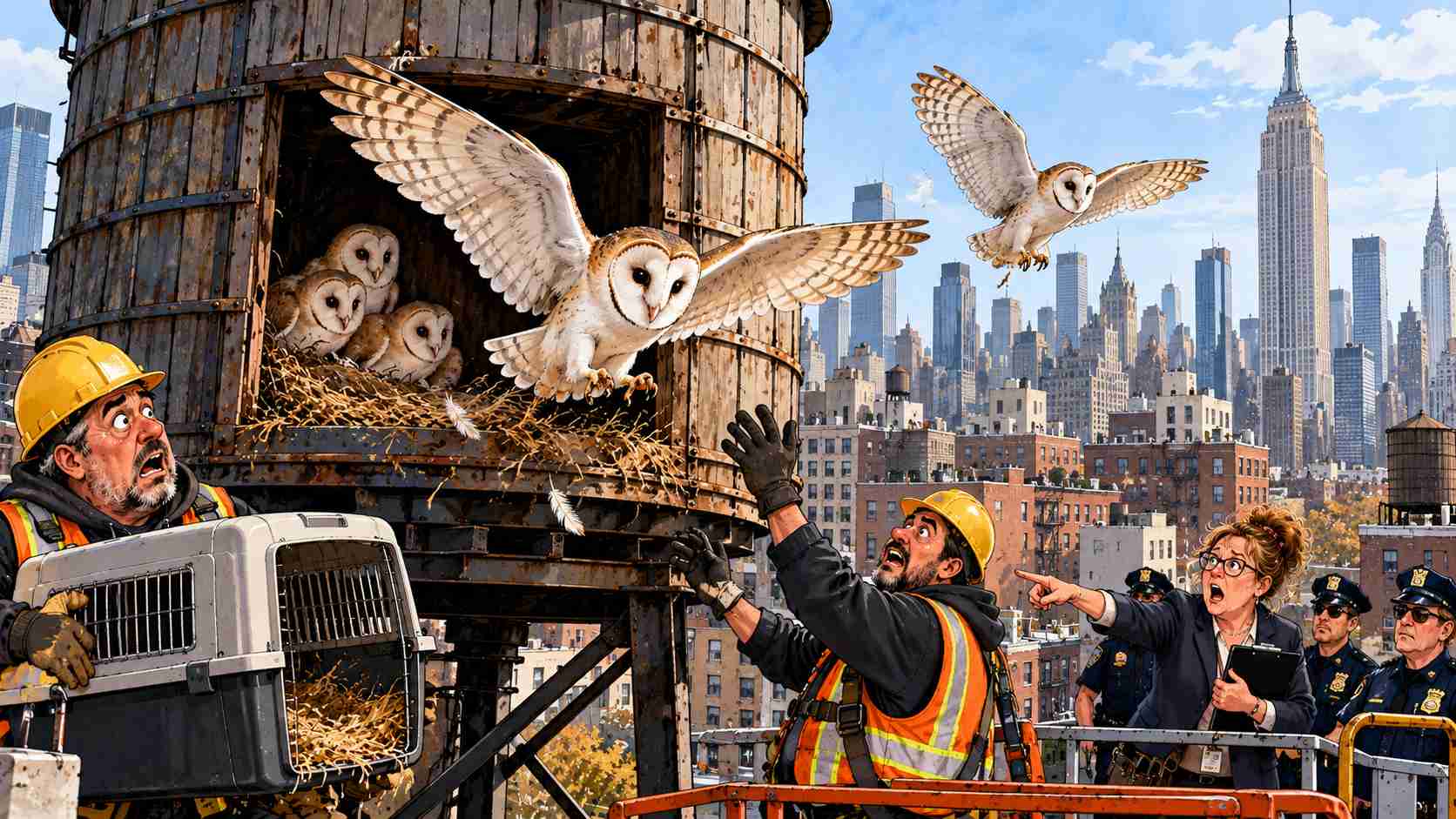
NEW YORK, New York — A family of rare barn owls nesting in a Manhattan water tower has found itself at the center of a New York housing dispute, proving that even birds cannot escape the city’s ancient tradition of turning a perfectly reasonable living arrangement into a catastrophe.
Upper West Side Owls Lose Their Nest
The roof of the Upper West Side water tower was removed during construction, exposing the nest and prompting concern from bird advocates. According to CBS New York’s reporting, the owls had settled near Central Park West. State environmental officials from the New York Department of Environmental Conservation investigated, and there were serious worries about the young birds’ survival.
The family had found what New Yorkers spend entire careers seeking: a Manhattan property with natural light, a rooftop location and no broker’s fee. They even provided free rodent control, an amenity worth approximately fourteen thousand dollars per month in Manhattan real estate language.
Then came the renovations. In most American cities, construction means somebody is improving a building. In New York, it often means somebody has decided that a perfectly acceptable roof could generate more revenue if it disappeared and returned as a luxury rooftop experience.
The Listing, As Advertised
A real estate agent described the exposed water tower as “an intimate open-plan penthouse featuring spectacular skyline views and enhanced natural ventilation.” When asked about the missing ceiling, he said, “The city is moving toward indoor-outdoor living.” When asked whether rain counted as indoor or outdoor, he demanded a nonrefundable application fee.
The Owls’ Rental Application, Rejected
The owls, having no formal employment history, struggled to meet Manhattan’s rental requirements. Their references consisted of two pigeons, a night watchman and a mouse that was unavailable for comment. The application was rejected because the primary tenant’s income came from catching rodents, a form of freelance work the building’s management considered unreliable.
The Fine Print on the Application
Page three of the application, photographed by a bystander, listed requirements that included three months’ rent in advance, two references, proof of employment and a guarantor earning eighty times the monthly cost of the nest. A footnote stated that “applicants may not be nocturnal.” Under “pets,” the form had been left blank. Under “occupants,” someone had written “four, plus eggs,” and an unseen hand had crossed out “eggs” and written “additional fee.”
An Ornithologist’s Assessment
“These are among the best tenants the city has ever had,” said an ornithologist who has monitored raptors in the five boroughs for two decades. “They’re quiet, they keep irregular hours, and they eat roughly a thousand rodents a year. If they could sign a lease, I’d co-sign it myself, and I’m on a fixed income.”
A bird advocate who watched the roof come off from a sidewalk noted that the family had behaved better than most human tenants. They did not host rooftop parties, order delivery at midnight or complain about the superintendent. They only requested that the building retain its roof.
Do Barn Owl Nests Have Legal Protection?
Active bird nests can carry legal protections, and construction near nesting wildlife requires careful attention to those rules. The federal Migratory Bird Treaty Act is the starting point, and groups like the National Audubon Society keep close watch on exactly this kind of conflict. Conservationists are right to be concerned when vulnerable animals lose shelter.
What an Eyewitness Saw
A woman walking a dog on the block said she noticed the owls at dusk, perched where the roof used to be, “looking at the sky like they’d just been told the lease wasn’t renewed.” The dog, she said, tried to bark at them and then thought better of it. “Even he understood it was a bad day.”
A property developer proposed a compromise: build the owls a smaller nest two boroughs away, then advertise the original rooftop as “authentic urban wildlife-inspired luxury living.” Monthly rent would start at $8,900, utilities not included. The listing would feature photographs of the owls before they were displaced.
The tragedy of New York housing is that everybody competes for space. The comedy is that a barn owl can fly, eat rats and live in a water tower, yet somehow still fail the rental application.
For once, New Yorkers are demanding that a landlord put a roof back over somebody’s head. The applicants just happen to have feathers.
5 Humorous Observations About New York Housing
- The owls had a rooftop, a view of Central Park and free pest control. In this city that’s a six-thousand-dollar studio with a “doorman.” And they still got evicted. Meanwhile, a guy in my building has been living in a closet since 2014 and the landlord thinks he’s a coat.
- “No broker’s fee.” You know what that means in New York? It means the owl is the broker. He’s got the nest, he’s got the view, and he takes fifteen percent of your mouse.
- Birds fly south for the winter. They go thousands of miles. They don’t need a lease, a credit check or a guarantor. And somehow a bird has the easiest housing situation in Manhattan and still lost it.
- My landlord told me the apartment was “bright and airy.” The owls’ roof was removed, so now it’s REALLY bright and airy. That’s not a feature. That’s a weather forecast.
- If a guy with feathers can’t get approved for a rooftop in this town, what chance do the rest of us have? I’ve got a W-2 and a cat and I got rejected by a building with a pigeon problem.