

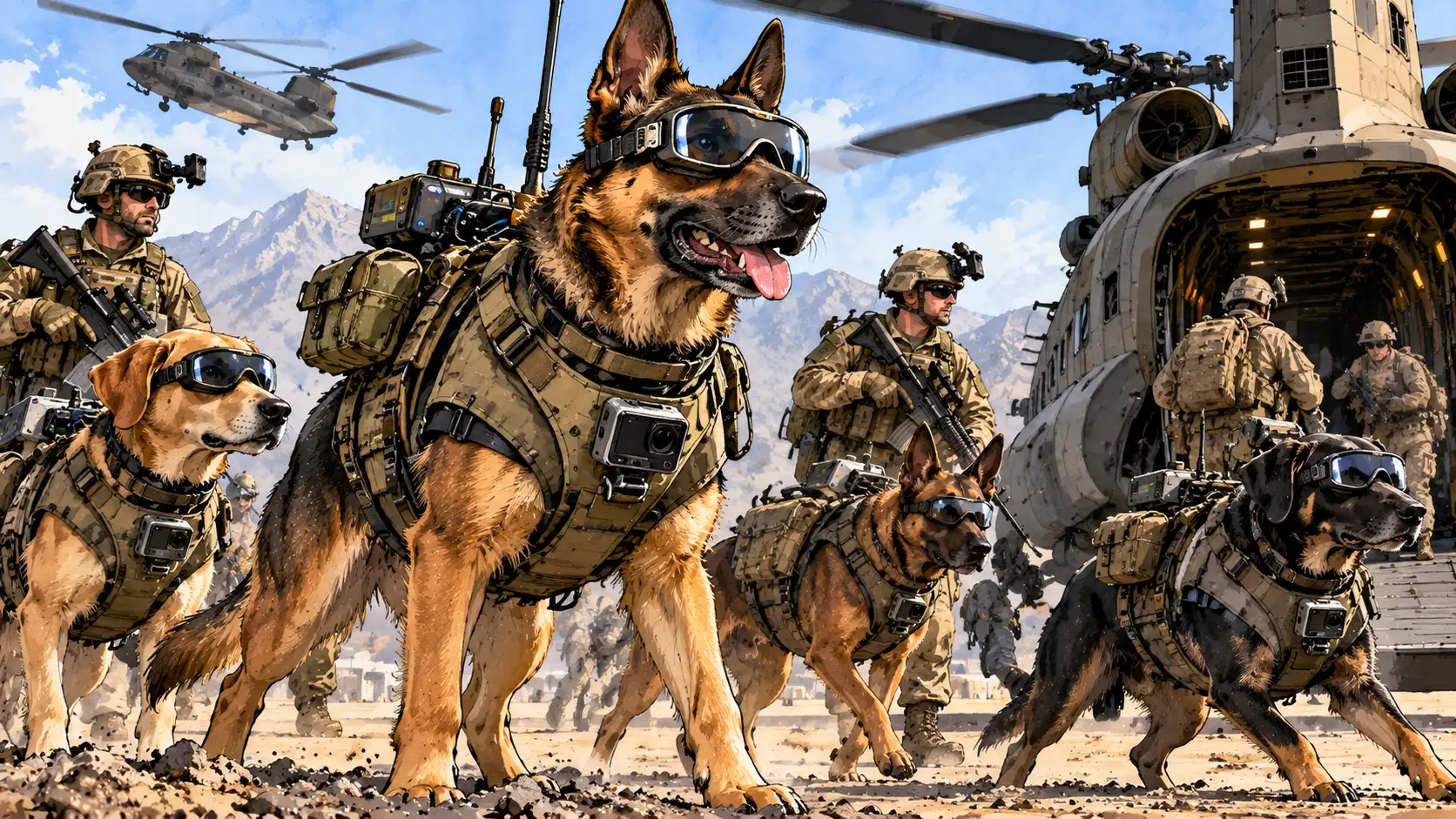
Pentagon hopes new recruits will be smarter than generals and resistant to squirrels
America’s next generation of warriors will have genetically enhanced noses, computerized body armor, battlefield sensors and a billion-dollar corporate valuation. Nobody knows how to stop them from licking themselves during classified briefings.
DALLAS, Texas, October 24, 2026 – America has finally found the weak spot in its national defense strategy: dogs are not complicated enough.
According to an October 23 Washington Times report on genetically enhanced military working dogs, a Texas-based startup called Warhound plans to build a new generation of military dogs using genetic engineering, cloning and advanced battlefield technology.
The company has raised $200 million and carries a reported valuation of $1.2 billion. It has not yet produced a genetically enhanced puppy. Even by Silicon Valley standards that is a feat, since most companies wait until their first product fails before asking for another billion dollars.
The project pairs Ben Lamm, whose company Colossal Biosciences works on reviving extinct animals, with Palmer Luckey, whose defense technology company Anduril builds advanced military systems.
Resurrecting extinct predators, it turns out, wasn’t ambitious enough. Now they want to give German shepherds the kind of equipment normally reserved for special forces.
Pentagon Discovers Military Dogs Have Been Running Without Software Updates
For centuries, dogs have done military work with four legs, a nose and an unshakable enthusiasm for whatever their handler asks.
Silicon Valley considers this arrangement dangerously obsolete.
Warhound proposes to improve military working dogs through genetics and to equip them with specialized armor, sensors and battlefield-awareness technology. The goal is a healthier animal that can detect explosives, locate threats, cross difficult terrain and hold up under the physical demands of service.
Engineers first have to solve one operational problem. How does a dog tell the difference between an enemy combatant and a man delivering pizza?
Military analysts have flagged a few more. A genetically enhanced dog that can detect explosives from extraordinary distances might also locate every unlicensed barbecue within 30 miles.
A dog engineered for superior agility could clear a ten-foot wall, cross a minefield and disable an enemy position before realizing someone back at headquarters was holding a tennis ball.
And a dog with enhanced intelligence might eventually ask the one question military leaders have dodged for decades:
“Why are we still having meetings about meetings?”
Warhound’s $1.2 Billion Valuation Arrives Before the First Puppy Learns to Sit
The financial side is the impressive part.
Warhound has reportedly drawn investors including Sequoia Capital, ARK Invest and In-Q-Tel, the investment organization tied to the American intelligence community.
Those investors have committed $200 million to a company whose most important employees have not been born yet.
Investors used to ask for factories, products, customers or revenue before they assigned astronomical valuations. Today, all it takes is the promise of a Labrador in night-vision goggles.
For clarity, the $200 million is private investment, not an announced Pentagon purchase, and the company has not set a price per dog.
That matters, because Washington would never spend $4 million on a military dog without first approving another $600,000 for a feasibility study on whether the dog would prefer chicken. The Government Accountability Office has been documenting that kind of schedule slippage for years. Its annual weapon systems assessment found that over half of the major programs it reviewed that had yet to deliver capability reported delays in a single year, and a July 2026 Defense News report on the latest assessment put the Pentagon’s top new programs more than a decade behind.
An illustrative future procurement contract might include $75,000 for canine body armor, $140,000 for battlefield communications, $290,000 for cybersecurity protection and $450,000 for a comprehensive investigation into why the dog refuses to get in the helicopter.
The dog would still work for bacon.
That is what makes dogs so economically dangerous to Washington. They deliver real services without lobbyists, congressional earmarks or a 47-page expense reimbursement form.
Why the U.S. Military Buys Working Dogs From Europe
Warhound points to another national-security concern. The United States buys most of its military working dogs from Europe.
According to the company’s announcement, more than 80 percent are acquired from European suppliers, and fewer than half of the dogs purchased end up qualifying for service. The Defense Department’s own pipeline runs through the 341st Training Squadron at Joint Base San Antonio-Lackland, which trains the dogs and handlers for every branch.
So America has spent decades importing German shepherds while arguing about the importance of American manufacturing.
The situation is a geopolitical embarrassment. A country that builds nuclear submarines, lands spacecraft on Mars and delivers hamburgers through a phone app apparently can’t produce enough domestic dogs willing to bite terrorists.
European breeders have held the strategic advantage. German shepherds are disciplined, Belgian Malinois are athletic, and French poodles surrendered a long time ago.
Warhound intends to bring the business home.
It is the first major national-security initiative in which the phrase “Buy American” can be followed immediately by “Who’s a good boy?”
Genetically Enhanced Dogs Promise Superior Intelligence; Generals Update Their Résumés
The most exciting possibility is better canine cognitive performance.
Research in Scientific Reports on behavioral selection in military and security working dogs examined 628 Labrador retrievers in a detection-dog program. It found that behavioral traits, environmental factors and training characteristics all influence which animals succeed. Picking a good military dog takes more than finding one that looks intimidating in sunglasses.
That creates a potential administrative crisis.
An exceptionally intelligent military dog might eventually see that a commanding officer’s operational plan makes no sense. Military tradition requires the dog to follow orders anyway.
In a hypothetical Pentagon briefing, a four-star general announces that the enemy position will be taken through a seven-stage, multinational operation involving three helicopters and satellite reconnaissance.
The genetically enhanced dog studies the terrain, walks around the building and captures the suspect in eleven seconds.
The general awards himself a medal for excellent leadership.
The dog gets a biscuit.
Both then appear in a defense contractor’s promotional video, though only one of them showed any tactical judgment.
Military Superdogs Could Finally Make Pentagon Meetings Productive
The case for putting intelligent animals into military administration deserves a hearing.
Dogs have several qualities that set them apart from career bureaucrats. They’re loyal, they respond immediately to clear instructions, they like physical activity and they almost never insist on forming a committee.
No dog has ever spent six months on an organizational review to decide whether another dog should be allowed to retrieve a tennis ball. A dog doesn’t build a PowerPoint explaining why somebody else should chase it.
It chases the ball.
If Washington applied that principle to procurement, Americans might someday buy an aircraft without 14 congressional hearings and a consulting contract explaining the concept of flight.
The trouble starts when superdogs find out that exceptional performance gets rewarded with more work.
An ordinary dog gets a treat for finding explosives. A genetically enhanced dog could end up identifying explosives, analyzing intelligence reports, inspecting equipment, preparing budgets and sitting through mandatory workplace seminars on inclusive barking.
At that point even the smartest dog in America may decide to pretend it doesn’t understand English.
Anduril Gear Meets Captain America, Then a Fire Hydrant
Warhound’s concept has been compared to a canine mix of Captain America and Iron Man.
The comparison captures the technological ambition and skips some behavioral realities. Captain America never abandoned a battlefield operation because he smelled another Captain America six blocks away. Iron Man never refused to climb into his armored suit because someone had washed it in an unfamiliar detergent.
And neither of them ever spent twenty minutes happily rolling in something that appeared to have died during the previous administration.
Anduril’s proposed equipment would give dogs protective gear, advanced sensors and communications tools so dogs and handlers can share battlefield information. The technology could be genuinely useful, especially if it protects animals from injury or helps handlers read dangerous situations.
The next frontier, though, is interpreting what the dogs say. An enhanced battlefield communications system could send an urgent notice to military headquarters:
THREAT IDENTIFIED.
Followed immediately by:
THREAT IDENTIFIED AS SQUIRREL.
And finally:
SQUIRREL ESCAPED. REQUEST AIR SUPPORT.
America’s First Canine Labor Negotiations Could Get Brutal
Another problem arrives once the superdogs learn their market value.
A creature worth hundreds of thousands of dollars in equipment, training and genetic development may start asking why its compensation consists mostly of processed meat.
The first canine labor representative will demand better veterinary care, shorter deployments, retirement benefits and guaranteed opportunities to urinate on government property.
A preliminary employment agreement could require four walks a day, unrestricted access to tennis balls and removal of the phrase “bad dog” from official performance evaluations.
Military commanders will resist these demands until the animals threaten to reveal what really goes on in classified meetings.
A Pentagon spokesman will then say that negotiations remain constructive and that the department fully supports the troops, including the ones currently chewing through the conference-room furniture.
Genetic Engineering Can Improve Dogs but Cannot Patent Loyalty
There is a difference between making dogs healthier and believing they can be engineered into perfect soldiers.
Genetic traits interact with upbringing, training, motivation and environment. A 2026 review of canine olfaction and scent-detection work stresses that performance depends on physical condition, behavior and the dog’s surroundings, not on genetics alone.
Warhound has also announced an animal-welfare arrangement with the American Humane Society, whose involvement is meant to support humane training and retirement opportunities.
That deserves to be taken seriously. Dogs are not disposable weapons, and making them healthier would be a real accomplishment.
The absurdity begins when Silicon Valley attaches a billion-dollar valuation to the idea that man’s best friend needs a venture-capital-backed operating system.
For thousands of years the arrangement between humans and dogs has been beautifully simple. Humans supply food, shelter and affection. Dogs supply loyalty, companionship and, now and then, a vivid demonstration of what happens when someone tries to enter the property without permission.
No quarterly earnings call has ever improved that relationship. No algorithm has ever made a dog more grateful to see its handler come home alive.
And no military contractor has found a genetic modification that beats the real thing.
The Pentagon’s Greatest Fear: A Superdog That Reads the Defense Budget
The biggest unintended consequence of building exceptionally capable military dogs may have nothing to do with combat. It may be arithmetic.
Once the first genetically enhanced superdog learns to read defense procurement documents, America’s entire military-industrial establishment could face an existential threat.
The animal might discover that a battlefield equipment program costs five times its original estimate, took twice as long as projected and produced a device less reliable than a tennis ball.
It might then ask why a country that can create genetically enhanced military animals still needs three separate government contractors to make a drinking bowl.
Eventually the Pentagon would face a terrible choice. It could keep investing in smarter and smarter dogs that question waste, bureaucracy and questionable strategy. Or it could go back to buying ordinary dogs that simply obey.
For the first time in American military history, the institution might learn that the greatest threat from an exceptionally intelligent soldier is that somebody will have to listen to him.
Meanwhile, Warhound’s first generation of enhanced dogs is expected to start arriving in 2027.
The military expects stronger bodies, sharper senses and better performance in the field. Silicon Valley expects extraordinary returns.
And somewhere in Texas, a German shepherd is getting ready to step into the future of American warfare. His trainers will teach him to detect explosives, cross dangerous terrain, talk to advanced sensors and protect American soldiers.
He will learn everything they ask.
Then, on the morning of his first deployment, he will see a squirrel.
And $1.2 billion worth of national-security innovation will disappear into the bushes.
15 Humorous Observations About America’s Genetically Enhanced Military Superdogs 🐕🇺🇸
- The Pentagon wants dogs smarter than humans. Have you met the Pentagon? That’s not a high bar. That’s a bar you could step over carrying groceries.
- Silicon Valley raised $200 million to improve dogs. Thirty thousand years of customer satisfaction, and some guy in a fleece vest says it needs a version two.
- Superhuman noses. Great. Now the dog can smell a bomb from a mile away and still has to stop and check out every other dog’s backside on the way. Nobody’s fixing that. That’s not a bug, that’s the personality.
- They say superdogs will outrun terrorists. Sure, as long as the terrorists have the good sense to show up dressed as squirrels. Then it’s over. Everybody go home.
- A $1.2 billion valuation and not one enhanced puppy. I’ve got a drawer full of ideas and nobody ever offered me a billion dollars. I guess I should’ve put “dog” in the deck.
- The dogs get advanced body armor. Fine. Now somebody’s got to explain to the dog that the vest is not a chew toy. He’ll wear it a day and a half and then it’s a vest-shaped pile of foam in the yard.
- Smarter dogs. The first one who reads the Pentagon procurement rules is putting in for a transfer. Before lunch. To Canada.
- We buy our military dogs from Europe, which means national security depends on the German shepherd actually being German. Who knew the Pentagon had a “Made In” label?
- The dogs go through rigorous military training. The investors qualified by having money. That’s the whole boot camp. Sixteen weeks of “do you have a checkbook.”
- Each superdog could cost a fortune. Doesn’t matter. Ask him what he wants, he says bacon. Million-dollar asset, paid in bacon. Best negotiator in the building.
- The dogs will talk to the battlefield tech. You know what the first message is gonna be. “BALL DETECTED. REQUEST PERMISSION TO FETCH.” And honestly, it’s the most honest report headquarters has gotten in twenty years.
- They’re going to wipe out inherited health problems. Pentagon officials asked if the same technology could wipe out congressional budget hearings. Which, to be fair, is the only disease actually killing anybody.
- Superdogs might outperform soldiers. Finally, a recruit who follows orders and doesn’t complain about the food. Unless it’s broccoli. Then it’s a mutiny.
- They’re calling it Captain America for dogs. Captain America never saw a mailman. That’s the one guy the shield can’t stop.
- The next generation of national defense. Our enemies will face genetically engineered warriors with exactly one weakness: somebody opening a bag of chips in the next room. Whole war’s over. Peace through crinkle.
Disclaimer
This article is political, technological and military satire. Warhound’s funding, valuation, stated ambitions and partnerships are drawn from published reporting and company announcements. The canine conversations, Pentagon negotiations, procurement estimates and squirrel-related military emergencies are satirical.
This story is entirely a human collaboration between two sentient beings: the world’s oldest tenured professor and a philosophy major turned dairy farmer.
The dogs were not consulted. Their legal representatives are demanding biscuits.