

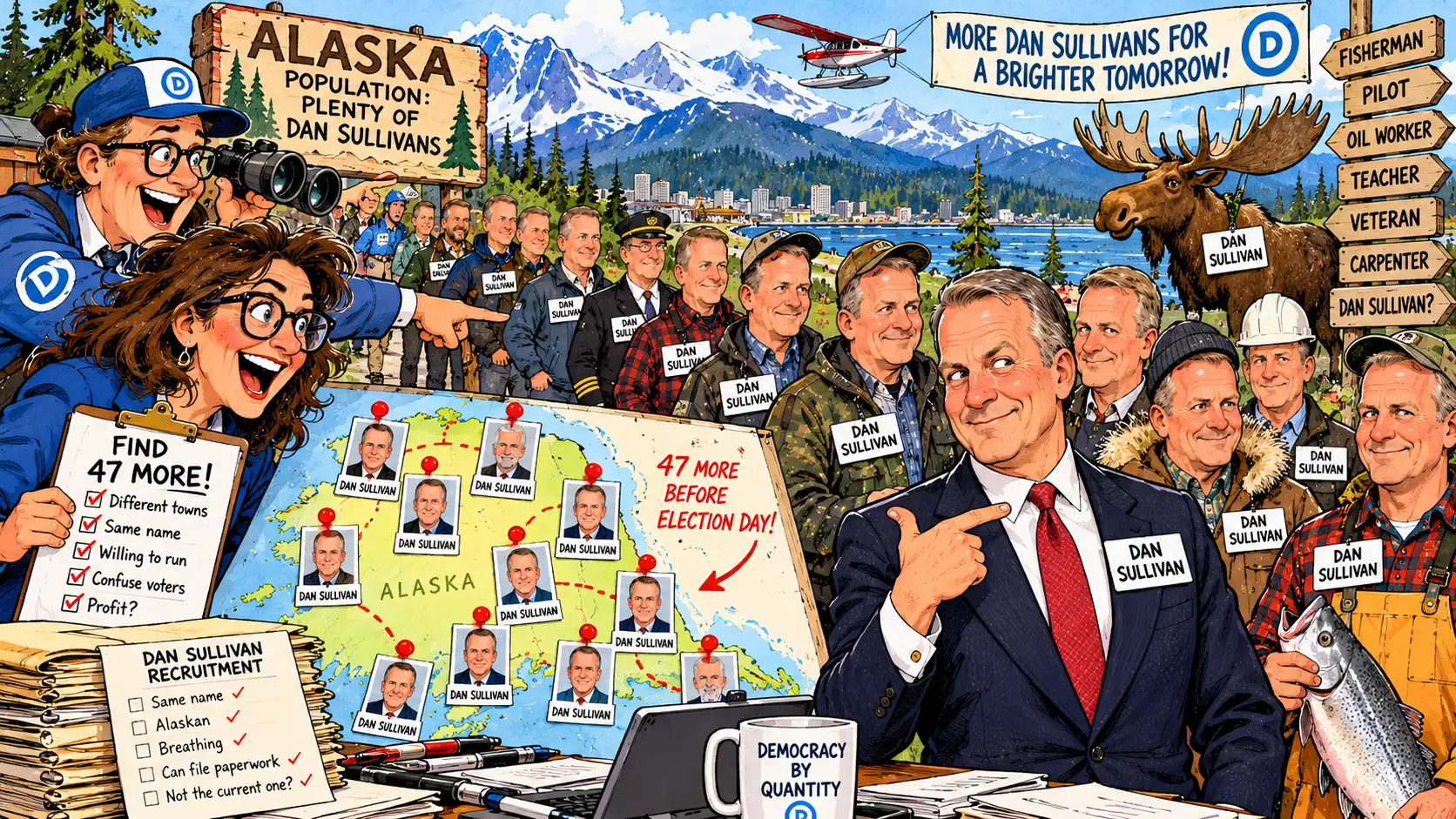
Alaska Democrats Find Another Dan Sullivan
Strategists Eye 47 More Before Election Day
ANCHORAGE, ALASKA (Bohiney.com) — American democracy has survived civil war, presidential assassinations, Watergate, hanging chads and several thousand congressional investigations. Nobody was prepared for the possibility that the United States Senate could be conquered by a guy with the same name as another guy.
Welcome to Alaska, where political strategy has apparently moved past the traditional business of convincing voters to support your candidate.
Now you just find somebody named Dan Sullivan.
Then you find another Dan Sullivan.
Eventually, if you locate enough Dan Sullivans, democracy surrenders from exhaustion.
An October 28 investigation by The New York Times reported that political operatives associated with Democratic Senate candidate Mary Peltola sought to recruit another Dan Sullivan to challenge Republican incumbent Senator Dan S. Sullivan. The candidate who emerged, retired teacher Dan J. Sullivan of Petersburg, is on the November 3 ballot.
Peltola’s campaign and the Democratic Senatorial Campaign Committee deny involvement. President Donald Trump has alleged election fraud, while legal experts have cautioned that strategic candidate recruitment is not automatically illegal.
But why stop at two?
Under the proposed Bohiney Institute for Electoral Nonsense expansion plan, Alaska Democrats could recruit another 47 Dan Sullivans, producing the first election in American history where the ballot resembles the guest registry at an Irish family reunion.
The strategy has one undeniable advantage: nobody needs to learn a new name.
Dan Sullivan Ballot Strategy: Democrats Try the Phone Book
Political campaigns used to hire economists, pollsters, communications directors and specialists in voter persuasion.
Somebody found the phone book instead.
According to the October 28 reporting, campaign associates searched voter records for Alaskans named Dan Sullivan. The reported effort became known among operatives as a ballot composition project, which sounds a lot more respectable than asking whether anybody knows a retired plumber named Ronald Reagan.
The difference between traditional campaigning and the latest Alaskan innovation is straightforward.
Traditional campaigning asks, “How do we convince people to vote for us?”
Alaskan political ingenuity asks, “What if the Republican voters accidentally vote for somebody else?”
It’s the electoral equivalent of opening a restaurant called McDonald’s next door to an actual McDonald’s, then acting surprised when customers complain that their Big Mac contains halibut.
At a Democratic strategy seminar, the keynote presentation would now consist of three instructions:
- Find the incumbent’s name.
- Find someone else with that name.
- Declare the whole thing a triumph of grassroots participation.
One consultant explained the economics: “Persuading 100,000 voters requires advertising, organizing and serious policy discussions. Finding one retired schoolteacher requires a telephone and potentially a sandwich.”
His colleague offered a correction.
“Two sandwiches. It’s Alaska.”
Itemized Invoice: Sullivan Name Verification Services, LLC
SULLIVAN NAME VERIFICATION SERVICES, LLC
Invoice No. 1047 | Billed to: Campaign Committee (Name Withheld at Client’s Request)
| Description | Qty | Rate | Amount |
|---|---|---|---|
| Voter roll search, “Sullivan, D.” | 1 | $4,200.00 | $4,200.00 |
| Retired teacher locator (Petersburg only) | 1 | $1,850.00 | $1,850.00 |
| Sandwich (Alaska rate) | 2 | $14.50 | $29.00 |
| Additional Dan Sullivans, to be located | 47 | $310.00 | $14,570.00 |
| Middle initial consulting | 1 | $2,500.00 | $2,500.00 |
| Plausible deniability, monthly retainer | 1 | $7,500.00 | $7,500.00 |
| Legal review of the word “coincidence” (hours) | 3 | $625.00 | $1,875.00 |
| TOTAL DUE | $32,524.00 | ||
Terms: Net 30. Payment may be sent to whichever Dan Sullivan is reading this.
Election Integrity and the Justice Department Lawsuit Over the Alaska Senate Race
The controversy has also introduced Americans to an entirely new definition of election integrity.
Election integrity, according to the Bohiney Dictionary of Convenient Political Principles, means protecting every citizen’s sacred right to vote, preferably for whichever candidate your campaign has already selected.
President Trump responded to the allegations by calling for legal consequences. Alaska Governor Mike Dunleavy ordered an investigation into whether the reported recruitment operation violated state law. No criminal wrongdoing has been established.
This has produced a remarkable constitutional situation.
Democrats are accused of trying to influence which candidates appear on the ballot.
Republicans have challenged the election arrangements in court.
And the voters are wondering whether anybody remembers that elections are supposed to involve them.
The Justice Department has filed a lawsuit that could prevent Alaska from certifying its Senate election results under certain circumstances if the incumbent loses. Alaska officials have disputed the lawsuit’s legal basis. Attorney General Todd Blanche has said the department is doing its own research under the law.
So America has found a new way to defend democracy: everybody hires lawyers, and the election becomes a scheduling inconvenience.
A constitutional scholar at the Bohiney Institute explained the dispute.
“The problem with American democracy is that voters keep making decisions without consulting the people who spent $40 million trying to make those decisions for them.”
He added that the Founding Fathers probably never imagined a Senate race where the decisive constitutional issue would be whether Dan Sullivan was actually Dan Sullivan.
Benjamin Franklin did once warn that Americans had a republic if they could keep it.
He never specified how many Dan Sullivans were included.
Alaska Ranked-Choice Voting Meets Its Greatest Enemy: The Alphabet
The confusion gets worse because Alaska uses ranked-choice voting.
Under the state’s election rules, voters can rank the candidates in order of preference. They don’t have to rank everyone, and each vote counts for only one candidate at a time. The system is explained by the Alaska Division of Elections.
That sounds perfectly reasonable until two candidates share a name.
Picture an Alaskan walking into the polling station.
“I’d like to vote for Dan Sullivan.”
“Which one?”
“The senator.”
“Which Dan Sullivan?”
“The Republican.”
“That doesn’t narrow it down as much as you’d think.”
“Well, the one with experience.”
“One’s a senator, and the other’s a retired teacher.”
“Which one understands government spending?”
“Sir, we’re going to need you to be more specific.”
By the time the voter has successfully distinguished Dan S. Sullivan from Dan J. Sullivan, he has missed lunch, used up his patience and acquired a lifelong hatred of middle initials.
Political scientists usually study voter confusion through surveys, ballot design and statistical analysis.
Alaska has simplified the research.
It just prints the name Sullivan twice.
Dispatch Log: Alaska Name Confusion Hotline (Volunteer-Run)
CALL LOG — TUESDAY — EARLY VOTING WEEK
07:42 Caller asks which Dan Sullivan is on the radio. Advised: both. Caller thanks us and says he feels worse.
09:15 Caller reports a Dan Sullivan at the harbor. Volunteer confirms it is the retired teacher. Caller asks if that’s the good one. Volunteer declines to say.
11:03 Caller says he voted early for Dan Sullivan and now wants to know how it’s going. Advised to ask Dan Sullivan.
13:30 Two Dan Sullivans reported at the same gas station. Turned out to be one Dan Sullivan and his cousin Dan.
14:55 Caller asks whether ranking both counts as cheating. Advised that the state allows it. Caller says that’s the worst part.
16:20 Caller states ranked-choice voting is hard. Dispatcher agrees. Call ends in mutual understanding.
Political Consultants Discover That a Middle Initial Beats a Campaign Promise
For decades, American politicians believed winning elections required an attractive platform, persuasive speeches and a compelling vision for the future.
The Alaska controversy suggests that alphabetic similarity deserves its own political science department.
Run with it for a second.
A Republican running against Chuck Schumer could recruit a retired electrician named Charles Schumer.
A Democrat facing Ted Cruz could locate Theodore Cruz, a substitute teacher who once visited Houston.
Eventually the nation would have congressional elections made up entirely of people with identical names, different middle initials and competing allegations of identity theft.
The debates would be magnificent.
Moderator: “Senator Sullivan, what’s your position on federal spending?”
Sullivan: “We need fiscal responsibility.”
Moderator: “And Senator Sullivan?”
Other Sullivan: “I’m not a senator.”
Moderator: “An unusually refreshing answer from a candidate.”
Campaigns could also dispense with complicated advertisements.
Instead of explaining healthcare, inflation or foreign policy, every commercial would simply feature the candidate’s birth certificate.
The winning slogan?
“I’m Dan Sullivan. Not That Dan Sullivan.”
Unfortunately, his opponent could use exactly the same slogan.
Campaign Mailer, Back Panel
Paid for by Alaskans for the Real Dan Sullivan. Not authorized by Dan Sullivan, either of them. Alaskans for the Real Dan Sullivan is not affiliated with Real Alaskans for Dan Sullivan, Alaskans for Dan Sullivan (Real), or the Sullivan Committee. Offer void in Petersburg. Middle initials may vary by household. Voting for both is permitted under state ranked-choice rules and will not make either Dan feel loved. Do not fold, spindle or ask which Dan. If this mailer was delivered in error, it was delivered to a Dan Sullivan, and you may be one.
Both Parties Accuse Each Other of Candidate Recruitment
There is one inconvenient detail in the controversy.
Democrats have accused Republicans of using similar candidate-recruitment tactics in earlier elections, including efforts involving Peltola’s 2024 House race. The Democratic Senatorial Campaign Committee has denied participating in the Sullivan recruitment.
That puts American politics at a stage where one party accuses the other of doing something that the other party says the first party did before.
It’s kindergarten with more expensive attorneys.
“Teacher, they recruited a candidate!”
“Well, they recruited one first!”
“Did not!”
“Did too!”
Meanwhile, the national debt keeps collecting interest while grown adults hold emergency conferences about a retired teacher’s name.
Whoever invented the scheme probably deserves an award for efficiency.
Why develop complicated public policies when you can simply interfere with the opposition’s brand recognition?
The old political saying was that all politics is local.
The new version is that all politics is alphabetical.
The Great Alaska Sullivan Shortage of 2026
The Bohiney Institute’s research division has now calculated that a truly ambitious name-duplication strategy would require 47 additional Dan Sullivans.
Such a campaign would create immediate logistical difficulties.
Debates would require numbered chairs.
Campaign signs would become useless.
Fundraising invitations would read, “Dear Dan Sullivan, please help defeat Dan Sullivan.”
The Alaska Republican Party would need a receptionist whose only job was answering questions about which Sullivan was calling.
The Democratic Party would need a separate receptionist to insist nobody knew anything about any of the Sullivans.
And election-night television coverage would fall apart completely.
“With 98 percent reporting, Dan Sullivan has defeated Dan Sullivan, although Dan Sullivan is demanding a recount on behalf of Dan Sullivan.”
The losing candidate would immediately allege irregularities.
The victorious candidate would declare democracy had prevailed.
Nobody would know which candidate had said either thing.
And somewhere in Petersburg, a retired teacher would wonder how a simple political campaign became a national investigation involving the president, federal attorneys and the entire American alphabet.
One-Star Review: Sullivan & Sullivan Print Shop, Wasilla
★☆☆☆☆ “Ordered 5,000 yard signs. Wanted them to say DAN SULLIVAN.”
Shop asked which one. I said the good one. They printed 2,500 of each and billed me for a consultation. Now my lawn looks like a hostage situation. The neighbor put up the other sign out of spite. The man at the counter was named Dan Sullivan, and he would not tell me which one he was voting for, which I respect, but still. Would not recommend. Would also not recommend the other one.
Verified buyer: Dan S. | 14 people found this helpful | 2 people found this confusing
Final Verdict: America Has 330 Million People and Apparently Only One Name
The genuine issue is whether voters can confidently identify the candidates they intend to support. Recruitment tactics, campaign coordination and election-law compliance deserve scrutiny, but accusations remain distinct from legal findings.
Alaska has mountains, glaciers, grizzly bears, oil fields, vast wilderness and enough geographical space to fit several European countries.
Yet the political establishment has somehow managed to turn its Senate election into a disagreement over two men with the same name.
The nation that landed astronauts on the moon, invented the internet and built nuclear submarines now faces an urgent democratic question.
Which Dan?
The answer may determine who represents Alaska in the United States Senate.
But the truly frightening possibility is that, after all the money, lawsuits, speeches and investigations, the winner will go to Washington and behave exactly like every other senator.
Because in American politics, changing the name is sometimes easier than changing anything else.
Five Observations on Two Dans
- That poor guy had the same name for sixty-some years and it never once came up. Not at the DMV, not at the pharmacy, nowhere. Then one summer he’s a federal case. Now every time he says “Hi, I’m Dan,” somebody asks “Which Dan?” like he’s a flavor of ice cream.
- Alaska has more land than Texas and California combined, and the whole Senate race comes down to two guys with the same name. You’d think in all that space you could find one Dan who doesn’t have a Dan.
- In Alaska you can rank both of them. That’s the only election in America where “I voted for both” is a legal answer, and also my entire dating history.
- The Justice Department sued over a name. A name! I’ve been called “Mike” by a guy at my gym for six years and nobody’s calling the Attorney General.
- He taught fifth grade. He has handled four Jacobs in one classroom during a fire drill. A second Dan Sullivan is the easiest thing that’s happened to him since Tuesday.
This story is credited to two sentient beings: the world’s oldest tenured professor and a philosophy major turned dairy farmer. Neither has admitted to being named Dan Sullivan.