

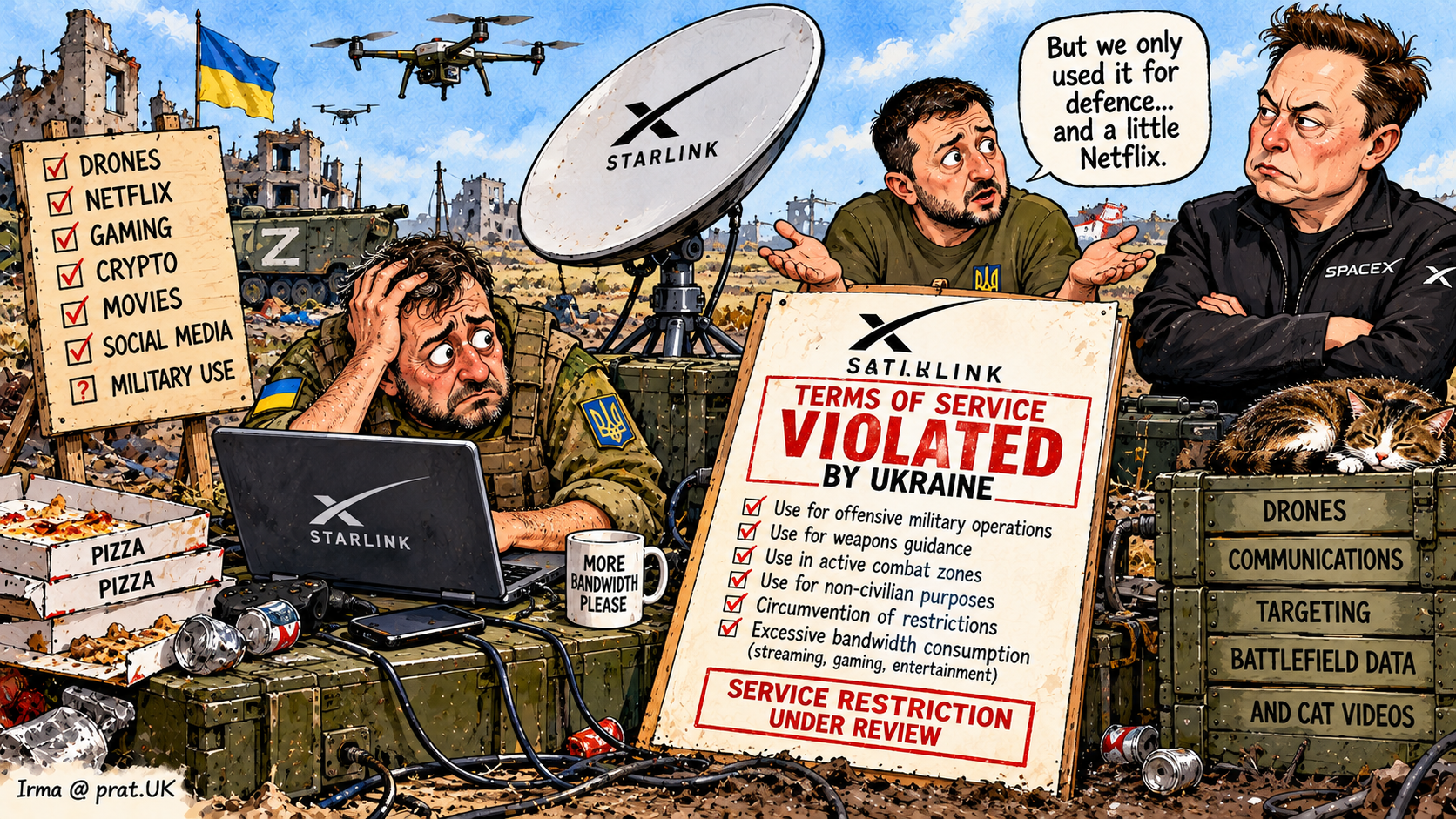
Napoleon had Waterloo. Germany had Stalingrad. Ukraine has a customer support ticket
KYIV, UKRAINE – The war between Russia and Ukraine has entered a remarkable new phase after Elon Musk accused the Ukrainian military of violating the Starlink terms of service by using satellite internet to conduct offensive drone strikes. That raises the disturbing possibility that a European nation’s survival may ultimately depend on whether its president remembered to check the little box marked I Agree.
For years, Ukraine believed it was fighting a war against Russian aggression. Apparently it was also fighting a contractual dispute with a billionaire in Texas.
According to Reuters reporting on Ukraine’s Starlink and Starshield disruptions, satellite communications restrictions interfered with Ukrainian military operations before service was restored. Musk subsequently accused Ukraine of using the civilian Starlink system for prohibited offensive drone attacks, an allegation Ukrainian officials disputed.
Russia has spent enormous sums developing sophisticated systems to defeat Ukrainian drones. It now appears Silicon Valley has found a considerably cheaper alternative: an administrator changing a setting.
Military historians are already reconsidering the great turning points of warfare.
Napoleon had Waterloo. Germany had Stalingrad. Ukraine has a customer support ticket.
For the first time in military history, a country may have to explain to its soldiers that the enemy is advancing because somebody in California updated the acceptable-use policy.
Elon Musk Says Starlink Terms of Service Ban Offensive Drone Strikes in Ukraine
The controversy began with Musk’s insistence that Starlink, designed primarily for civilian communications, should not be used for offensive drone strikes. He distinguished it from Starshield, a separate military system operated under U.S. government control.
The distinction is real. Starlink’s published acceptable use policy for satellite internet services restricts using the service to remotely pilot drones without contractual permission, and its military-use provisions carry restrictions of their own. It isn’t the first time, either. SpaceX curbed Ukraine’s use of Starlink for drones back in 2023.
The comedy is that Ukraine is engaged in an actual war, which traditionally involves military equipment being used for military purposes.
The first sign of trouble should have been the moment Ukrainian soldiers opened their satellite terminals and found a subscription that included unlimited communications, worldwide coverage, and absolutely no defeating the invading army.
Under the emerging philosophy of technology-assisted warfare, Ukraine can use Starlink to talk to headquarters, request medical assistance, and perhaps arrange a pizza delivery.
But sending a drone to destroy an ammunition depot may require upgrading to the Business Genocide Prevention Plus package.
Nobody knows what that costs. The pricing page keeps redirecting customers to a motivational video about Mars.
This raises a broader question about the modern technology industry.
If a billionaire sells the technology that enables a military to function, is he providing a service, conducting foreign policy, or simply running the world’s most consequential internet café?
The answer depends largely on whether the drone is moving toward or away from Russia.
Russia’s Billion-Dollar Air Defense Loses to a Starlink Settings Menu
For decades, military engineers have studied radar, electronic warfare, missile interception and sophisticated counter-drone technology.
Russia deployed weapons, surveillance systems and electronic countermeasures to stop Ukrainian aircraft from striking its military logistics.
Then Ukrainian commanders reported drone speed restrictions that disrupted missions, including operations involving longer-range aircraft. After the restrictions were lifted, Ukrainian officials reported restored operating speeds above 400 kilometers per hour, nearly 250 miles per hour. One report says Musk ordered the Starlink slowdown.
Imagine explaining this to a Russian general.
For years, his military has worked to stop Ukrainian drones through conventional methods. He has requested more missiles, better radar, additional electronic warfare equipment, and several billion dollars in emergency appropriations.
Meanwhile, the most effective weapon turns out to be a software limitation.
The Russian Ministry of Defense can now reorganize its military strategy around the customer service departments of American technology companies.
Instead of deploying an antiaircraft battery, it could send Ukraine an email.
“Dear valued customer, your satellite connection has been temporarily restricted. We apologize for any inconvenience caused by the ongoing invasion.”
A military strategist might reasonably ask why Russia needs an elaborate air defense network if a sufficiently complicated licensing agreement can achieve the same result.
The Russian military has spent years trying to penetrate Ukrainian defenses.
Silicon Valley achieved what artillery could not. It made Ukrainian operators read the fine print.
And nobody in the modern world has ever defeated fine print.
Trump’s Ukraine Peace Plan Meets Starlink Throttling and Strikes on Russian Oil
The satellite controversy also intersects with President Donald Trump’s efforts to negotiate an end to the war.
Washington has pressured Kyiv over attacks on Russian oil infrastructure, and calls for Zelensky to end those strikes have only grown louder, while the satellite disruptions intensified questions about American policy toward Ukraine.
The American administration is attempting to manage an extraordinarily difficult diplomatic situation involving Russian energy, Ukrainian sovereignty, European security and the possibility of a broader confrontation.
Its most innovative negotiating instrument appears to be making the battlefield increasingly inconvenient for one of the participants.
The principle is familiar to anyone who has ever negotiated with a landlord.
First, the landlord raises the rent. Then he turns off the electricity. Finally, he explains that both parties must make concessions.
Washington’s diplomatic challenge is especially delicate because Moscow and Kyiv have fundamentally different interpretations of peace.
For Ukraine, peace generally means an end to Russian attacks and some assurance of national security.
For Russia, peace becomes considerably more attractive when Ukrainian weapons stop functioning at full speed.
Trump, who has repeatedly emphasized his ability to negotiate difficult deals, may have discovered a bold new formula.
When two people are fighting, take away one person’s boxing gloves.
The other person immediately becomes more enthusiastic about the negotiations.
This is particularly effective if the second person is Vladimir Putin.
The strategy has extraordinary applications elsewhere, too.
The next time a burglar enters your home, perhaps the police can disable your alarm system to encourage both sides to reach a mutually acceptable settlement.
If the burglar is unhappy with the negotiations, the police could also ask you to stop locking the doors.
Naturally, this would be called a historic peace initiative.
Pentagon Starshield vs. Starlink: A Military Satellite Network With a Family Netflix Account Problem
The most remarkable element of the controversy may be the distinction between Starlink and Starshield.
Starlink is a commercial satellite internet system, whereas Starshield provides specialized services for U.S. government and military customers, including a $70 million U.S. Space Force contract.
SpaceX has said changes were made to civilian Starlink while maintaining that it did not modify Starshield. Reports about what caused the wider operational disruptions have been contested, including questions about decisions made by SpaceX and U.S. officials.
The Pentagon therefore faces a fascinating new challenge.
America operates enormously sophisticated military systems, including aircraft carriers, stealth fighters, nuclear submarines, satellites and advanced communications networks.
But somewhere in this technological empire sits a licensing agreement that may ultimately carry more influence than an admiral.
Military planners once calculated how many missiles would be needed to defeat an enemy.
Now they must calculate whether their current subscription permits missiles.
A hypothetical Pentagon briefing practically writes itself.
“General, the equipment is operational, our satellites are functioning, and our pilots are prepared.”
“Excellent. Can we begin the mission?”
“Not until Legal gets back from lunch.”
The American military-industrial complex has finally reached the point where the most dangerous battlefield weapon may be a lawyer holding a clipboard.
Previously, national defense was determined by the availability of ammunition. Now it may depend on whether someone in procurement selected the correct service tier.
That raises another concern. What happens when a major military operation requires a password reset?
Does the commanding general receive a six-digit authentication code?
Does it expire after thirty seconds?
And if the verification message fails to arrive, is the invading army expected to hold its position?
NATO could soon require every member nation to maintain a special battalion devoted entirely to remembering passwords.
Zelensky Files a Warranty Claim for $1 Million in Lost Starlink-Dependent Drones
For President Volodymyr Zelensky, the consequences have been considerably less entertaining.
Ukrainian commanders reported that the restrictions disrupted operations, complicated strikes on Russian logistics, and resulted in lost equipment. One commander told The New York Times that his unit lost more than $1 million worth of drones on the first night of the disruptions.
That is an expensive internet outage.
Most ordinary consumers respond to slow internet by restarting the router and complaining that Netflix won’t load.
Ukrainian soldiers were watching expensive aircraft lose connectivity during combat operations.
Under normal circumstances, a million-dollar equipment loss might generate an insurance claim.
In Ukraine, it raises the question of whether the product warranty covers direct exposure to Russian artillery.
Unfortunately, the standard exclusions probably include war, invasion, aerial combat, geopolitical disagreement and anything involving Crimea.
Zelensky may therefore have to file a complaint explaining that his country’s military equipment stopped performing as expected while defending his country’s territory.
The customer support representative will naturally ask whether he has tried turning Ukraine off and turning it back on again.
If that doesn’t resolve the issue, a technician can schedule an appointment sometime between Tuesday morning and the end of civilization.
There’s also the matter of customer satisfaction.
What rating should Ukraine give a service that provides crucial battlefield communications for years but suddenly becomes unreliable during a particularly important week?
Three stars seems generous.
One star seems ungrateful.
Five stars seems appropriate only if the Russian military agrees to stop invading during scheduled maintenance.
Perhaps the solution is to create an entirely new rating category: Excellent equipment, unpredictable geopolitics.
American Billionaires Now Hold More Foreign Policy Power Than Most Foreign Ministers
The most serious question is not whether Elon Musk supports Ukraine, opposes offensive drone strikes, or believes technological restrictions could reduce the killing.
Those are legitimate subjects for debate.
The question that remains is how a single private company’s technology became so central to the military operations of a sovereign nation that changes to its service could influence events on the battlefield.
Modern governments have spent generations outsourcing increasingly important services to private companies.
They outsourced manufacturing, logistics, communications, computing and infrastructure.
Now the outsourcing appears to have reached national sovereignty.
An elected president can command an army, approve military operations, and request assistance from allies.
But before the aircraft take off, somebody must determine whether the operation complies with a California corporation’s licensing agreement.
Democracy, it turns out, may be a monthly subscription.
The next generation of diplomatic negotiations could feature a completely new seating arrangement.
The American president sits at one end of the table.
The Russian president sits at the other.
The Ukrainian president occupies the middle.
And Elon Musk sits beside the router.
Nobody can begin until he confirms that the network is working.
Ukraine’s Drones Return to 400 KPH While International Diplomacy Stays Stuck on Buffering
Ukraine subsequently reported that its satellite services were functioning at their previous operating speeds. Zelensky publicly thanked American officials and partners who helped resolve the dispute, while the broader disagreement over responsibility remained.
That’s welcome news for Ukrainian military operators.
The drones are moving again.
The communications are functioning.
The battlefield technology is operating closer to its intended capabilities.
Diplomacy, unfortunately, continues to buffer.
The incident has demonstrated that modern warfare requires considerably more than soldiers, aircraft, intelligence and ammunition.
It also requires reliable technical support, sufficiently flexible licensing agreements, and an international telecommunications system that doesn’t change the meaning of national defense halfway through a battle.
Military academies will eventually teach this episode as a cautionary tale about technological dependence.
Their students will study how satellite communications transformed warfare, how private companies acquired strategic influence, and how national security became entangled with commercial contracts.
And somewhere in Moscow, a Russian general will look at his expensive air defense systems and wonder why nobody suggested contacting customer service.
The final lesson is simple. Napoleon needed an army to invade Russia. Modern Russia may only need somebody to update Ukraine’s subscription.
Five Humorous Observations About Starlink, Ukraine and the Terms of Service
- Ukraine’s got a country at war, and the thing that got in the way was an “Accept updated terms” popup. Look, I’ve been clicking “I Agree” on iTunes for fifteen years and I’ve never read a word of it either. The difference is my worst case is losing a Taylor Swift album. Theirs is a Tuesday offensive.
- There’s Starlink for civilians and Starshield for the military. So that’s a restaurant with one menu for hungry people and another menu for the really hungry ones. And somebody in the back is deciding which one you’re allowed to order from during an air raid.
- A million dollars of drones, gone in one night, because of slow Wi-Fi. I once lost a Zoom call to slow Wi-Fi and I wanted to move to Canada. These guys lost a million bucks and they can’t even blame the neighbor for streaming.
- “Have you tried turning Ukraine off and on again?” Sir. It has a front line. And you know the hold music is just artillery, you can’t even enjoy it because somebody keeps saying your call is important to them.
- The big peace plan is take one guy’s boxing gloves away so the other guy gets more reasonable. That’s not diplomacy. That’s my brother-in-law “refereeing” Thanksgiving football, and everybody knows how that ends: somebody’s crying in the driveway and the dog’s been blamed.
Satirical Disclaimer
This article is political and technological satire. Its exaggerated scenarios, customer-service conversations, and subscription packages are comic commentary, not reported events. The underlying controversy concerns real allegations and disputed accounts of satellite-service restrictions.
This story is entirely a human collaboration between two sentient beings: the world’s oldest tenured professor and a philosophy major turned dairy farmer.