

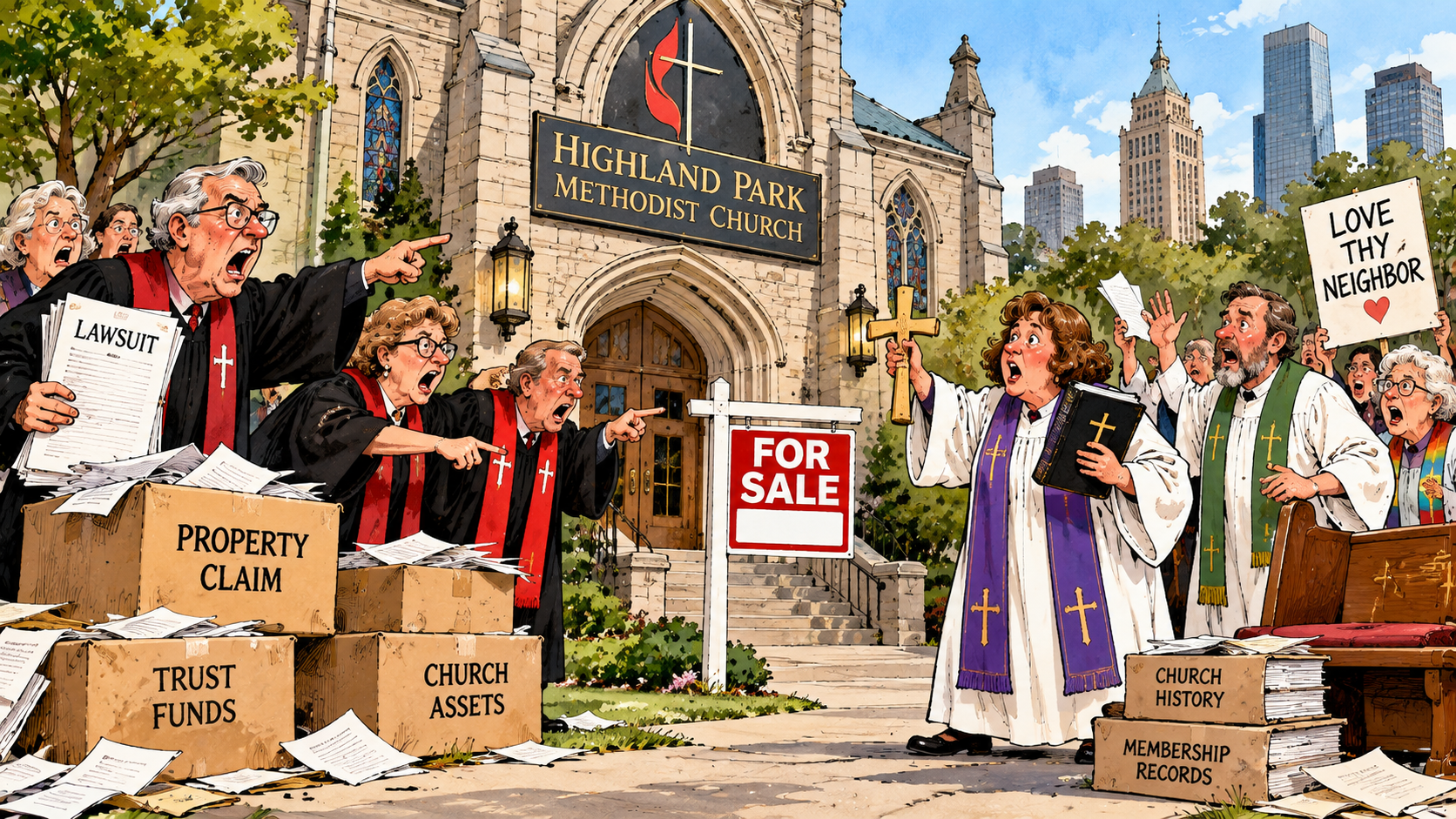
Methodists Preach Forgiveness, Then Sue Over the Building
Highland Park Votes 90% to Leave; Headquarters Requests Paperwork
DALLAS, Texas, October 28, 2026 — After generations of preaching love, forgiveness, unity and Christian brotherhood, the United Methodist Church has discovered that the only thing harder than loving your enemies is getting along with other Methodists.
Highland Park United Methodist Church, one of America’s largest Methodist congregations, voted 90.35% over the weekend to separate from its denomination following a dispute over church governance, denominational authority and property rights, United Methodist News reported. Of 4,775 votes cast, roughly nine in ten supported leaving.
That’s an impressive margin. Saddam Hussein used to get numbers like that, and even he never had to explain them to a bishop.
The congregation has served Dallas for 110 years, and its council governance arrangement dates to 1998. Several decades of cooperation turned out to be poor preparation for the discovery that church officials disagree about who is in charge. As of Sunday, the congregation worships under the name Highland Park Methodist Church, and the church council has set December 1 as the target date for finishing the separation.
The denomination responded the traditional Christian way: litigation. Jesus taught forgiveness. The Methodist bureaucracy prefers discovery, depositions and a permanent injunction.
DALLAS: Highland Park United Methodist Church
- Methodists can love their enemies all day long. Just not their enemies who have a key to the building. That’s where Jesus stops and the paralegal starts.
- Forty years of fellowship. Potlucks. Funerals. Casseroles. Taken down by four paragraphs of bylaws. Nobody ever lost a friend over a casserole. You lose them over Section 4.
- Jesus says turn the other cheek. The Methodist lawyer says, “Sure, but let’s get it in writing that it’s not a waiver.”
- They believe in forgiveness, absolutely. But there’s no statute of limitations on who owns the parking lot. That one’s forever. That’s the real eternal life.
- Methodists agree on eternal salvation. They can’t agree on who gets the parking lot. Heaven has no parking problems, which is how you know it isn’t Dallas.
Horizon Texas Conference Lawsuit: Love Thy Neighbor Has a Property Exception

The conflict began when the Horizon Texas Conference sued Highland Park over changes to the church’s corporate documents. The conference says the changes, made in 2022 and 2023, removed references to the United Methodist Church and the Book of Discipline and skipped the required procedures.
Church leaders said they were protecting their independence. Denominational officials said they were protecting Methodist governance. Both sides invoked religious principles, and both ended up in civil court.
The Bible offers plenty of guidance on love, mercy and humility. It says very little about the Texas nonprofit corporation law that now governs the matter.
Matthew 5:39 encourages turning the other cheek. A modern denominational administrator might respond, “Certainly. But turning the other cheek constitutes no waiver of our contractual or equitable rights.”
The situation resembles a 40-year marriage in which both spouses insist they still believe in love, but neither can remember who bought the refrigerator. Except this marriage involves thousands of Christians, valuable church property and enough lawyers to start a small congregation of their own.
United Methodist Church Split: Getting Along With Other Methodists Is the Hard Part
For decades, American Methodists have debated theology, morality, marriage, sexuality and biblical interpretation. Thousands of congregations departed amid those disagreements, and the denomination changed its policies on LGBTQ clergy and same-sex weddings in 2024.
Highland Park stayed through all of it. Its present dispute concerns governance rather than LGBTQ inclusion, according to the congregation’s leadership, and the distinction matters to them. After surviving arguments about the nature of Christian marriage, the congregation reached its breaking point over corporate bylaws.
Methodists can accommodate profound theological differences, it seems, provided nobody touches Section 4, Paragraph C of the administrative handbook.
The denomination’s governing rulebook is called the Book of Discipline. That’s an unfortunate title for an organization currently demonstrating how difficult it is to discipline itself.
Church leaders spent decades emphasizing unity. Now everyone agrees on one thing: the other side is responsible for destroying it.
Highland Park Gave $12 Million, and It Still Didn’t Buy Independence
According to Highland Park’s own account, the congregation contributed more than $12 million to the conference and other Methodist organizations over four years. That’s enough money to build churches, support ministries and purchase approximately three cups of coffee at a fashionable Dallas airport.
The church also reports helping launch 41 Methodist congregations during its history. Some parents have trouble persuading three children to attend Sunday school. Highland Park helped establish enough congregations to form a small denomination.
And now the parent organization and its exceptionally productive offspring are arguing over who controls the house. The bishop’s position emphasizes a shared denominational covenant and responsibilities that extend beyond any single congregation. Highland Park’s leadership emphasizes its right to govern local affairs.
It’s the oldest family argument in Texas.
“We love having you here, son. Now hand over the keys.”
Congregational Vote vs. Methodist Headquarters: Democracy Requires Permission
Highland Park members delivered a 90.35% vote in favor of separation. In ordinary American politics, that would be called an overwhelming mandate. In Methodist governance, it is the opening move in an argument over whether the voters were authorized to have a mandate.
The Horizon Texas Conference said in a statement that a congregational vote does not, by itself, sever a local church’s relationship with the United Methodist Church, as Baptist News Global reported. That is the conference’s stated reading of Methodist rules, not a final court judgment.
Still, imagine applying the arrangement to ordinary life. You resign from your job, and your boss explains that resignation requires approval from the Employee Continuation Committee. You sell your car, and the manufacturer informs you that ownership remains a shared covenant. You announce a divorce, and your spouse replies that marriage is a sacred connection and the relevant exit clause expired in 2023.
This is why lawyers love organizations with elaborate governing documents. Ordinary people can end an argument by walking away. Institutions can turn the same argument into a pension.
The Methodist Trust Clause: John Wesley Founded a Church, Not a Real Estate Trust
The denomination’s trust clause, rooted in the history of Methodism and its founder John Wesley, holds that local church property is held in trust for the benefit of the wider denomination. The principle is meant to preserve religious assets for future generations.
Highland Park disputes how denominational authority applies to its corporate arrangements under Texas law. These are legitimate legal questions. They are also awkward ones for an institution whose principal product is spiritual salvation. A Methodist congregation can promise eternal life with considerably less paperwork than it takes to establish who owns the fellowship hall.
Both sides claim to be preserving the same Christian mission. One wants to protect local autonomy. The other wants to protect shared accountability. Neither seems enthusiastic about surrendering its legal position.
Somewhere, a real estate attorney has found a new interpretation of the phrase “treasures in heaven.” The treasures may be in heaven, but the property deeds are in Dallas County.
Bishop Ruben Saenz Jr. and Highland Park Practice Reconciliation Through Attorneys
Bishop Ruben Saenz Jr. has publicly emphasized covenant, mutual accountability and the connections among Methodist congregations. “None of us owns Highland Park United Methodist Church,” he has said, as The Christian Post reported. Highland Park’s council says denominational actions destroyed its trust in the conference.
Both sides describe their positions in the language of Christian duty. The bishop wants unity. The congregation wants independence. The lawyers want everyone to keep talking.
A non-jury trial is scheduled for October 12, 2027. That gives the parties nearly a year to contemplate whether Jesus really intended Christian fellowship to culminate in a district courtroom.
One can imagine a special Methodist prayer: “Lord, grant us patience, humility and the wisdom to forgive those who trespass against us, while reserving all rights under applicable Texas law.”
Amen. And please initial every page.
Church Property Dispute: Forty Years of Fellowship, Then Separate Representation
The dispute offers a lesson in institutional behavior. Religious organizations preach principles that sound magnificent during Sunday services: love, forgiveness, unity, sacrifice, mutual respect. Then somebody changes the bylaws, and everyone discovers the practical limits of universal brotherhood.
Nobody is suggesting that churches should ignore legitimate property disputes. Congregations need governance, accountability and legal protection. But there is a comedic contradiction between telling parishioners to forgive their enemies and spending years fighting fellow Christians over documents.
Highland Park and the denomination could probably agree on most of the Ten Commandments. The difficulty begins when somebody introduces the eleventh:
Thou shalt not leave the denomination without permission from headquarters.
Exhibit A: Fellowship Hall Reservation Form, Fine Print
Printed on the back of Form 14-B, available at the church office and in the narthex:
FELLOWSHIP HALL RESERVATION: TERMS AND CONDITIONS
1. Use of the hall for reconciliation, forgiveness, or the sharing of peace does not constitute a waiver of any right, title or interest in the hall, its kitchen, or any folding table therein.
2. Coffee is provided in the spirit of unity and may be withdrawn upon notice of dissolution.
3. Parking is available in Lot C, subject to ownership.
4. Casseroles left on the premises after 90 days become the property of the trust.
5. Any person who turns the other cheek does so without prejudice. Please initial: ______
Exhibit B: One-Star Review of a Dallas Methodist Congregation
Posted to a popular review site on Tuesday morning:
★☆☆☆☆ Dale R., Dallas, TX
Came for salvation, left with a summons. The sermon was lovely and the choir was excellent. The greeter handed me a bulletin and a litigation hold notice. Parking is free but the title is not. Nobody could tell me whether the coffee belongs to the church, the conference or the trust. Would not recommend to anyone with a deed.
Response from the owner:
Thank you for your feedback. Your concerns have been forwarded to General Counsel. Please do not contact the church directly.
Exhibit C: Civil Courts Building Security Desk Log
Excerpt from the front desk log, Dallas County Civil Courts Building, a weekday in October:
SECURITY DESK LOG
08:15 Two men in matching navy suits arrive carrying eleven banker’s boxes marked BYLAWS. Cleared through screening.
09:40 Woman asks where to file a forgiveness. Directed to the clerk’s window. Clerk advised.
10:05 Man carrying a Bible asks whether it is admissible. Told to ask the judge.
11:30 Group of ushers reports a dispute over ownership of the offering plate. Referred to small claims.
13:12 Man in clerical collar offers the other cheek during metal detector screening. Screener asked him to remove his belt.
14:47 Choir arrives to sing in the corridor. Informed that singing within 100 feet of a courtroom requires leave of court.
15:20 Three people ask which side of the hallway is the Christian side. Both sides answered.
16:58 Building closed. Nobody reconciled.
Exhibit D: Itemized Invoice for Legal Services
Invoice issued to a Texas nonprofit corporation of the Methodist persuasion for the month of October:
PREWITT, HOLLIS & GANE, LLP
Invoice No. 2026-1041 | Matter: Defense of Ecclesiastical Autonomy
Description Hours Amount Review of the complete Book of Discipline 41.0 $25,625.00 Analysis of Matthew 5:39 for contractual effect 3.4 $2,125.00 Drafting of prayer with reservation of rights 1.2 $750.00 Attendance at Sunday service (client present) 1.5 $937.50 Photocopies of bylaws, four paragraphs, 212 sets $42.40 Fellowship hall coffee $18.00 Parking, Lot C (ownership disputed) $12.00 TOTAL DUE $29,509.90 Rate: $625.00 per hour. Payment due within 30 days. Late payments will be forgiven seventy times seven, then referred to collections.
Jesus Saves, but the Lawyers Keep Billing
The saddest part is that both sides still identify with the Methodist tradition. They continue to emphasize service, ministry, faith and Christian community.
Dozens of clergy and clergy family members even urged Highland Park members to reject the separation proposal and pursue reconciliation. Their appeal did not persuade the overwhelming majority who voted.
Now the institution that has spent generations encouraging people to resolve their differences must confront its own inability to agree.
Perhaps the Methodists should establish an annual Forgiveness Sunday. Everyone would gather, apologize, exchange handshakes and promise to love one another. Then the lawyers could meet Monday morning to decide whether those apologies constituted binding admissions.
The Methodists have already shown they can survive centuries of theological disagreement. What remains uncertain is whether they can survive a disagreement about who owns the building in which they discuss theology.
After all, Jesus fed five thousand people with five loaves and two fish. The modern church can feed an entire legal profession with one disputed set of bylaws.
And that may be the greatest Methodist miracle of 2026: turning forty years of fellowship into a lawsuit without anybody having to change religions.
10 Humorous Observations Behind the Story
- The church says everybody’s welcome. Leaving, though? You need a form. It’s a roach motel with a choir.
- Ninety percent vote. Everywhere else on earth, that’s a landslide. At Methodist headquarters, it’s a strongly worded suggestion.
- Twelve million dollars they gave. Twelve million! That buys you a lot of goodwill. It does not buy you the door. You can’t even pay your way out of a church, and they take cash.
- Pulpit says unity. Back office has a divorce department. Better lawyers than most marriages ever got.
- The Bible has 66 books. Turns out Methodist bureaucracy needed a 67th. Corporate governance. Chapter one: “In the beginning was the Bylaw.”
- Jesus flipped the tables of the money changers. Today he’d flip a table and get served.
- Nobody walks into church thinking, “I sure hope this ends in a non-jury trial.” Nobody. Okay, the lawyers.
- Forgive seventy times seven. That’s 490 times. Somebody mentions the deed, and they’re done by number twelve.
- Centuries of theological fights, and they survived all of it. Schisms, reformations, arguments about hymn tempo. Then a Texas nonprofit corporation walks in and the whole thing folds like a lawn chair.
- Father, Son and General Counsel. And the Holy Spirit? Still waiting on the invoice.
Reporting and Sources
- United Methodist News: Highland Park Votes to Leave United Methodist Church
- Religion News Service: One of the Largest UMC Churches in the Country Just Voted to Leave the Denomination
- Baptist News Global: Dallas Megachurch Overwhelmingly Votes to Leave UMC
- D Magazine: Why the United Methodist Church Is Suing Highland Park UMC
- KERA News: Highland Park UMC Votes to Leave United Methodist Denomination
- United Methodist Church: Book of Discipline, Paragraph 2501, Requirement of Trust Clause