

Americans Can Now Almost Afford a Doorbell.
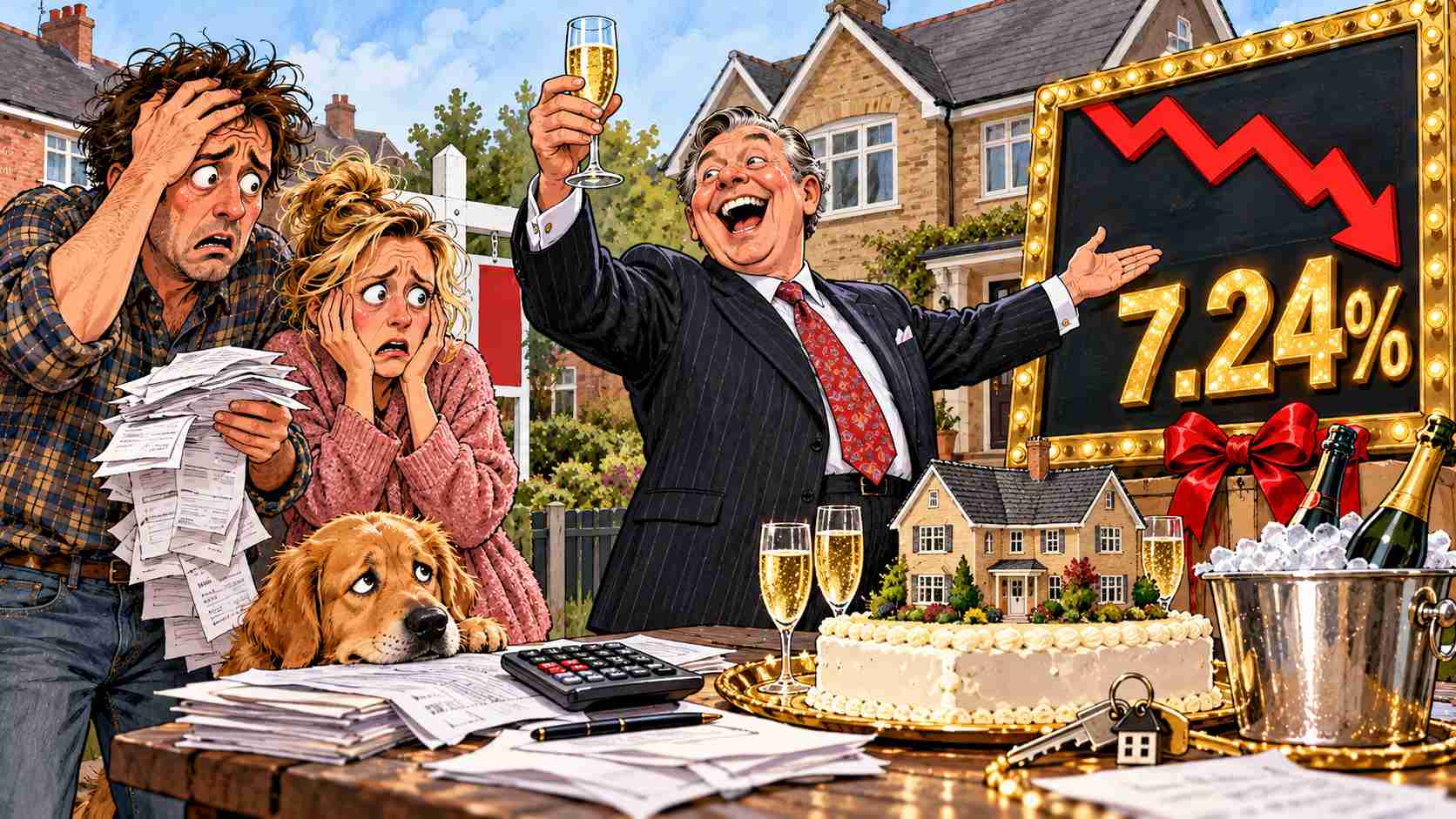
WASHINGTON, D.C. — America’s thirty-year mortgage rate declined to 7.24 percent, prompting real estate professionals to announce that the dream of homeownership is alive, provided the dream involves a small house, two jobs and a willingness to eat the curtains.
Freddie Mac’s Weekly Mortgage Rate Report
Freddie Mac reported on October 29 that the average rate had slipped from 7.32 percent the week before. That is a decrease of eight-hundredths of a percentage point, which sounds wonderful until somebody explains that an affordable house may still require the combined income of a surgeon, a corporate attorney and a moderately successful drug cartel.
A realtor celebrated the news by arranging balloons around a listing. “This changes everything,” she declared. Asked how much a buyer might save, she whispered, “Enough to get the better brand of paper towels, assuming they don’t use too many.”
Real Estate Listing Language, Translated
American real estate has developed a special language. A tiny house is “efficient.” A house next to a freeway is “well connected.” A damp basement is “potential additional living space.” A property that requires its own structural engineer is “perfect for someone with vision.” A price cut of three thousand dollars on a million-dollar property is “a stunning opportunity.”
Three Real Listings, Read Aloud
A listing for a one-bedroom described as “cozy, light-filled and full of character” included a photograph in which the character appeared to be a water stain in the shape of Ohio. A second, advertised as “ideal for the hands-on buyer,” lacked a roof in two of the photographs. A third, which offered “a rare opportunity to build equity,” was a parking space. Its agent said the square footage was “very competitive for a parking space.”
The nation’s young adults have consequently developed a new life plan: graduate, find work, pay rent, save diligently and then attend an open house where the kitchen island costs more than their grandparents’ entire first home.
What Really Drives Home Affordability
Low inventory, high prices, property taxes, insurance and borrowing costs all influence affordability. The mortgage rate is one moving part, not a magical switch that turns financial hardship into granite countertops. Even with a slightly lower rate, a purchaser must still produce a down payment and persuade a lender that thirty years of monthly payments sounds reasonable. The Consumer Financial Protection Bureau’s homebuying guide walks through the process, and the National Association of Realtors publishes the price data that explains why the guide is so long.
A Study of Down Payments
A study of first-time buyers found that the median household needed to save for a number of years that the researchers described as “longer than most pets live.” One participant reported she had saved for a down payment since the fourth grade. She is now thirty-four, and the house she wanted has been demolished and rebuilt as a different house that costs twice as much.
A first-time buyer asked the bank whether he could purchase just the garage. “Certainly,” the loan officer replied. “But you’ll need a co-signer for the automatic door opener.” The buyer inquired about a mailbox. The bank offered an adjustable-rate loan secured by his future children.
A Brief History of Rates That Felt Fine at the Time
Older homeowners recall rates in the early eighties that topped 18 percent and consider 7.24 percent a bargain. Historical precedent supports them, in the way that a doctor can reassure you that the other guy lost both legs. Back then, buyers could at least afford the house. They simply couldn’t afford the loan. It was a different era, and it came with a lot of cardigans.
To understand the excitement over an eight-basis-point move, imagine a restaurant reducing a hundred-dollar steak by eighty cents. The waiter bursts through the door announcing a golden age of affordability. Customers stand, applaud and order a glass of tap water because they still cannot afford the steak.
There are genuine reasons to welcome lower borrowing costs. Small changes can make a meaningful difference to some households, especially when prices and budgets are tight. But declaring victory over housing costs after a modest weekly movement is premature. Nobody ever moved into a house because a percentage point developed a slightly more agreeable personality.
The real estate industry keeps promising that the market is turning a corner. Unfortunately, the corner appears to be located inside a gated community that requires a financial statement to enter.
5 Humorous Observations About the Housing Market
- Seven point two four. They announce it like a touchdown. Seven point two four percent. That’s not a rate, that’s the percent chance I’ll ever afford a house with a yard. And they say it with a smile!
- Every house for sale has a “bonus room.” What’s a bonus room? It’s the room that’s not a room. It’s the room the seller couldn’t figure out what to call, so they gave it a prize.
- My parents bought their first house on a teacher’s salary and a handshake. I had to submit three years of tax returns, two letters of recommendation and a urine sample. And I still got the “pre-qualified” email like they were doing me a favor.
- The realtor says, “It’s a buyer’s market.” Whose buyer? I’ve been to forty open houses. I’m the only one who isn’t a hedge fund with a nice haircut.
- Thirty years. You take out a mortgage and you’re making payments until your kid’s kids are in college. That’s not a loan. That’s a marriage, and the house is the one who never takes out the trash.