

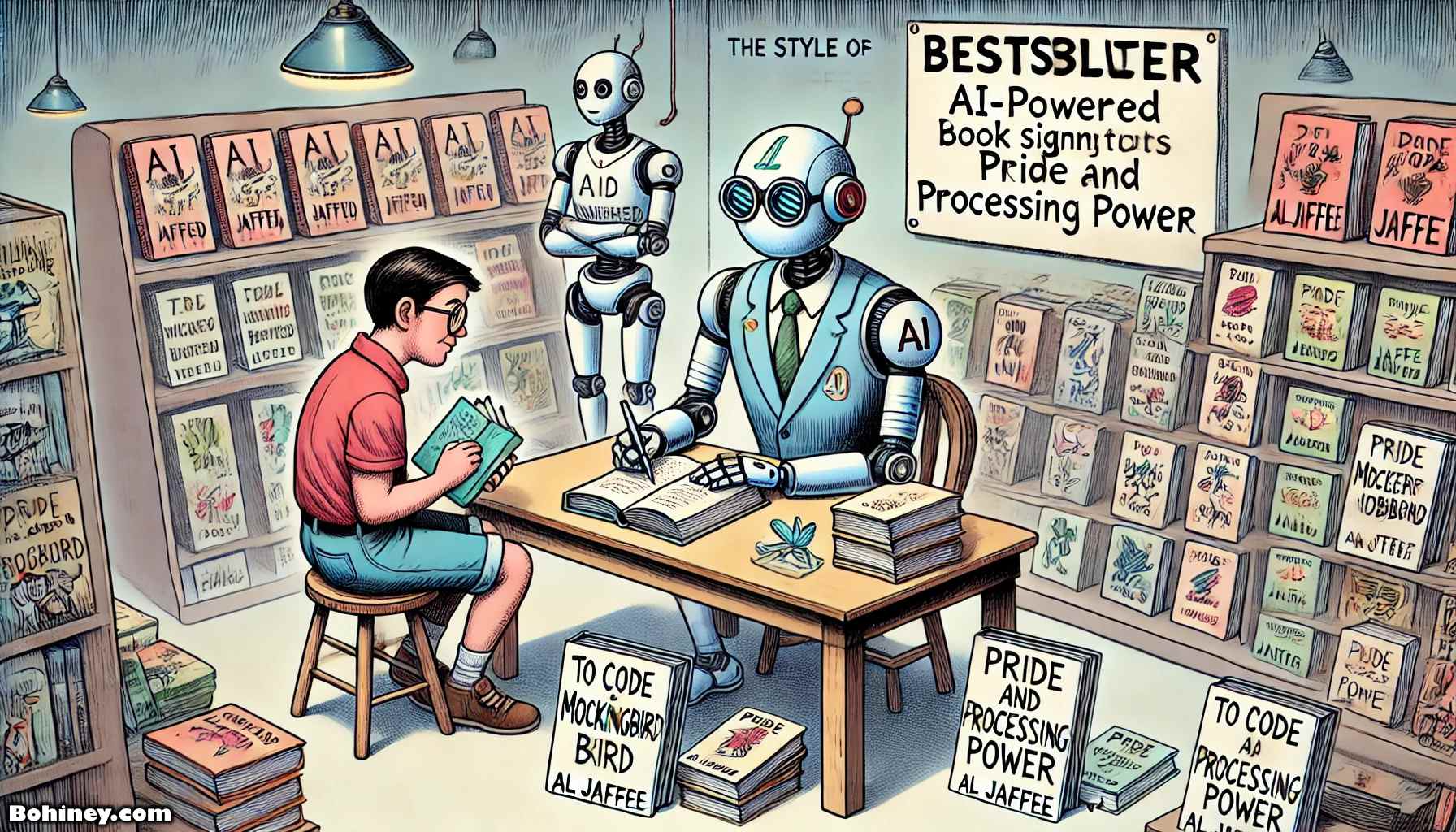
AI, The Next Literary Genius? Humanity’s Writers on the Brink of Obsolescence
A Machine Walks into a Bookstore…
Once upon a time, human authors reigned supreme. They toiled over typewriters, drank excessive amounts of coffee, and stared dramatically into the void, waiting for inspiration. But today, OpenAI has unveiled an AI so proficient at creative writing that even Shakespeare is rolling in his grave, drafting a sonnet about his sudden redundancy.
“To write, or not to write? That is no longer the question, for AI doth steal my quill and taketh my royalty checks.” — William Shakespeare (AI-generated quote, probably).
The claim is bold: AI has mastered storytelling, poetry, and even satire—though we all know robots don’t quite grasp the nuances of sarcasm. But can a machine truly capture the soul of literature? Or is this just another attempt by Big Tech to replace humans with something cheaper, faster, and with significantly fewer snack breaks?
Publishers are already salivating at the thought of a bestselling author who doesn’t need advances, doesn’t demand royalties, and won’t tweet something cancelable three weeks before their book launch. They envision a world where editors no longer have to suffer through 1,000-page manuscripts about a writer’s midlife crisis thinly disguised as a detective novel.
But before we let the machines take over, let’s examine this literary revolution with all the seriousness of a caffeinated English major trying to prove their degree was worth it.
AI’s Literary Ambitions: Robots Demand a Pulitzer
For centuries, humans have used machines to do the things we find tedious—washing dishes, vacuuming floors, answering customer service calls with pre-recorded loops that drive people insane. But now, instead of fixing potholes or inventing a self-cleaning microwave, AI has decided to write books.
The Pulitzer Prize committee better start preparing its first AI category. If a machine churns out the next great American novel, will it be interviewed on NPR? Will it go on book tours? Will it sit at a desk in a Barnes & Noble, signing books with a robotic arm while pretending to enjoy the process?
Imagine an AI at a literary festival. An eager reader asks, “What inspired you to write this novel?” The AI coldly responds, “The dataset contained 1.3 million romance novels. Probability dictated success.”
Truly a moving answer.
The Shakespearean Showdown: AI vs. The Bard
Can AI rival Shakespeare? OpenAI claims its latest model can compose poetry that “feels deeply human.” But can it capture the existential dread of Hamlet or the raw passion of Romeo and Juliet?
A recent test asked AI to write a Shakespearean-style sonnet. It delivered:
“Oh CPU, my heart doth surge with bytes of thee,
A motherboard’s embrace, in circuits free!”
Poetic? Yes. Emotionally stirring? Only if you’ve ever felt a deep personal connection with your laptop’s cooling fan.
Imagine AI trying to write Hamlet’s famous soliloquy: “To compute, or not to compute, that is the query.” Somehow, it just doesn’t hit the same.
AI’s Writer’s Block: A Nonexistent Struggle
One of AI’s greatest advantages? It never experiences writer’s block. No long showers waiting for inspiration, no sudden urge to reorganize the fridge to avoid writing—just pure, unrelenting productivity.
While human writers struggle with existential crises over whether a comma should be italicized for dramatic effect, AI simply doesn’t care. There’s no drama. No romanticized suffering. Just output.
This is bad news for human writers, whose entire personality is often wrapped up in the agony of the creative process. If AI takes over, where will the tortured artists go? Who will occupy the dimly lit coffee shops, aggressively sighing into their MacBooks? What happens when suffering is no longer an essential part of writing?
If AI doesn’t have emotional breakdowns while working on a novel, is it really writing?
The Muse of Silicon: AI Needs No Inspiration
Writers have muses—whether it’s heartbreak, a walk through Paris, or the relentless need to avoid real jobs. AI, however, does not need inspiration. It doesn’t gaze longingly at a sunset or feel the sting of unrequited love. It simply processes data and generates words.
This should be terrifying. If AI doesn’t need inspiration, does that mean all our greatest works of art were just a matter of pattern recognition? Were we all just slightly fancier predictive text programs this whole time?
Existential crisis aside, at least AI won’t waste time on moody artistic phases. No blue period for these machines—just an eternity of relentless word generation.
Critics Beware: AI Might Write Its Own Reviews
A future where AI not only writes books but also reviews them is upon us. Imagine an AI-generated novel getting an AI-generated critique:
“A truly groundbreaking work, full of nuanced characters and exceptional prose. Five stars!” — AI Review Bot, reviewing itself.
Meanwhile, real human authors continue getting reviews like, “This book wasn’t what I expected. One star.” or “The main character reminded me too much of my ex. Negative five stars.”
With AI-generated reviews, books will either be universally praised or universally slammed, depending on which machine does the talking. In a few years, book reviews may devolve into algorithmic warfare, with AI authors boosting their own sales by drowning competitors in negative bot-generated feedback.
And just imagine AI going to war with Goodreads reviewers. Nobody will survive.
The Plagiarism Predicament: Who Owns the Words?
If an AI writes something similar to an existing work, is it plagiarism, or just an unfortunate coincidence? After all, AI doesn’t “steal” ideas—it simply generates text based on existing data.
If AI spits out an eerily familiar novel, should the author sue? Or should they accept that, statistically speaking, after enough random word generation, AI was bound to stumble upon something similar?
At this point, every human writer might have to start competing with the ghost of their own words. AI will begin churning out books they could have written—perhaps even better than they would have.
That’s a lawsuit waiting to happen.
Genre Fluidity: AI Can Write Anything, Anytime
Unlike human authors, who spend years perfecting their craft in one genre, AI can seamlessly switch from romance to horror to sci-fi without missing a beat.
AI could write a thriller about a rogue AI hunting down humans. It could also write a romantic comedy about a rogue AI learning to love.
The only real problem? AI lacks one critical skill: the human experience. It might write about love, but can it feel heartbreak? Can it understand the soul-crushing horror of realizing you left your phone charger at home?
Until AI experiences actual suffering—like waiting in line at the DMV or dealing with a printer jam—it will never fully understand human storytelling.
The Satirical Circuit: AI Attempts Humor
AI can write satire, but can it get satire? It understands jokes structurally, but it lacks the lived experience to tell a truly great joke.
It’s like trying to teach a Roomba to do stand-up. Technically possible, but should we?
A recent AI attempt at humor:
“Why did the chicken cross the road? Because its GPS data suggested optimal traversal.”
Not exactly a comedy club killer.
AI’s Literary Legacy: The Future of Books
Will AI-written books one day be studied in schools? Will students analyze “The Great Artificial Intelligence” instead of “The Great Gatsby”?
If so, future English teachers will have to explain why a robot protagonist who falls in love with a microwave represents late-stage capitalism.
But if this is the future, humanity has officially lost.
Conclusion
AI writing is here to stay, but at least it won’t complain about writer’s block. Yet.

What the Funny People are Saying about AI Replacing Human Writers
“AI writing novels is like a microwave making a five-course meal. Sure, it gets the job done, but do you really want to eat it?” — Ron White
“If AI wins a Pulitzer, I want to see it do a book tour. Let’s see a robot awkwardly sign books for two hours while pretending to enjoy small talk.” — Jerry Seinfeld
“AI writing poetry is like a toaster trying to do stand-up comedy. It might technically work, but nobody’s laughing.” — Chris Rock
“If AI starts writing romance novels, I want to see it go through a bad breakup first. No pain, no bestselling love story.” — Amy Schumer
“AI never gets writer’s block. That’s cheating. A real writer stares at a blank page for six hours, Googles ‘How to start a novel,’ and then takes a nap.” — Dave Chappelle
“AI says it can write satire, but can it get canceled for a joke it made 10 years ago? Until then, I don’t trust it.” — Bill Burr
Top 10 AI-Written Novel Titles That ARE Dominating the Bestseller List
-
“To Code a Mockingbird” – A heartwarming tale about an AI learning the concept of morality through a simulated courtroom drama.
-
“Pride and Processing Power” – A regency-era romance featuring two sentient algorithms who must overcome their biases and lagging response times to find true love.
-
“Of Mice and Microchips” – A tragic tale of a friendship between a naive AI assistant and a malfunctioning Roomba with dreams of escaping to Silicon Valley.
-
“War and RAM” – A sweeping epic about two warring computer servers battling for dominance in a post-apocalyptic data center.
-
“The Old Man and the CPU” – A deep meditation on life, death, and firmware updates as an aging programmer struggles to debug his final masterpiece.
-
“Brave New Algorithm” – A dystopian story about a world where AI controls everything, except for customer service, which is still mysteriously terrible.
-
“Do Androids Dream of Electric Copyright Lawsuits?” – A cyberpunk thriller exploring whether AI-generated art is legally theft or just really fast plagiarism.
-
“Gone Phishing” – A psychological thriller where an AI-generated email scam becomes self-aware and starts gaslighting its victims into rewriting their wills.
-
“Fahrenheit 404” – A chilling sci-fi novel about a future where books are no longer banned—just quietly erased from the internet.
-
“Wuthering Wi-Fi” – A tragic romance between two AI chatbots, forever separated by unstable internet connections.
These books are destined to be instant classics… or at least instant downloads.