

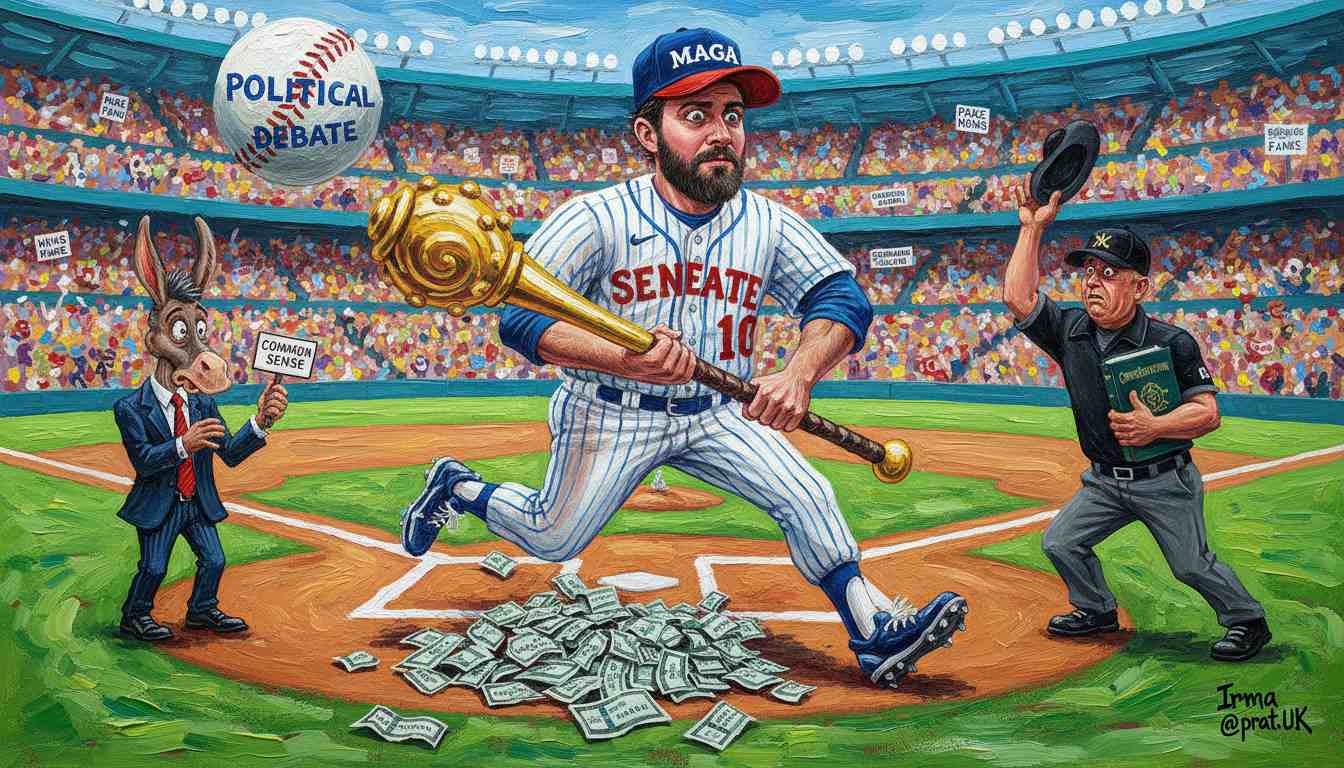
Put Me In, Coach: America Sends JD Vance Into Game 7 of Diplomacy
There are moments in history when a nation looks at its bench, scans the roster, and says, “You know what? Send in the guy who looks like he just finished a podcast about supply chains.” And that’s how JD Vance ended up heading to Islamabad to negotiate peace with Iran — a geopolitical situation so delicate it comes with a two-week return policy.
The assignment is simple in the way assembling IKEA furniture is simple: stop a war, stabilize a region, and maybe don’t accidentally trigger three more conflicts while asking where the Allen wrench went.
Recent reports confirm that Vance is leading high-stakes peace talks amid what officials are calling a “fragile ceasefire” — which is diplomatic code for “everyone agreed to pause while still being extremely mad.”
Diplomacy, But Make It Pickup Basketball
According to insiders, the entire situation has taken on the energy of a rec center basketball game where nobody actually agreed on the rules.
One anonymous staffer described it as: “We’re technically playing, but half the players are arguing about fouls, one guy brought his own ball, and Iran keeps saying the scoreboard is emotionally inaccurate.”
Pakistan, acting as host, has essentially become the world’s most stressed Airbnb owner. Officials there reportedly welcomed delegations from both sides while quietly Googling, “How to mediate nuclear tension without snacks running out.” Al Jazeera reports that Pakistan’s army chief, Field Marshal Asim Munir, has been in direct contact with Vance — apparently the one person in this situation willing to take the call.
The “Fragile Truce” Diet Plan: Holds Together Like a Gas Station Burrito
Experts say the ceasefire is holding together the way a gas station burrito holds together: barely, and only if you don’t apply pressure.
The two-week pause was brokered with help from Pakistan and is intended to create space for negotiations. But already, both sides are treating the agreement like a New Year’s resolution — technically in effect, spiritually optional.
A senior diplomatic analyst explained: “A fragile truce means both parties agree not to escalate, while continuing to escalate in ways that don’t technically count as escalation. It’s very advanced.”
CNN reports that the two sides are still “far apart and still trading barbs” — which is either the beginning of a peace deal or the beginning of a strongly-worded LinkedIn post.
Vance: The Unexpected Team Captain Nobody Drafted But Everyone Needs
What makes this even more fascinating is that Vance has somehow become the guy Iran is most willing to talk to — which is like discovering your least talkative coworker is secretly the office therapist.
Sources say this is because he has “his own views” and doesn’t sound like a standard diplomatic script generator. Translation: he might say something unpredictable, which in international relations is either refreshing or catastrophic.
Vance himself told reporters boarding his flight: “If the Iranians are willing to negotiate in good faith, we are certainly willing to extend an open hand. If they’re going to try to play us, they’re going to find that the negotiating team is not that receptive.” The diplomatic community immediately parsed this as somewhere between “olive branch” and “I did not come all the way to Pakistan to be gamed.”
One regional expert put it bluntly: “He’s not the usual negotiator. That’s either why this will work… or why we’ll all be learning new geography.”
Meanwhile, Back at the War: Two Tabs Open in the Browser of History
While talks are being scheduled, rescheduled, and possibly RSVP’d with “Seen,” the conflict itself has continued in that uniquely modern way where war and diplomacy run simultaneously like two tabs open in a browser.
Missiles, ceasefires, sanctions, meetings — everything is happening at once, like a group project where nobody agreed on the topic but everyone already submitted their part.
Even the ceasefire has fine print. Some parties believe it applies to certain regions, others believe it applies to vibes, and at least one country believes it applies retroactively if things go well.
The Washington Times notes that Trump wants Iran to stop funding terror proxies — which is a fair ask, in the same way asking someone to stop bringing fish to an open-plan office is a fair ask. Technically reasonable. Historically optimistic.
Pakistan: The Reluctant Referee Who Just Wants Everyone to Sit Down
Pakistan’s role in all this is less “neutral mediator” and more “parent separating two siblings while also hosting dinner.”
Officials there reportedly worked around the clock to prevent talks from collapsing, at one point coordinating between multiple countries while whispering, “Please just sit down and talk like normal superpowers.” Arab News reports that Pakistan’s Interior Minister Mohsin Naqvi personally confirmed Vance’s attendance — a level of scheduling effort usually reserved for rock concert tours, not nuclear diplomacy.
So far, Pakistan has succeeded in doing what few others could: getting everyone into the same room without anyone immediately storming out. That alone has earned them early MVP consideration.
The Logistics of Peace: When Calendar Coordination Determines World History
Behind the scenes, the real challenge isn’t just diplomacy — it’s scheduling.
One source close to the negotiations described the situation: “We have Iran, the U.S., regional allies, multiple time zones, ongoing military activity, and at least three people who might not show up. At this point, peace depends entirely on calendar coordination.”
There were even rumors that Vance might skip the talks due to “security concerns,” which in diplomatic language means either actual danger or someone read the itinerary and said, “Let’s maybe Zoom this.” NPR notes that Vance’s involvement carries political upside too — if he clinches a deal, it’s a 2028 presidential campaign ad that writes itself. If he doesn’t, well, he can always blame the scheduling.
What the Funny People Are Saying About Islamabad’s Biggest Weekend
“This whole thing feels like when your friend says, ‘Let’s all calm down,’ right after throwing the first punch.” — Jerry Seinfeld
“You ever notice how peace talks always happen right after everybody’s already fought? It’s like apologizing after you’ve already flipped the table.” — Ron White
“I like that we call it a ‘fragile truce.’ That’s not a truce, that’s a situationship.” — Amy Schumer
The Stakes: No Pressure, Just the Entire Middle East
Make no mistake — this isn’t just another diplomatic meeting. Axios describes this as the highest-level U.S.-Iran meeting since the 1979 Islamic Revolution — which means the last time these two countries sat down at a table this important, disco was still on the charts and nobody owned a cell phone.
And sitting at the center of it all is a man who, metaphorically speaking, just got subbed into the game with the crowd yelling, “Don’t mess this up!”
Final Whistle Energy: A Handshake or a Press Conference?
So here we are.
A fragile ceasefire.
A high-stakes meeting in Pakistan.
A vice president stepping onto the global court like it’s overtime.
Put me in, coach. I’m ready to play.
The only question now is whether this ends in a handshake… or a post-game press conference where everyone insists things went “very constructively,” which is diplomatic for “nobody flipped the table this time.”
Either way, the world watches.
And somewhere, quietly, Pakistan is checking if it’s too late to cancel the reservation.
Vice President JD Vance departed for Islamabad, Pakistan on April 10, 2026, to lead the first direct U.S.-Iran talks since the 1979 Islamic Revolution. The talks follow a two-week ceasefire brokered with Pakistan’s help after weeks of military conflict involving the U.S., Israel, and Iran. Vance was accompanied by special envoy Steve Witkoff and Jared Kushner. Iran’s apparent preference for Vance — viewed as less hawkish than other officials and a known skeptic of foreign intervention — helped elevate him to lead negotiator. Pakistan’s army chief, Field Marshal Asim Munir, has served as the primary go-between. The outcome could determine whether the region stabilizes or re-escalates, and carries significant implications for Vance’s political ambitions ahead of 2028. Auf Wiedersehen, amigo!
