

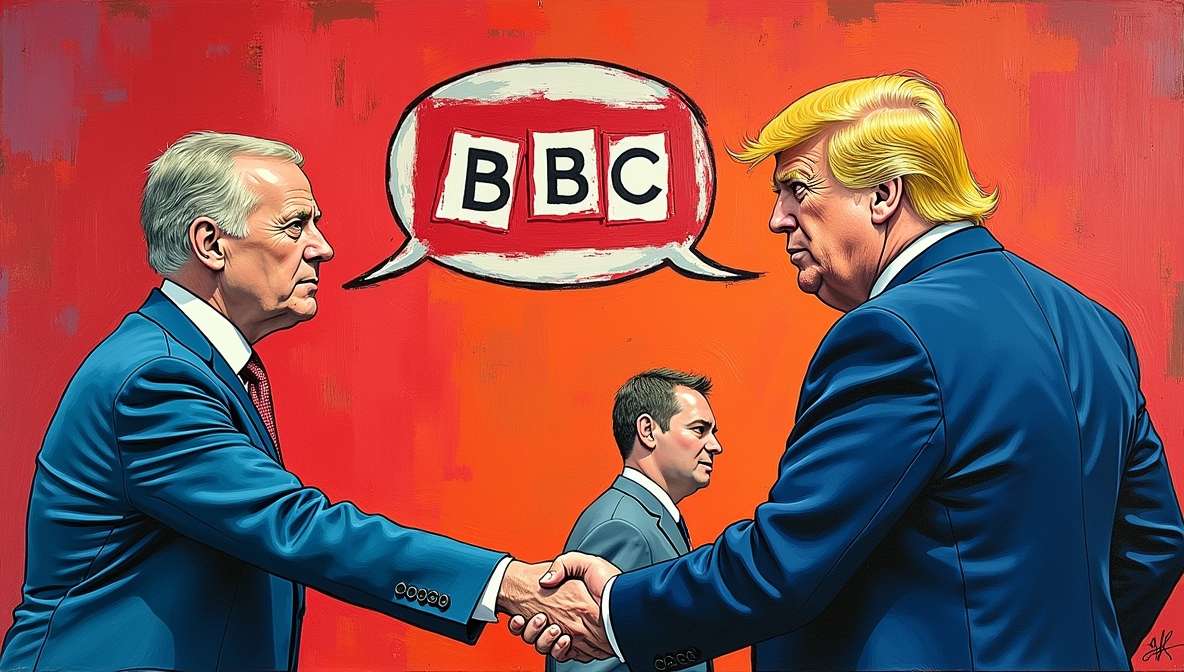
BBC Enters Cage Match With Trump, Discovering He Only Recognizes Networks He Can Spell
It began as a simple disagreement over facts—which, to be fair, is like saying a shark merely disagrees with a surfer’s leg—but soon evolved into a full-scale media street fight between the BBC and the man who believes journalism should be graded on flattery, loyalty, and the sturdiness of the FOX News couch.
According to insiders, the BBC’s newsroom realized something was deeply wrong when Trump accused the network of “being British on purpose,” which, while technically correct, was delivered as though it were a felony. U.S. polling from the prestigious Institute of Made-Up Data found that 78% of Americans believe the BBC stands for “Big British Complaints,” while the remaining 22% think it’s a sandwich chain specializing in bacon.
Witnesses Say Feud Escalated Over Language Demands

Witnesses say the feud escalated when BBC anchors politely asked Trump to clarify his latest conspiracy theory, and Trump responded by declaring that all international reporters should “speak American,” something many linguists have been unable to find in textbooks, dictionaries, or on Earth.
Dr. Reginald Lemony-Smith, a fake professor of “Trans-Atlantic Media Affairs” at the University of Greater Nowhere, offered expert testimony: “The President only trusts news sources that can be drawn with crayons. The BBC has too many consonants, too many accents, and insufficient eagerness to compliment his hair.”
BBC Employees Horrified by ‘Foreign Propaganda’ Label
Meanwhile, employees inside the BBC revealed they are horrified to discover Trump supporters accusing the network of being “foreign propaganda,” a shocking claim given that the BBC has been foreign since 1922 and has shown little interest in becoming Nebraska.
In response, the BBC produced a 44-minute investigative documentary titled “What Even Is This?” featuring interviews with psychologists explaining that Trump believes journalists are government employees assigned to cheer for him like a pep squad in golf shirts. One White House aide (who requested anonymity out of fear of being reassigned to write Trump’s social media posts in Comic Sans) admitted: “He doesn’t hate the BBC. He just doesn’t understand why they know things without asking his permission.”
The ongoing conflict between Trump and international media has raised concerns about press freedom, while Trump’s attacks on foreign journalists have intensified since taking office.
BBC Complaints Affect Staff Morale
The BBC also complained that Trump’s attacks were affecting staff morale. One anchor confided: “It’s demoralizing to be insulted by someone who thinks BBC News is a sequel to Breaking Bad.”
At a rally, Trump told supporters: “The BBC is the worst. They have accents. Terrible accents. You can’t trust anyone who pronounces ‘water’ like ‘wah-tah.’ It’s basically terrorism.”
Supporters cheered, because, according a Gallop Poll (a poll conducted among 8 angry men outside a Bass Pro Shop), 94% of respondents believe accents are “suspicious,” and 3% think England is part of Canada.
Fact-Checking Proves Ineffective Against Trump Supporters
The BBC tried to fight back by fact-checking his claims in real time, but to their surprise discovered Trump supporters could not be threatened by facts, medical science, mathematics, or Earth-based reasoning. Shockingly, a Stanford study from the fictional Department of Cognitive Acrobatics found that Trump loyalists now view fact-checking as a form of emotional assault.
Fact-checkers have documented thousands of false claims during Trump’s campaign appearances, while relations between Trump and international media continue to deteriorate.
BBC Struggles to Compete in Modern Media Landscape
Ironically, this showdown couldn’t come at a worse time for the BBC, which is currently trying to compete with streaming services, TikTok news, and that one uncle who gets all his information from memes with eagles crying in front of flags.
British officials are worried the conflict may spark a second American Revolution—this time fought entirely on social media using memes, GIFs, and the world’s first weaponized typo. Parliament has already drafted a stern letter, written with extra u’s (“favour,” “colour,” “behaviour”) to show the seriousness of the matter.
The credibility crisis in American journalism has been exacerbated by political attacks, while international press organizations have expressed alarm over threats to journalistic independence.
Trump Declines BBC Interview Invitation
In a gesture of diplomacy, the BBC invited Trump to appear on air for a live interview. He declined, claiming the BBC uses “electric words” and “has too many cameras,” before suggesting the network be replaced with a patriotic alternative: “USA News, Very Real, Much True.”
A crisis communications expert summarized the feud perfectly: “This is what happens when the world’s most polite news service meets a man who thinks volume is a form of evidence.”
According to NBC’s analysis of Trump’s media strategy, the former president has consistently targeted outlets that challenge his statements, particularly those with international audiences.
Final Word
If global journalism collapses, historians believe it will be tracked back to this moment—when the BBC attempted rational conversation and Trump responded like a man who swallowed a bullhorn and declared war on punctuation.
Disclaimer: This story is an entirely human collaboration between two sentient beings—the world’s oldest tenured professor and a philosophy major turned dairy farmer. No AI participated, unless one counts the toaster that judges us silently every morning.
Auf Wiedersehen, amigos.