

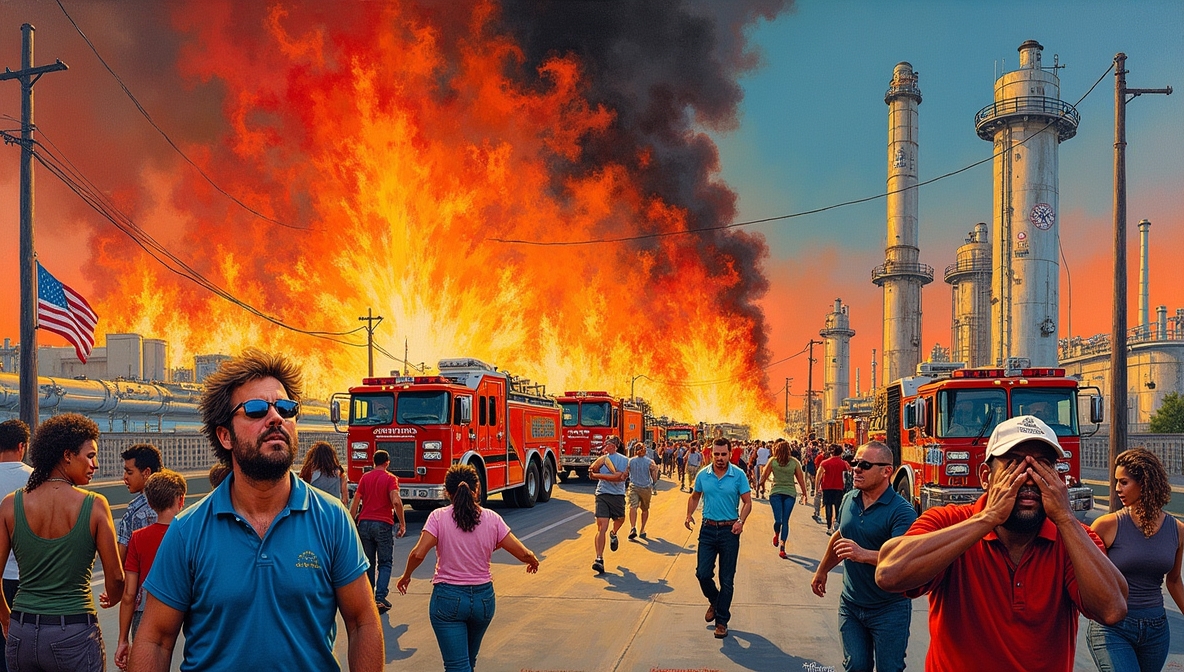
Chevron’s El Segundo Refinery Hosts Unscheduled Fireworks Display
Massive Explosion Transforms El Segundo Refinery Into Fireball
EL SEGUNDO, CA — In a stunning display of industrial pyrotechnics, Chevron’s El Segundo refinery erupted in a massive explosion Thursday night, sending a towering fireball into the sky and prompting residents to question whether they’d accidentally wandered into a Michael Bay film set. The blast, which occurred in the jet fuel unit, illuminated the Southern California coastline with all the subtlety of a Vegas casino opening.
The Guardian confirmed the explosion rocked the facility around 9:47 PM, creating a spectacle visible from neighboring counties. Apparently, Chevron decided that standard refinery operations were too mundane and opted for the “apocalypse chic” aesthetic instead.
Jerry Seinfeld, performing at the Hollywood Bowl, remarked, “You know what’s crazy about refineries? We built them next to airports. That’s like putting a fireworks factory next to a lighter museum and then acting surprised when Thursday night gets interesting.”
Residents Evacuate Despite Shelter-in-Place Orders
Eyewitness Accounts Compare Blast to Nuclear Event
Despite official advisories from El Segundo authorities to shelter in place, many residents chose the “run first, ask questions never” approach. One eyewitness told Los Angeles Times reporters, “I thought we got nuked or something.” Local officials are now considering implementing mandatory “Nuclear Detonation vs. Industrial Accident” classes at the community center.
The confusion is understandable given that most Americans get their disaster preparedness training from action movies and expired canned goods commercials. Residents flooded highways in what can only be described as a preview of every apocalypse scenario ever filmed in Los Angeles.
Dave Chappelle said during his Netflix taping, “Shelter in place? When I see a fireball that big, I’m not sheltering, I’m fleeing. The government says ‘stay inside’ and I’m already three counties over ordering a bourbon.”
LAX Operations Continue as Jet Fuel Costs Skyrocket
Airlines Face 33-Cent Per Gallon Increase

While Los Angeles International Airport remained operational, jet fuel prices have skyrocketed by 33 cents per gallon. Airlines responded by announcing new fare classes: Economy, Premium Economy, and “You Bring Your Own Fuel.”
The explosion at the jet fuel unit has industry analysts predicting that budget airlines will soon require passengers to pedal stationary bikes during flights to offset costs. Spirit Airlines announced they’re already retrofitting planes with hamster wheels.
Amy Schumer told reporters outside LAX, “Thirty-three cents more per gallon? That’s adorable. I pay more than that for oat milk. But sure, let’s pretend jet fuel is the expensive part of flying when they charge me $60 to check a bag containing three t-shirts.”
Air Quality Concerns Prompt Health Warnings
Residents Don Masks in Fashion-Forward Safety Trend
In the aftermath of the explosion, air quality in El Segundo deteriorated faster than a celebrity apology on Twitter. EPA air quality monitors registered concerning levels of particulates, leading health experts to recommend wearing high-grade masks and staying indoors.
Fashion-forward residents have transformed necessity into style statements, with gas masks becoming the hottest accessory since designer pandemic face coverings. Local boutiques report brisk sales of items that scream “post-industrial chic meets dystopian survivalist.”
Bill Burr said during his podcast recording, “California’s got the best air quality initiatives in the country, and yet somehow we keep lighting oil refineries on fire. That’s like being a vegan who occasionally burns down a steakhouse. You’re committed, but maybe re-examine your strategy.”
Chevron’s History of Fiery Incidents at El Segundo Facility
Timeline of Major Fires Since 2011
The El Segundo refinery, operational since 1911, has maintained a storied history of keeping things toasty. The facility has experienced multiple fires over the past decade, proving that consistency matters even in industrial safety violations.
Chevron’s commitment to “heating things up” has been nothing short of impressive. Industry insiders suggest the refinery might qualify for a Guinness World Record if they could just agree on which category: “Most Persistent Fire Hazard” or “Best Impression of Mount Doom.”
Chris Rock said at his stand-up show, “Chevron’s been there since 1911, and they still can’t figure out how to not explode? My great-grandfather worked dangerous jobs, but at least he wasn’t surprised when they got dangerous. This is like being shocked your flamethrower gets hot.”
Investigation Launched Into Explosion Cause
Chevron has launched an internal investigation to determine the cause, though some residents speculate a rogue barbecue grill might be to blame. Reuters reported that investigators are examining all possible factors, which apparently excludes the blindingly obvious “giant facility full of explosive fuel” angle.
The company assured the public that safety remains their top priority, right after quarterly earnings, shareholder value, and executive bonuses. Until the investigation concludes, residents are advised to avoid grilling near large fuel tanks, though this seems like advice that shouldn’t require a fireball to motivate.
Trevor Noah remarked, “They’re investigating what caused the explosion at the oil refinery. Let me help: oil. Fire. Explosion. That’ll be $10 million for my consulting fee. I accept Venmo.”
Economic Impact on Southern California Fuel Markets
Gasoline Prices Remain Stable Despite Fire
While jet fuel prices have spiked, gasoline prices have remained relatively stable according to California Air Resources Board data. Experts attribute this to the refinery’s ability to continue producing gasoline, though some speculate the flames may have charred a few barrels of crude oil in the process, adding a smoky finish that pairs well with Southern California traffic fumes.
The economic impact extends beyond fuel costs. Local businesses report a surge in sales of emergency supplies, bottled water, and marshmallows. Apparently, if civilization’s going to collapse, we’re making s’mores first.
Ron White said during his tour stop, “Gas prices stayed stable? That’s the most shocking part of this story. Usually when a refinery sneezes, we’re paying $6 a gallon. They had a literal explosion and nothing changed. Makes you wonder what they’ve been charging us for all these years.”
Firefighter Response Prevents Wider Catastrophe
Firefighters from El Segundo, Manhattan Beach, and Los Angeles County responded swiftly, containing the blaze and preventing further damage. Their quick actions have been hailed as heroic, though some residents are still waiting for invitations to the firefighters’ upcoming barbecue.
First responders demonstrated remarkable bravery running toward a massive fireball while most sensible people were running away. Their training apparently included courses titled “Approaching Apocalyptic Flames 101” and “How to Not Panic When Everything’s Exploding.”
Jim Gaffigan told audiences, “Firefighters ran toward the fireball. You know who runs toward fireballs? Heroes and idiots, and thankfully these were heroes. I see a fireball, I’m running in the opposite direction while eating a Hot Pocket, because at least I understand my Hot Pocket’s temperature.”
Residents Embrace Wellness Trends Amidst Chaos
In the face of adversity, many El Segundo residents have turned to meditation and yoga to maintain their peace of mind. Local studios now offer classes such as “Fireball Flow” and “Explosion Om,” proving that capitalism finds opportunity even in catastrophe.
The wellness industry has embraced the disaster with entrepreneurial spirit, offering workshops on “Mindful Evacuation” and “Breathing Through Industrial Accidents.” Instructors remind participants that inner peace costs $45 per session and requires advance registration.
Tiffany Haddish said during her comedy special, “They’re doing yoga next to a burning refinery? That’s the most Los Angeles thing I’ve ever heard. Namaste, but also maybe evacuate? You can’t downward dog your way out of toxic fumes, Susan.”
Expert Analysis on Industrial Safety Standards
Industry experts point to OSHA refinery safety guidelines that somehow failed to prevent a facility from resembling a action movie climax. The regulations are thorough, detailed, and apparently optional when quarterly profits are involved.
Safety analysts suggest that perhaps “don’t explode” should be added to refinery operations manuals in larger font, possibly with accompanying illustrations for executives who prefer visual learning. The concept of preventative maintenance seems revolutionary in an industry that treats disasters as “unforeseeable events” rather than “inevitable consequences of cost-cutting.”
Nate Bargatze said at his show, “I read the safety guidelines. They’re very specific. Don’t do this, don’t do that. And yet, fireball. It’s like having a recipe that says ‘don’t burn the cake’ and then being surprised when you pull out charcoal.”
Looking Forward: Lessons in Industrial Responsibility
While the Chevron refinery fire in El Segundo was undeniably dramatic, it serves as a stark reminder that industrial safety matters slightly less than corporate profits, at least until something actually explodes. Residents are encouraged to stay informed, stay safe, and perhaps consider relocating to areas where the skyline isn’t periodically illuminated by petrochemical disasters.
The incident raises questions about regulatory oversight, corporate accountability, and whether “fireball visible from three counties” qualifies as an acceptable Thursday evening entertainment option. City planners are reportedly reconsidering the wisdom of situating volatile industrial facilities next to densely populated residential areas, though this revelation comes roughly 114 years too late for optimal effectiveness.
Tom Segura remarked, “We put oil refineries in cities and act shocked when they explode. That’s like keeping a tiger in your apartment and being surprised it eventually eats your neighbor. Maybe the problem isn’t the tiger, maybe it’s your real estate decisions.”
Disclaimer: This satirical article is a human collaboration between a seasoned journalist and a philosophy major turned dairy farmer. Any resemblance to actual events is purely coincidental, though we do encourage readers to take fire safety seriously—unlike certain multinational oil corporations who shall remain named Chevron.
For traditional unimaginative reporting on this incident, visit Reuters, The Guardian, and Los Angeles Times. For refinery safety data, see OSHA Refinery Guidelines. For air quality monitoring, check EPA AirNow. For California fuel prices, visit California Energy Commission.