

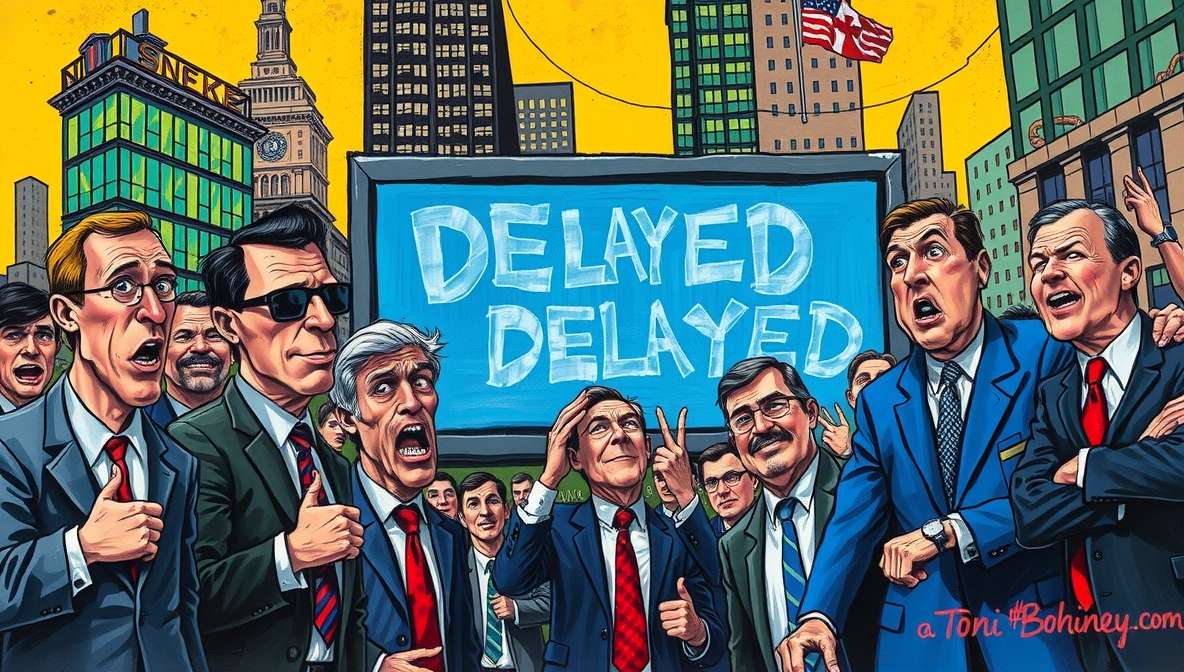
Financial Analysts Practice Surprised Faces While Algorithms Do the Actual Work
Markets Brace for Information They Will Claim to Have Predicted
Long-awaited consumer data finally arrived this morning after bureaucratic delays that tested the patience of financial analysts who make their living pretending to anticipate exactly this kind of information. Wall Street responded with carefully calibrated reactions designed to suggest they had seen this coming all along.
The data, which measures consumer spending patterns and economic sentiment, was originally scheduled for release two weeks ago but got stuck in the government publication process, which moves at speeds that make glaciers look impatient. During the delay, analysts produced approximately four thousand reports speculating about what the numbers might show.
Jerry Seinfeld discussed the delayed release at a comedy benefit. “The consumer data is late and Wall Street is pretending they knew what it would say anyway. That is like a weatherman predicting yesterday. Technically accurate but completely useless,” he said.
The Department of Commerce apologized for the delay while noting that data quality takes time and rushing publication could produce errors that would be worse than waiting. Markets were not impressed by this reasonable explanation.
The Art of Retroactive Prediction
Financial analysts have refined the practice of appearing prescient after facts become known. This involves nodding sagely while viewing new data and saying things like this confirms our thesis without specifying which of their many contradictory theses is being confirmed.
Dave Chappelle offered his analysis during a surprise performance. “Analysts always say they predicted whatever happened. If numbers are up, they called it. Numbers down, they called that too. It is a grift but a well-dressed grift so nobody questions it,” he said.
The Wall Street Journal interviewed several market strategists who all claimed the data aligned with their expectations while declining to provide documentation of said expectations from before the release.
What the Data Actually Shows
The consumer spending figures revealed patterns that economists described as mixed, which is economist code for we are not sure what this means but we need to say something. Certain sectors showed strength while others showed weakness, creating a picture that supported virtually any narrative.
Amy Schumer weighed in at a podcast appearance. “The data is mixed. Of course it is mixed. When is it ever not mixed? Find me economic data that is clear and I will show you a typo,” she said.
Retail spending increased in some categories while declining in others, suggesting consumers are selectively spending based on priorities that differ from person to person. Economists found this revelation groundbreaking despite its obvious nature.
Algorithms React Faster Than Humans Can Process
Before any human analyst could read the full report, trading algorithms had already executed millions of transactions based on headline numbers. This created market movements that human traders then had to explain retrospectively, reversing the traditional relationship between analysis and action.
Bill Burr addressed algorithmic trading on his podcast. “Computers trade before people can blink and then people explain why the computers were right. We are servants to the machines already. The robot apocalypse already happened. We just call it high-frequency trading,” he said.
The Securities and Exchange Commission has expressed concerns about algorithmic trading speed but has not implemented meaningful restrictions, possibly because regulators cannot understand the algorithms well enough to regulate them effectively.
Expert Reactions to Delayed Data
Market experts provided analysis that was simultaneously confident and hedged, a communication style perfected over decades of being wrong about predictions while maintaining employment. Key phrases included in line with expectations and broadly consistent with trends.
Chris Rock commented at an investor conference he somehow attended. “These experts get paid to say things that mean nothing. In line with expectations. What expectations? Whose expectations? Do not ask. Just nod and check your portfolio,” he said.
Television financial networks dedicated hours of coverage to discussing the data, filling airtime with speculation, expert panels, and graphics that made simple numbers look enormously complicated and important.
The Delay Itself Becomes News
Perhaps more interesting than the data was the delay itself, which raised questions about government data infrastructure and whether the world’s largest economy should have publication systems that function more reliably. These questions will not be addressed.
Wanda Sykes offered her take at a charity gala. “The data was late because the government’s systems are old. Our economic information runs on computers from the last century. But sure, we are definitely a modern country,” she said.
Ron White discussed government efficiency at a club show. “Two weeks late on data that everyone was waiting for. That is government work. If any private company operated this way, they would be bankrupt. But government cannot go bankrupt because government prints money. Different rules,” he said.
The Government Accountability Office has previously recommended infrastructure upgrades for data systems but recommendations are not requirements and budgets are limited and priorities are elsewhere.
What This Means Going Forward
Future consumer data releases will presumably face similar potential delays unless systematic improvements are made, which would require funding, attention, and follow-through. None of these things are guaranteed in the current political environment.
Tiffany Haddish shared her perspective at an entertainment event. “They will probably be late again next time. And the time after that. We will all pretend to be surprised. Then we will forget. Then it will happen again. Circle of bureaucracy,” she said.
Jo Koy wrapped up the comedy commentary at a theater show. “Wall Street pretends to predict everything and government cannot even release data on time. These are the systems running the economy. Sleep well everyone. Nothing to worry about here,” he said.
Auf Wiedersehen, amigos.