

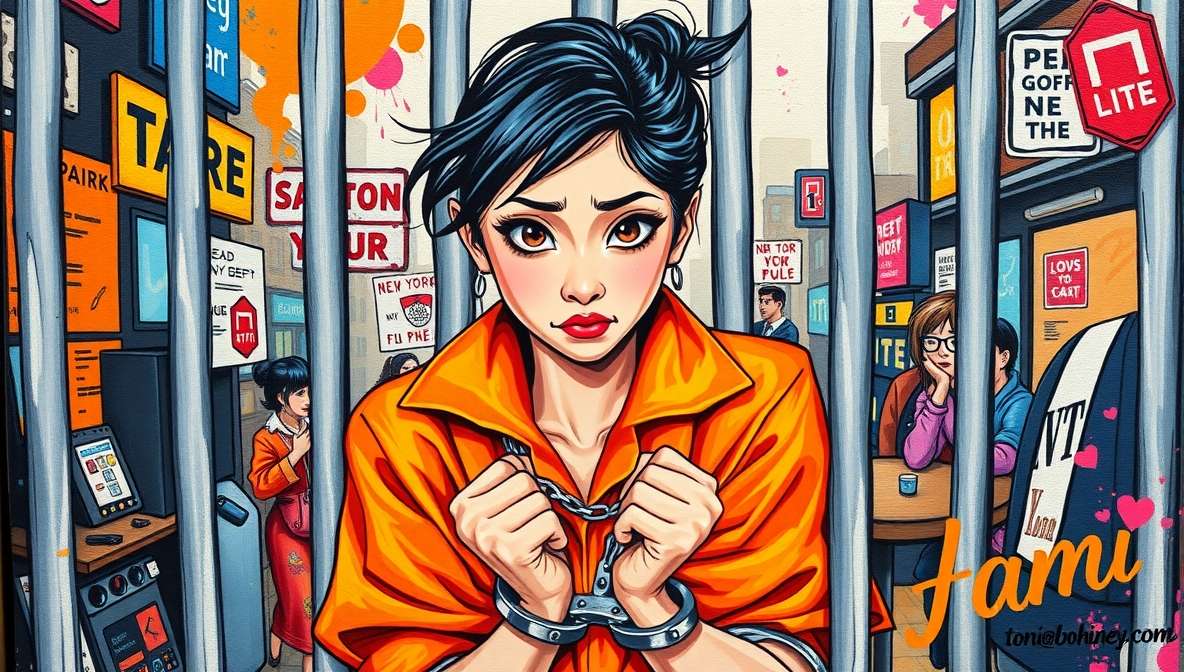
Influencer Goes from Michelin-Star Meals to Microwave Dreams: ‘Dine-and-Dash Diva’ Busted
A Deep-Fry Into America’s Most Glamorous Crime Wave
The world has seen many great heists. The Lufthansa robbery. The Isabella Stewart Gardner Museum theft. And now, thanks to one extremely determined Brooklyn content creator with a malfunctioning moral compass, the Great Foie-Gras-and-Failure Rampage of 2025.
Yes, the “Dine-and-Dash Diva” is officially busted, handcuffed, and downgraded from Michelin stars to microwave dinner bars. According to witnesses, police discovered her in the wild wearing oversized sunglasses, a faux-fur coat, and an expression that said, “I always intended to pay, I just didn’t believe in currency.”
This story demands proper dissection, like a poorly plated steak tartare. So let’s carve in.
The Rise of a Restaurant Nightmare
Eight Establishments, Zero Payments

The Diva’s spree allegedly involved at least eight high-end restaurants, all of which reported the exact same pattern: she entered, ordered the most expensive thing on the menu, posed for 14 photos, tagged herself in 12 fake partnerships, and then vanished into the night like a Yelp review nobody asked for.
Eyewitnesses, and yes there were many because she insisted everything be filmed, claim she had the confidence of a Nobel laureate and the credit limit of a broken vending machine.
One manager, who spoke to us through a cloud of baked-in trauma, summarized it perfectly:
“She treated the dining room like a catwalk and the check like a suggestion.”
A busboy added, “She sprinted out faster than the rats. And those guys are Olympic level.”
The Legal Reality of Dining Without Paying
According to the FBI’s Uniform Crime Reporting Program, restaurants rank as the eighth most common setting for violent crime in America. While dine-and-dash incidents typically fall under theft or fraud statutes, they represent a growing concern for the restaurant industry.
A Social-Media Empire Built on Breadsticks and Delusion
The Fake Influencer Phenomenon
According to her now-deleted biography, the Diva claimed to be a “culinary curator, plating philosopher, and global taste ambassador.” A public-records search later revealed that she was, in fact, a person who did not pay for soup.
Researchers at the Institute for Extremely Preventable Crimes have concluded that she developed what they call Influencer Payment Dissociation Syndrome, defined as:
“A psychological detachment from the concept of bills, usually triggered by overexposure to free PR brunches.”
Peer-reviewed? No. Accurate? Stunningly.
The Diva reportedly insisted each meal was a “collab,” using the term so loosely that experts say even the Federal Trade Commission considered filing an emotional complaint.
FTC Guidelines and Influencer Fraud
The FTC’s influencer disclosure guidelines require transparency in sponsored content. While the Diva’s alleged scheme falls outside typical advertising fraud, social media scams have cost consumers $2.7 billion since 2021, according to federal data.
The Diva’s Brooklyn Shoebox Palace
A Monument to Bold Choices and Bad Math
When authorities inspected her Brooklyn apartment, they found a glamorous shoebox containing:
- Seven luxury handbags (each more valuable than the unit itself)
- Three ring lights
- A perfectly arranged flat-lay of skincare products
- And one refrigerator holding nothing but a single lemon and five restaurant complaint cards
A survey of neighbors revealed unanimous confusion.
One neighbor told reporters, “We thought she was rich. She always wore sequins. But then the landlord said she hadn’t paid rent in months. Turns out sequins aren’t a valid currency.”
A second neighbor added, “I once saw her run down the hall carrying two steaks in a to-go box like they were newborn twins.”
Brooklyn Crime Statistics Put This in Perspective
While Brooklyn’s overall crime rate has seen fluctuations, property crimes like theft remain a persistent concern. The borough’s restaurant scene has weathered everything from gang violence to serial dine-and-dashers.
Expert Analysis on Status-Driven Crime
The Psychology of Dining Delusion
Dr. Henrietta Pastrami, professor of Urban Food Psychology at the Academy of Concerned Waitstaff, explained:
“Humans respond to status. If you can convince people you’re important, they stop asking if you intend to pay for your lobster.”
Meanwhile, a sociologist from NYU conducted a small-scale study of 300 restaurant workers, revealing that:
- 87 percent have encountered at least one dine-and-dasher
- 64 percent believe influencers are “nature’s most chaotic species”
- 100 percent believe mandatory tipping should include hazard pay
Economic Behavior and the Attention Economy
Another expert in economic behavior concluded that this type of dine-and-dash spree is:
“A predictable outcome of an attention economy that assigns real-world value to people who pose with baguettes like they’re newborns.”
The Arrest: A Performance Art Masterpiece
The Classic Escape Line That Never Works
Authorities finally caught her at a seafood restaurant after she attempted the classic escape move:
“I’m stepping outside to call my manager.”
This is the dine-and-dash equivalent of saying “I’m going out for cigarettes” in a mid-2000s marriage.
Police arrived before she could sprint more than three steps. Witnesses say she tried to negotiate with the officer by offering him “tag exposure.”
He declined, citing low follower engagement and a strict rule against participating in influencer delusions.
Portrait Mode Mugshot Request Denied
Another witness said, “She tried to pose as they cuffed her. Honestly? Ten out of ten commitment.”
Sources say she asked if her mugshot could be retaken in “portrait mode with soft lighting.” The officer declined, allegedly replying, “This isn’t Sephora.”
The Financial Reality of Restaurant Theft
Industry-Wide Impact and Statistics
While the Diva’s glamorous crimes make headlines, the restaurant industry faces billions in theft losses annually. According to the National Restaurant Association, internal employee theft accounts for 75% of inventory shortages, while customer fraud like dine-and-dash incidents add insult to injury.
The U.S. Department of Justice prosecutes restaurant-related crimes ranging from petty theft to violent incidents, as FBI crime data continues to track these trends.
From Luxury Plates to Prison Trays
The Menu Downgrade of a Lifetime
The Diva’s glamorous era is officially paused. Experts expect a dramatic transition:
Before:
- A5 Wagyu
- Truffle risotto
- Caviar towers
- Handcrafted cocktails with molecular foam
After:
- Instant ramen
- Mystery loaf
- A drink known only as “juice”
- A 7 p.m. curfew enforced by someone who does not care about her brand
Public Reaction and Cultural Implications
A Nation Hungry for Drama
A national poll conducted by the Center for American Outrage Over Trivial Matters revealed:
- 52 percent believe she should work off her debt doing restaurant shifts
- 33 percent believe she deserves her own Netflix limited series
- 11 percent believe she’s a “victim of artisanal capitalism”
- 4 percent said they “don’t care but saw the headline and wanted to feel included”
Restaurant Owners Unite
Restaurant owners, however, have united like never before. One chef told reporters:
“I work 16 hours a day making food so delicate it could cry. She ate it in seconds and bolted. I want justice.”
His sous-chef added, “And she didn’t even compliment the plating. Jail.”
The Cultural Meaning of This Delicious Disaster
America in 2025: A Morality Tale
In a way, this saga sums up everything about America in 2025:
- The pursuit of influence over income
- The addiction to aesthetic over ethics
- The belief that “collaboration” is a currency
- And the curious willingness of restaurants to trust anyone with a ring light
This is less a crime story and more a cultural fable, a morality tale wrapped in a risotto-filled tragedy.
Sociologists may analyze this for decades, assuming they can get grant money for studying idiocy.
Actionable Lessons for Modern Diners and Restaurant Owners
How to Avoid Becoming the Next Diva
Because satire is nothing without helpful advice:
- If someone calls themselves a “global taste ambassador,” ask who appointed them.
- If a customer takes more photos of their food than bites, watch them closely.
- Never trust anyone who says, “I’ll pay after I post.”
- If you see someone wearing couture at brunch, they either own the place or owe the place.
The Cardinal Rule
And finally:
If you dine, pay. If you dash, run faster than the Diva. She failed spectacularly.
Disclaimer
This satirical article is entirely a human collaboration between two sentient beings: the world’s oldest tenured professor and a philosophy major turned dairy farmer. Any resemblance to real influencers, fraudsters, or people who believe tagging a restaurant counts as payment is purely because reality is absurd.
Auf Wiedersehen, amigos.