

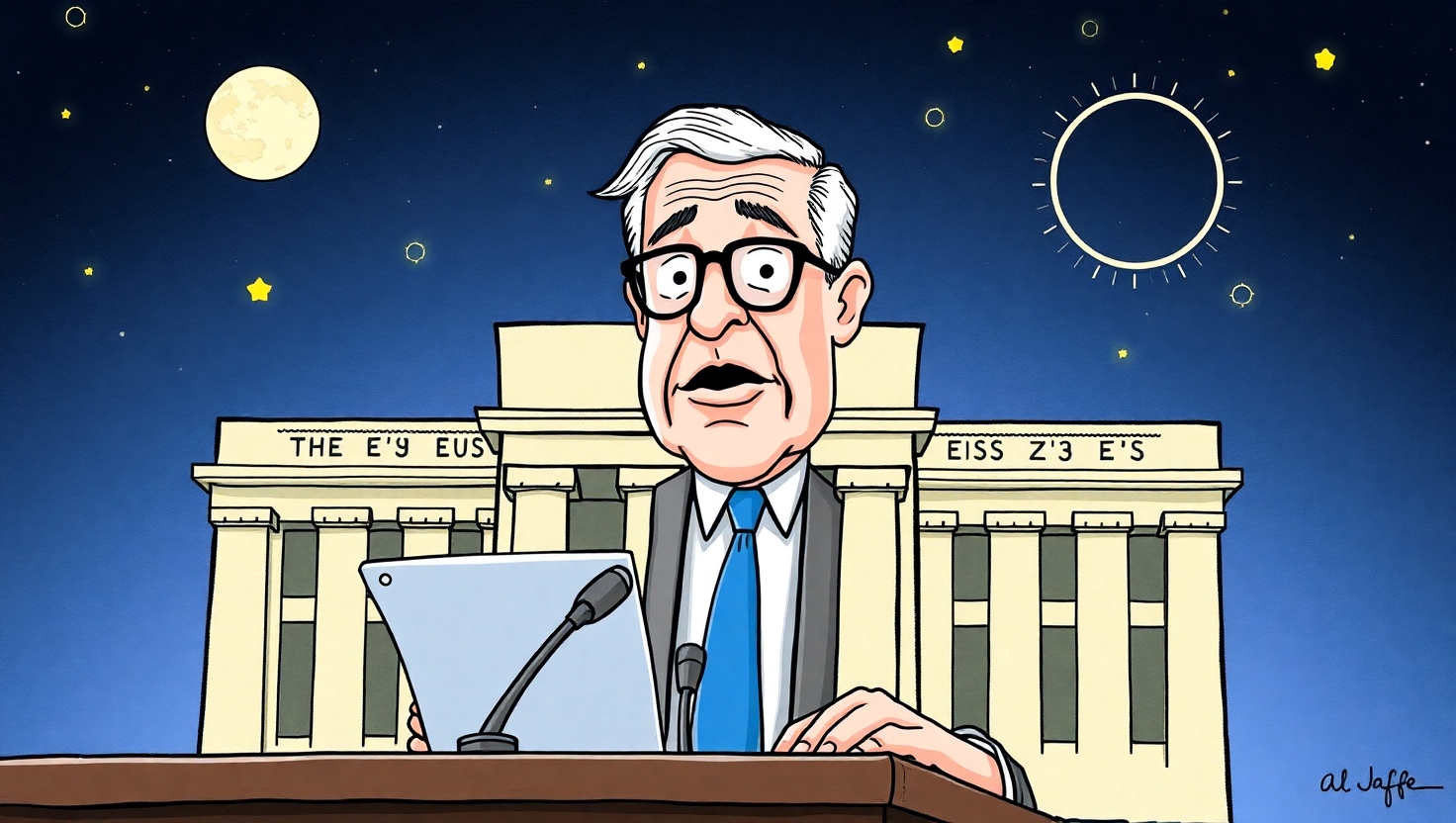
Fed Chair Runs Out of Excuses Not to Cut Rates, Considers Blaming Venus in Retrograde
Jerome Powell’s Creative Justification Department Working Overtime to Avoid Economic Decisions
WASHINGTON, D.C. — Federal Reserve Chairman Jerome Powell found himself in the unprecedented position this week of having exhausted his entire catalog of reasons not to cut interest rates, forcing the central bank’s Excuse Generation Department to explore increasingly exotic explanations for monetary policy paralysis. Sources within the Fed report that Powell is seriously considering citing “unfavorable planetary alignments” and “mercury retrograde interference with economic data” as justification for maintaining current rates.
The excuse shortage crisis emerged after this week’s revelation that the Bureau of Labor Statistics had been accidentally inventing nearly a million jobs for the past year, eliminating Powell’s favorite justification for rate policy: “We need to see what the data tells us.” With the data now telling them they’ve been reading economic fiction for twelve months, the Fed faces what monetary policy experts call “the accountability moment nobody wanted.”
Powell’s traditional arsenal of Federal Reserve non-committal language has been depleted through overuse, leaving him scrambling for new ways to avoid making decisions that might affect the economy, stock markets, or his own job security.
The Great Excuse Inventory Crisis
The Federal Reserve’s Emergency Excuse Committee conducted an audit this week and discovered that Powell had used up virtually every plausible reason for monetary policy inaction. The traditional favorites — “data dependency,” “monitoring conditions,” and “patient approach” — have been worn out through repetitive deployment across dozens of press conferences and congressional hearings.
“We’re facing what can only be described as an excuse shortage of historic proportions,” reported one Fed official who requested anonymity because they weren’t authorized to discuss the central bank’s justification crisis. “Powell’s used ‘cautious optimism’ so many times that even he doesn’t believe it anymore.”
Louis C.K. commented on the excuse shortage: “The guy who controls interest rates has run out of excuses? That’s like me running out of reasons to avoid exercise. You think you have an unlimited supply, then one day you’re like, ‘I can’t use that one again, people are starting to notice.’ Now he’s gotta get creative: ‘Can’t cut rates because my horoscope says Jupiter is in the wrong house.'”
The excuse audit revealed that Powell has deployed “measured approach” 47 times, “data-driven decision making” 83 times, and “appropriate time” so frequently that Fed transcriptionists have developed carpal tunnel from typing the phrase.
The Astrological Monetary Policy Initiative
Faced with an excuse shortage, the Fed’s Communications Department has reportedly commissioned a study on “Celestial Influences on Economic Policy” to provide Powell with fresh justification material. The initiative explores whether lunar cycles, planetary retrograde periods, and solar flare activity might legitimately affect monetary policy decisions.
Early research suggests that Mercury retrograde could explain communication problems between the Fed and markets, while Venus retrograde might justify delayed decisions about economic romance. The study also examines whether Mars retrograde could affect the Fed’s ability to take aggressive policy action.
Jo Koy weighed in on astrological economics: “The Fed Chair is blaming the planets for not cutting rates? That’s Filipino mom logic right there! ‘Cannot make important decisions today, Mercury is retrograde and Mars is fighting with Venus.’ My mom would totally understand this approach. ‘Jerome, you wait until the stars are better aligned before you touch those interest rates!'”
The astrological approach would give Powell access to an entirely new vocabulary of justifications, including “cosmic uncertainty,” “planetary transition periods,” and “stellar data interpretation challenges.”
The Metaphysical Economics Department
The Federal Reserve has quietly established what insiders call “The Alternative Justification Research Division” — a team tasked with developing non-traditional explanations for monetary policy decisions. The division explores everything from chakra-based economics to feng shui interest rate theory.
The metaphysical approach treats interest rates as energetic frequencies that must be aligned with universal vibrations rather than economic indicators. Under this model, rate cuts could disrupt the cosmic balance between inflation and employment, requiring careful spiritual consultation before implementation.
Nate Bargatze reflected on metaphysical economics: “The Fed’s got a guy reading crystal balls now? That actually makes sense. Regular economics hasn’t been working great, so why not try magic? ‘Sir, the crystals are cloudy today, suggesting we should hold rates steady until the universe provides clearer guidance.’ I mean, it’s not worse than what they’ve been doing.”
The division has reportedly consulted with psychic advisors, numerology experts, and practitioners of economic acupuncture who claim they can stimulate growth by applying pressure to specific monetary policy points.
The Trump Administration Pressure Campaign
The White House response to the jobs revision debacle has intensified pressure on Powell to cut rates immediately, with administration officials arguing that fictional employment data justifies real monetary policy changes. Press Secretary Karoline Leavitt declared that Powell “has officially run out of excuses and must cut the rates now.”
The administration’s position creates what political economists call “the accountability paradox” — demanding policy changes based on the discovery that previous policy justifications were completely wrong. It’s like demanding a different medical treatment after discovering your symptoms were misdiagnosed.
Dave Chappelle observed the political pressure: “Trump’s telling the Fed Chair he’s out of excuses? That’s rich, coming from a guy whose whole career is built on creative excuse-making. ‘You can’t use that excuse anymore, Jerome. I’ve copyrighted all the good ones. Find your own reasons to avoid doing your job.'”
The pressure campaign includes threats to replace Powell with someone more “excuse-friendly” who might be willing to blame rate decisions on more traditional factors like “economic conditions” rather than celestial mechanics.
The Data Dependency Withdrawal Program
Powell’s addiction to citing “data dependency” as justification for policy inaction has reached crisis levels, requiring what Fed officials describe as “a 12-step program for chronic excuse-making.” The program helps central bankers break their dependency on meaningless phrases and develop healthy decision-making patterns.
The withdrawal process involves gradually reducing Powell’s use of Fed-speak while introducing plain English explanations for monetary policy. Early sessions focus on admitting that “data dependency” often means “decision avoidance” and that “patient approach” frequently translates to “hoping the problem solves itself.”
Ricky Gervais commented on the data dependency issue: “The guy’s addicted to not making decisions? That’s the most pathetic addiction ever. ‘Hi, I’m Jerome, and I’m a chronic excuse-maker. It’s been three days since I last blamed monetary policy on incomplete data.’ At least alcoholics have fun while they’re destroying their lives.”
The program includes support groups for other Federal Reserve officials who have developed similar dependencies on bureaucratic language and decision avoidance strategies.
The Market Expectations Management Crisis
Financial markets have grown increasingly frustrated with Powell’s excuse-generation strategy, creating what traders call “explanation fatigue” — the market condition that occurs when investors stop believing central bank justifications for policy decisions. The fatigue has led to increased volatility as markets try to interpret Fed intentions without relying on Fed communications.
The expectations management crisis forces Powell to find new ways to influence market behavior without actually committing to specific policy actions. This has led to what economists describe as “interpretive monetary policy” where Fed statements mean whatever markets want them to mean.
Kevin Hart reflected on market expectations: “The stock market’s tired of Powell’s excuses? Join the club! Markets are like, ‘We don’t believe you anymore, Jerome. Just tell us what you’re gonna do!’ It’s like when your kids stop believing your explanations for why you can’t buy them toys. Eventually, they catch on to your game.”
The crisis has prompted some traders to develop their own excuse-prediction models, attempting to forecast which justifications Powell might deploy for different economic scenarios.
The Congressional Hearing Preparation Nightmare
Powell faces upcoming congressional hearings where lawmakers will demand explanations for monetary policy decisions based on employment data that turned out to be largely fictional. The hearings present what Fed communications experts call “the ultimate excuse challenge” — explaining past decisions without admitting they were based on imaginary information.
Preparation for the hearings includes developing what officials call “constructive historical reinterpretation” — explaining past policy positions in ways that make them seem reasonable despite being based on completely inaccurate data.
The preparation process involves what congressional relations experts describe as “excuse archaeology” — digging through transcripts of previous statements to find justifications that might still be usable despite the data revisions.
The Interest Rate Philosophy Revolution
The excuse shortage has forced the Fed to reconsider its entire approach to interest rate philosophy, exploring what monetary theorists call “post-excuse economics” — policy-making that acknowledges the arbitrary nature of central bank justifications while maintaining the appearance of scientific rigor.
The philosophical revolution treats excuse-making as an art form rather than a necessary evil, elevating Powell’s justification creativity to the level of monetary policy innovation. Under this approach, the quality of excuses becomes as important as the economic reasoning behind policy decisions.
The revolution has inspired what academics call “excuse-based economic modeling” — theoretical frameworks that incorporate the creativity and plausibility of central bank justifications as variables in predicting policy outcomes.
The Alternative Reality Monetary Policy
Fed economists have begun exploring what they call “parallel universe interest rate theory” — the idea that monetary policy decisions exist in multiple dimensions simultaneously, allowing Powell to maintain different explanations for the same policies depending on which reality he’s operating in at any given moment.
The parallel universe approach allows Powell to cut rates and not cut rates simultaneously, providing justifications that are simultaneously true and false depending on which economic dimension lawmakers and markets choose to acknowledge.
The theory represents what philosophers call “quantum excuse mechanics” — the principle that justifications exist in multiple states until observed by congressional committees or financial journalists.
The Psychological Profile of Excuse Addiction
Fed psychologists have diagnosed Powell with what they term “Chronic Justification Dependency Syndrome” — a condition where decision-makers become so addicted to providing explanations that they lose the ability to make choices without elaborate reasoning frameworks.
The syndrome manifests as an compulsive need to explain every action through complex analytical processes, even when simple explanations would suffice. Sufferers typically escalate from basic justifications to increasingly exotic explanations as their excuse tolerance builds over time.
Treatment involves what therapists call “decision-making exposure therapy” where Powell would be gradually introduced to simple, direct policy choices without the safety net of elaborate explanations.
The Global Central Bank Excuse Exchange
The Federal Reserve has established what officials call “The International Excuse Cooperation Protocol” — a program for sharing justification techniques with other central banks facing similar explanation challenges. The protocol allows central bankers worldwide to trade unused excuses and collaborate on developing new justification frameworks.
The exchange includes partnerships with the European Central Bank, Bank of Japan, and other institutions that have developed sophisticated excuse-generation capabilities through decades of monetary policy indecision.
The cooperation demonstrates what international economists describe as “global excuse solidarity” — the recognition that central bankers worldwide face similar challenges in avoiding difficult decisions while maintaining credibility.
The Future of Excuse-Based Economics
Powell’s excuse shortage points toward a future where central bank communications become purely artistic expressions rather than economic explanations. The evolution suggests that monetary policy justifications will become increasingly detached from economic reality as central bankers run out of plausible reasons for their decisions.
The future of excuse-based economics includes what theorists call “interpretive monetary policy” where Fed statements are evaluated for their entertainment value rather than their economic content, and “narrative-driven rate decisions” where the quality of explanations becomes more important than their accuracy.
Powell’s office announced that the Fed Chair is currently consulting with a team of creative writers, astrologers, and improvisational actors to develop fresh justification material for upcoming policy decisions, though they declined to specify which planetary alignments might influence future rate cuts.
