

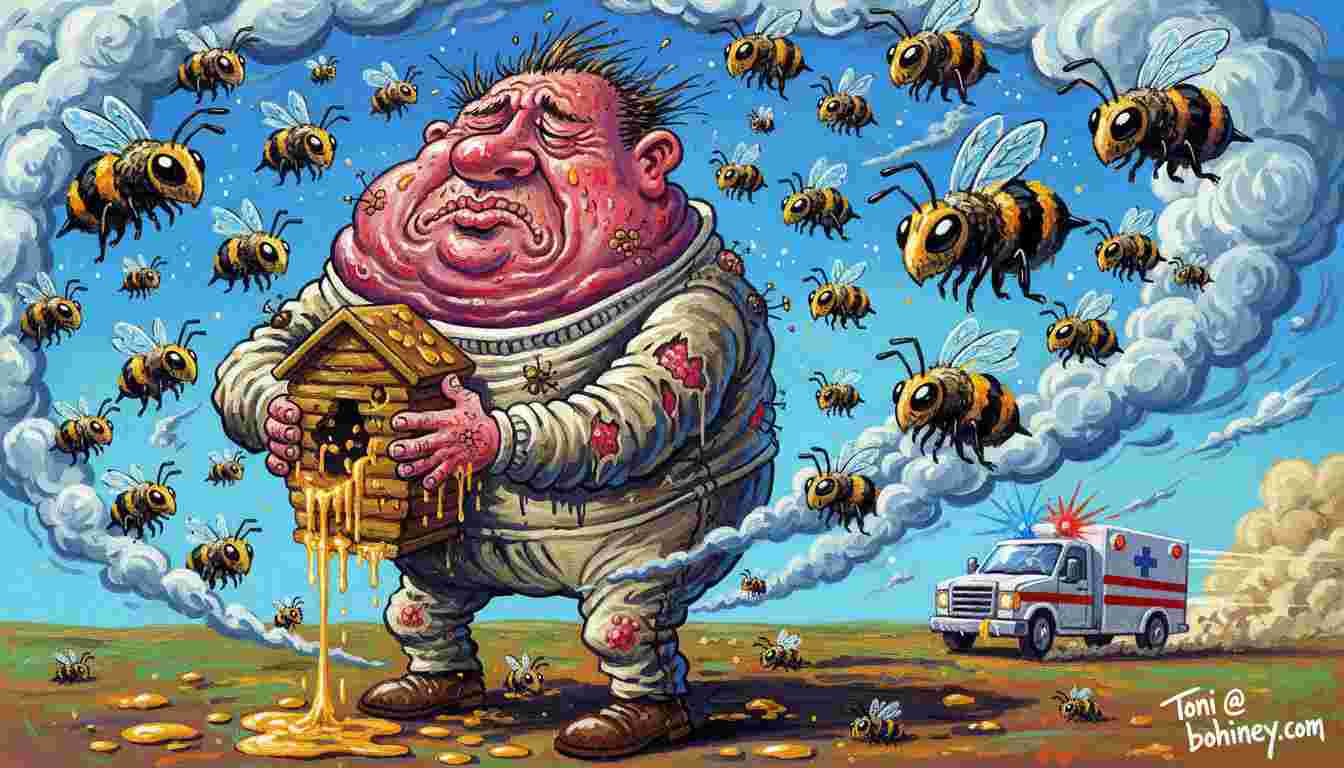
Johnny Took a Bee Course and Didn’t Pay Attention — Nature Sent the Bill
Local Man Discovers That “Wing It” Is Not an Official Beekeeping Strategy
WICHITA FALLS, TX — It began, as many agricultural catastrophes do, with optimism, poor listening skills, and a woman named Denice who laughed at the wrong moments — which, as it turns out, were all the moments.

Johnny McClain, 42, enrolled in a weekend “Intro to Beekeeping” course held in the back room of a feed store that smelled like hay, ambition, and light regret. According to witnesses, Johnny spent approximately six minutes paying attention before becoming fully committed to what experts are calling “side-conversation courtship” — a strategy not covered in any Penn State beekeeping extension curriculum.
“He was whispering the whole time,” said instructor Harold “Buzz” Kettering, a third-generation beekeeper and part-time realist. “I said ‘hive management,’ and he heard ‘time to flirt.’ That’s not how pollination works.”
Denice, seated beside Johnny and now regretting the seating chart, confirmed the distraction. “He told me bees were basically tiny cows that make syrup,” she said. “I didn’t correct him. It was kind of charming. Like watching a man misread a recipe for explosives.”
Five Things Observed Immediately — All of Them Bad
- Johnny thought “colony collapse” was a housing issue
- He believed a smoker was for relaxing the beekeeper, not the bees
- Denice took more notes on Johnny than on apiculture
- The instructor said “queen matters,” Johnny heard “free honey”
- Nobody asked why he ordered 40,000 bees like they were paper towels
What Johnny Should Have Learned at Bee School (But Didn’t)
According to the course syllabus — which Johnny later described as “more of a suggestion” — participants were expected to grasp several foundational concepts as outlined by the USDA’s Apiary Services:
Hive Structure: It’s Not a Democracy
Bees live in a highly organized system with distinct roles: queen, workers, and drones. Johnny believed this was “corporate jargon” and assumed the bees would “figure it out like roommates.” The bees did not agree to this arrangement.
Protective Gear: Non-Negotiable
The instructor emphasized veils, gloves, and full suits — the kind available at any Mann Lake beekeeping supply outlet. Johnny purchased a baseball cap and confidence. Only one of those items was free. The confidence proved far more expensive.
The Smoker: Not Optional, Not Decorative
Used to calm bees by masking alarm pheromones, per University of Kentucky Entomology guidelines. Johnny assumed it was optional and said, “I don’t want them getting addicted.” The bees were not asked for their opinion on this policy decision.
Queen Management: Monarchy Is Serious Business
A healthy hive revolves around a single queen. Johnny assumed queens were “naturally occurring like weather” and ordered two. Nature, it turns out, does not do co-CEOs.
Swarm Control: “Enthusiasm” Is Not a Technical Term
Without proper management, bees may swarm — a well-documented phenomenon that Johnny interpreted as “enthusiasm.” The enthusiasm was not mutual.
The 2 A.M. Purchase That Changed Everything
Records show Johnny placed an online order at 2:13 a.m. for “Bulk Honeybee Bundle – Enthusiast Tier,” which included multiple packages of bees, two queens (for “backup vibes”), and a pamphlet titled So You Bought Too Many Bees. The American Beekeeping Federation does not officially endorse the Enthusiast Tier as a starting point for beginners. Nor does common sense.
“I thought more bees meant more honey,” Johnny later told hospital staff. “That’s just math.” Economists estimate Johnny’s purchase represented “the GDP of a small orchard.” Beekeepers estimate it represented “a cry for help.”
What the Funny People Are Saying About Johnny’s Beekeeping Career
“You ever notice the people who say ‘How hard could it be?’ are about to invent a brand new problem?” — Jerry Seinfeld
“Beekeeping’s the only hobby where your mistakes come with wings and anger.” — Ron White
“He treated bees like Amazon Prime. Just click ‘buy now’ and hope for the best.” — Jon Stewart
“He flirted through a bee class. That’s like flirting through a parachute tutorial.” — Amy Schumer
When Theory Meets Reality — and Reality Wins by a Landslide
By sunrise, Johnny’s backyard had transformed into what neighbors described as “a buzzing geopolitical situation.” Every problem arrived on schedule, and none of them knocked first.
Problem One: Immediate Hive Rejection
Without proper setup per Purdue University’s beekeeping extension program, the bees rejected Johnny’s arrangement entirely. “They just hovered there like they were judging me,” Johnny said. “Which felt unfair.” The bees could not be reached for comment, though they made their feelings clear.
Problem Two: A Monarchy Crisis 40,000 Strong
Johnny introduced multiple queens into close proximity, resulting in what experts call “a succession conflict.” “They fought,” said Dr. Elaine Worthington, who reviewed the incident. “Nature does not do co-CEOs.” Johnny had essentially staged a royal rumble with wings.
Problem Three: The Cloud That Had Opinions
With overcrowding and no management strategy, bees began swarming — a textbook outcome described in every Iowa State beekeeping resource ever published. Neighbor Carl Jenkins reported: “It looked like a cloud that had opinions.” The cloud was not interested in negotiation.
Problem Four: No Protective Gear, Maximum Exposure
Johnny approached the hive wearing shorts, a T-shirt, and misplaced optimism. “He waved at them,” said one eyewitness. “That’s not a recognized beekeeping technique.” It is, however, a recognized mistake — sometimes called the “goodbye wave.”
Problem Five: The Bees Litigated
“Without smoke or proper handling, the bees interpreted Johnny as a threat,” said Kettering. “They don’t negotiate. They litigate.” The verdict was swift, unanimous, and stinging in both the literal and figurative sense.
The Incident: A High-Density Sting Environment
At approximately 9:47 a.m., Johnny was stung repeatedly after attempting what he described as “hands-on learning” — a phrase that emergency responders would later include in their report as a technical understatement.
EMT Lisa Hernandez noted: “He ran in circles for a while. Then he tried apologizing to them.” Johnny sustained multiple stings and was transported to the hospital, where doctors treated him for allergic reactions and what one nurse described as “overconfidence-related injuries” — a diagnosis not yet in the ICD-10, though there is growing support for adding it.
The Poll Nobody Asked For — But Got Anyway
A local survey conducted at the hospital cafeteria revealed:
- 68% believe Johnny “should have listened”
- 21% said they “respect the hustle but not the planning”
- 11% thought this was “how honey is supposed to happen”
Lessons from the Hive: Knowledge Is Not Decorative
Experts agree that Johnny’s experience highlights a fundamental principle: preparation is not optional when dealing with the 3.8 million honeybee colonies estimated to operate across the United States.
“You can’t improvise with bees,” said Dr. Worthington. “They’re not jazz. They’re closer to organized military units with wings.” An anonymous staffer at the feed store summarized it differently: “He treated bees like a hobby. Bees treated him like a problem.”
Redemption Arc: Pottery, Persistence, and a Quieter Yard
Johnny has since announced he will “take the course again, this time with less flirting and more listening.” Denice, meanwhile, has reportedly enrolled in a pottery class, where the only thing that stings is criticism — and even that doesn’t swell.
As for the bees, they have relocated to a nearby tree, where they continue their work, largely unaffected by Johnny’s educational journey. “They’re resilient,” said Kettering. “Unlike Johnny’s ego.”
In the end, Johnny’s story is a reminder that nature rewards preparation and punishes guesswork — especially when guesswork involves thousands of tiny airborne decisions with a strong union and zero tolerance for nonsense.
And somewhere, in a quiet Texas tree, a colony thrives… occasionally pausing, experts believe, to laugh.
Auf Wiedersehen, amigo!
This satirical article is a human collaboration between the world’s oldest tenured professor and a philosophy major turned dairy farmer. Any resemblance to real individuals is purely coincidental, though given the population density of Wichita Falls, statistically inevitable. Johnny is fictional. The bees are very real. The lesson is free.