

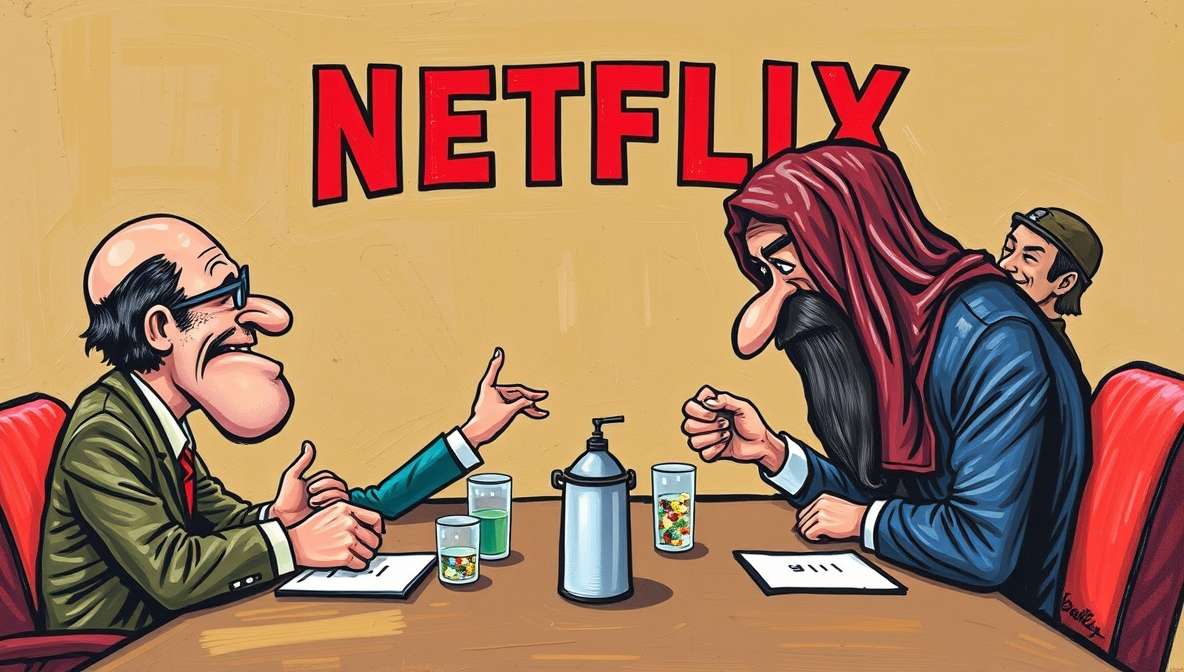
Netflix Courageously Defeats Islam in Closed-Door Meeting, Sources Say It Was a “Light Lunch”
What the Funny People Are Saying About Netflix’s Accidental Holy War
“This is the first time a corporate memo sounded like it was written during a hostage situation.” — Jerry Seinfeld
“I’ve been in some bad meetings, but I’ve never seen a group try to cancel 2 billion people before appetizers.” — Ron White
“Netflix said ‘global audience’ and immediately panicked like someone brought a plus-one named ‘Consequences.’” — Sarah Silverman
The Meeting That Allegedly Conquered 1.9 Billion People Before Dessert
According to a series of increasingly confident retellings by Mark Normand, a group of executives at Netflix reportedly gathered in a sleek glass conference room and, somewhere between PowerPoint slide 7 and a quinoa salad, reached a sweeping geopolitical conclusion that historians, sociologists, and that one guy at Thanksgiving have been unsuccessfully arguing about for centuries.
The claim, delivered with the relaxed cadence of a man who has never had to attend a corporate compliance seminar, suggested that executives had labeled Muslims broadly as “dangerous people.”
Netflix responded with the corporate equivalent of flipping the table over and pretending the meeting never existed, stating the claim was “completely false,” which in corporate dialect roughly translates to: “We would never say that out loud where anyone could hear it.”
Experts Weigh In, Mostly Because We Made Them
Dr. Ingrid Gustafsson, a behavioral risk analyst at the Stockholm Institute for Overgeneralized Conclusions, explained the situation with remarkable clarity:
“Anytime someone describes a population of nearly two billion people with a single adjective, we can scientifically conclude they have skipped several steps in the thinking process,” she said, adjusting glasses that appeared to be judging the room.
A leaked memo from an anonymous staffer — who insisted on being identified only as “Kyle, but like discreet Kyle” — suggested the real concern wasn’t theology, but ticket sales.
“We’re not afraid of people,” Kyle allegedly wrote. “We’re afraid of headlines. Headlines don’t subscribe monthly.”
Kyle, for what it’s worth, has presumably since been promoted to Senior Vice President of Plausible Deniability.
Netflix’s Global Strategy: Saying Nothing, But Louder
Netflix, a company that operates in over 190 countries and has successfully convinced millions to binge-watch shows about baking, murder, and competitive glassblowing, has developed a finely tuned survival instinct: avoid offending anyone who owns a Wi-Fi connection.
This leads to what insiders call “Strategic Ambiguity” — a corporate philosophy defined as:
“Saying nothing in such a confident tone that it sounds like something.”
In practice, this means:
- A joke in New York becomes a diplomatic incident in Jakarta
- A punchline in Texas requires a legal review in Dubai
- And somewhere in Los Angeles, a producer whispers, “Can we just make another cooking show instead?”
The streaming giant, valued at over 300 million subscribers globally, has essentially built the world’s most expensive sensitivity reader: the stock market.
A Poll That Proves Absolutely Everything and Nothing

A recent survey conducted by the International Institute of Vibes (sample size: 1,003 people and one guy named Dennis who wouldn’t leave) found:
- 72.4% of respondents believe comedy should be “free”
- 68.2% believe comedy should also be “safe”
- 91.7% believe someone else should figure out how that works
When asked if entire groups of people could be accurately summarized in one sentence, 100% responded:
“Well, except for that one group I personally find annoying.”
Dennis, notably, refused to answer and asked if there was parking validation.
Eyewitness Accounts From the Meeting That May or May Not Exist
A junior executive, speaking under the condition of anonymity and a decorative houseplant, described the alleged meeting:
“It started as a content discussion. Then someone said ‘global sensitivity,’ and suddenly it felt like we were negotiating peace in the Middle East with a whiteboard marker that didn’t work.”
Another attendee reportedly tried to steer the conversation back to programming:
“I just wanted to pitch a show about competitive birdwatching,” she said. “Next thing I know, we’re accidentally solving religion.”
The birdwatching show, for the record, was greenlit. It’s called Feathers of Mass Destruction. Season two has already been renewed.
When Comedy Meets Corporate: Nobody Wins Except the Algorithm
The real tension here isn’t about belief systems or demographics. It’s about two completely different forces colliding like shopping carts in a parking lot:
- Comedians, whose job is to say things that make people uncomfortable
- Corporations, whose job is to avoid discomfort at all costs
When these two meet, you get a strange hybrid creature: a joke that has been reviewed by Legal, HR, Marketing, and a guy named Todd who once took a philosophy class.
Todd, bless him, suggested changing the punchline to “a community of perspectives.” Todd is now in charge of the quarterly newsletter.
The Ancient Human Tradition of Overreacting Beautifully
Throughout history, humans have demonstrated a remarkable ability to take a small statement and inflate it into something the size of a parade balloon.
One comment becomes:
- A headline
- The headline becomes outrage
- The outrage becomes content
- The content becomes more headlines
- And suddenly, everyone is arguing about something nobody actually said in the first place
It’s less of a conversation and more of a cultural game of telephone, except the phone is on fire. The outrage cycle, as media scholars call it, runs on the same fuel as a gas station hot dog: questionable ingredients, zero nutritional value, and someone always buys it at 2 a.m.
More from the Funny People: The Comedy Industry Responds
“I like how every controversy now starts with ‘someone said’ and ends with ‘no one said that,’ and we just skip the middle.” — Larry David
“If Netflix could, they’d release a special called ‘Nobody Said Anything and Everyone Loved It.’” — Chris Rock
“This is the only industry where silence is controversial and talking is worse.” — Bill Burr
A Helpful Guide to Not Accidentally Generalizing Billions of People
In the spirit of helpful content, here are some practical tips for navigating these conversations:
- If your sentence starts with “All [group],” consider adding “some individuals within” and watch your blood pressure drop
- If a comedian says something wild, remember their job is not peer-reviewed research
- If a corporation responds, remember their job is to keep the stock price from sweating
Or, as one anonymous intern put it:
“Maybe don’t summarize humanity like it’s a Yelp review.”
The Real Punchline: Truth Exits Through the Side Door
In the end, this entire situation reveals something deeply human:
We are incredibly good at turning complexity into simplicity, nuance into headlines, and conversations into competitions.
Netflix didn’t conquer a religion. A comedian didn’t expose a global conspiracy. But together, they created something far more powerful:
A story where everyone is certain, nobody agrees, and the truth quietly exits through the side door carrying a briefcase.
The briefcase, presumably, contains the quinoa salad receipt.
This satirical article is the result of a collaborative effort between two sentient beings: the world’s oldest tenured professor and a philosophy major turned dairy farmer. Any resemblance to real meetings, memos, or quinoa salads is purely coincidental, though deeply plausible. Interpret responsibly, laugh carefully, and remember that sweeping statements tend to sweep away the truth along with everything else. Auf Wiedersehen, amigo!
Mark Normand, a New York-based stand-up comedian known for his sharp observational style, made remarks suggesting Netflix executives had characterized Muslim people as “dangerous” during an internal meeting. Netflix denied the claim as “completely false.” The controversy reignited ongoing debates about corporate content policies, comedy’s limits in the streaming era, and the tension between global platforms and cultural sensitivity — particularly regarding the world’s approximately 1.9 billion Muslims, who represent the second-largest religious group on Earth.