

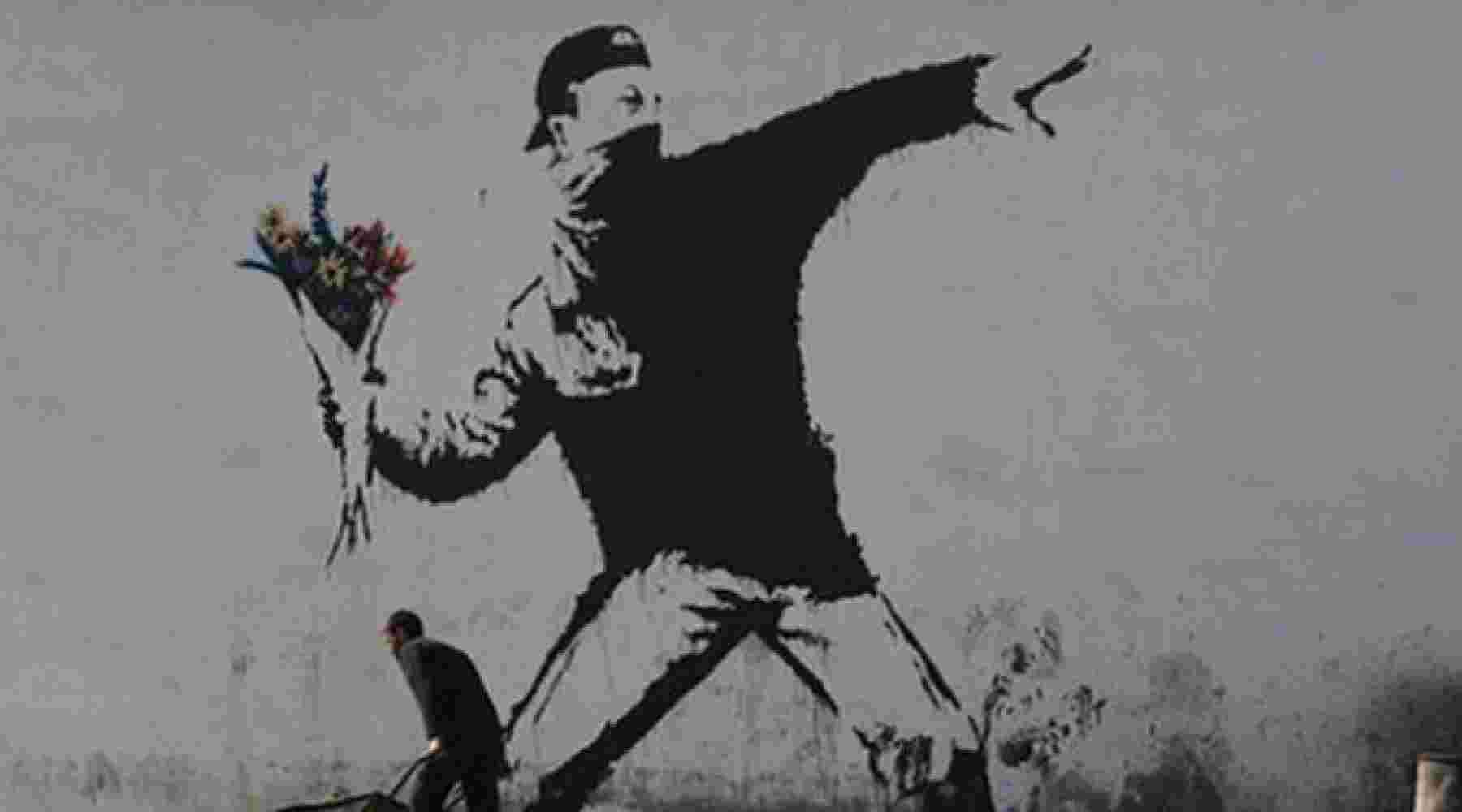
Banksy Identity Crisis: Man Proven to Be Banksy Immediately Disproves It by Existing Poorly
Bohiney.com Exclusive: Robin Gunningham — also known as David Jones, also known as “Not Banksy,” also known as the world’s most reluctantly famous anonymous person — has been conclusively identified as Banksy by Reuters, and has responded by doing absolutely nothing in a deeply suspicious way. He is, by any measure, the only man in history to build a $25 million brand on the solid foundation of not existing.
The Most British Crime in American History
In September 2000, a man named Robin Gunningham was arrested on a Manhattan rooftop for defacing a Marc Jacobs billboard with goofy teeth and a Jaws reference. He paid a $310 fine, completed five days of community service, and spent the next 25 years becoming the most valuable graffiti artist on Earth. Let’s do that math: $310 invested, $25 million returned. That’s not a criminal record. That’s the greatest misdemeanor ROI in the history of Western art. The SEC has questions.
Note also that his name is Robin Gunningham — a man whose surname contains the word “gun” spent his career doing illegal art and somehow the name never raised a flag. Investigators filed the confession under “M” for “Mystery,” where it sat in a Manhattan filing cabinet for 25 years while Reuters spent a year geolocating photos, reconstructing fashion week timelines, and ultimately confirming what half of Bristol already knew at the pub, on a Tuesday, between rounds.
Five Observations from the Scene
- People trust evidence until it becomes slightly convincing, at which point they panic and call it a conspiracy — which is, itself, a Banksy piece.
- The more someone denies being Banksy, the more stencil-like their denial handwriting becomes.
- Authorities have upgraded from “no idea” to “strong hunch with paperwork,” which feels like progress but legally isn’t, and artistically might be.
- Anyone who claims not to like art becomes instantly suspicious in Britain, where even toast is considered conceptual and a burnt crumpet recently sold at Christie’s.
- The phrase “beyond dispute” now officially means “we’ve decided to stop arguing about this” — which is, coincidentally, how most Banksy pieces end up on someone’s living room wall.
The Science of Guessing With Confidence
In a development described by experts as “definitive, conclusive, and emotionally exhausting,” Gunningham was identified beyond dispute — only to immediately dispute the claim by continuing to exist in a manner wholly inconsistent with being Banksy. Witnesses report the man woke up, made tea, and denied everything in what one analyst called “a deeply un-Banksy morning routine.” No stencils. No rats. Just tea.
Dr. Lionel Crumb, senior fellow at the Institute for Advanced Guessing, explained the methodology. “We used a sophisticated technique known as Guessing With Confidence. It combines circumstantial evidence, geographic coincidence, and the firm belief that we are simply tired of not knowing. Statistically, the method is 87 percent convincing and 13 percent vibes.” He added that the vibes were “extremely high-quality,” which the Institute is seeking to publish in a peer-reviewed journal pending peer availability, which has been pending since 2019.
Bohiney Analytics conducted a parallel poll finding that 62.4 percent of respondents believed the man was Banksy, 21 percent believed Banksy is actually three raccoons in a hoodie operating as a collective, and 16.6 percent admitted they thought Banksy was a restaurant — specifically a good one, West Village, impossible reservation, the kind where the menu has no prices and neither does the artist.
David Jones: The Man Who Hid at the Bottom of His Own Name
After the British tabloid Mail on Sunday first identified Gunningham in 2008, he made a bold strategic move: he legally renamed himself David Jones. Not a clever alias. Not an anagram. Just David Jones — one of approximately 6,000 David Joneses currently wandering the British Isles. It is worth noting, for those keeping score at home, that David Jones is also the birth name of David Bowie — history’s most celebrated shape-shifter — which means Banksy didn’t just hide in a common name, he hid in the world’s most famous fake name. Intentional? His lawyer isn’t saying. His lawyer isn’t saying anything useful at all.
Former manager Steve Lazarides confirmed the arrangement with characteristic flair. “There is no Robin Gunningham,” Lazarides told Reuters. “The name you’ve got I killed years ago.” He paused. “It’s just another name.” He did not elaborate. He has presumably stencilled “no comment” somewhere nearby.
Art World Market Panic and Convenient Amnesia
The art world reacted with the sort of cautious confusion that is, frankly, its factory setting. Gallery owner Marcus Delaney issued a statement: “If we know who Banksy is, we must immediately pretend we don’t, or the prices collapse. Mystery is the markup. This is basic economics — like diamonds, bottled water, or abstract expressionism.”
Delaney went on to explain that Banksy’s value is directly, structurally, existentially tied to his invisibility. “Once you attach a face to the art, it becomes just a man with opinions. And we already have far too many of those, several of whom have solo shows in Chelsea and none of whom are worth $25 million.”
Sotheby’s sold Banksy’s “Girl with Balloon” for $1.4 million, only for the piece to shred itself live at auction in 2018 — a stunt so audacious it immediately rebranded as “Love Is in the Bin” and sold again in 2021 for £18.5 million. The painting destroyed itself and became worth more. Now the artist has been identified and the market is very quietly wondering if the same trick works in reverse. It does not appear to.
The Suspect Doesn’t Even Like Art (This Is Somehow the Funniest Part)
In a twist that no screenwriter would dare submit, Gunningham reportedly told investigators he doesn’t even like art. The man who built the world’s most valuable anonymous art empire spanning thirty years, five continents, a self-shredding auction piece, and murals on the walls of the Royal Courts of Justice — does not, personally, care for art. He is, in the most literal sense possible, his own most cutting piece of social commentary.
Professor Elaine Mortimer, a cultural sociologist, offered a chilling analysis: “When someone claims not to like art, it forces society to confront an uncomfortable truth — what if art has been liking us this whole time?” She paused. She asked if anyone wanted coffee. No one answered. This too may be a Banksy.
Mortimer’s recent study, published in the Journal of Public Confusion, found that 73 percent of people prefer their artists anonymous, 19 percent prefer them mysterious but technically findable, and 8 percent specifically require the artist to be Banksy regardless of identity — a preference that now includes, apparently, a man who has spent thirty years making art he doesn’t even like. He is the most committed method actor in the history of not acting.
The Investigation Continues, Mostly Out of Habit
Gunningham’s lawyer, Mark Stephens, told Reuters his client “does not accept that many of the details contained within your enquiry are correct” — a statement so precisely, surgically vague that it may itself qualify for the Turner Prize. Stephens also warned that publishing would “violate the artist’s privacy, interfere with his art, and put him in danger.” Reuters weighed this against 25 years of public interest, a signed confession, and geolocated immigration records, and published anyway. Because that is, technically, also what Banksy does.
Authorities remain confident. “We have identified Banksy,” said Chief Inspector Harold Finch. “Our next task is proving that identifying him hasn’t made him disappear — which early results suggest it has. He’s been trending on X all week and we haven’t spotted a single new mural. We consider this both suspicious and, in context, deeply on-brand. The absence of art is the art. We think. We’ve called the Tate.”
A documentary filmmaker named Greg is following the suspect everywhere, convinced this is his moment. It is not, according to Greg’s agent, Greg’s moment. Greg persists. He carries a ring light into public spaces and stands near walls in a thoughtful manner. Bristol has flagged him as a Person of Interest.
What the Funny People Are Saying
“I love that they found Banksy. It’s like finding Waldo, except Waldo has a lawyer, a mortgage, and legally changed his stripes in 2008.” — Jerry Seinfeld
“He spray-painted that denial like he was signing autographs. In stencil. Flawless stencil.” — Ron White
“Only in Britain can you solve a mystery and make it more mysterious. That’s not closure. That’s a jazz funeral where nobody’s sure who died.” — Jon Stewart
This article is a collaborative effort between two sentient beings: the world’s oldest tenured professor and a philosophy major turned dairy farmer. All conclusions are based on highly reliable evidence, including a $310 court filing, 25 years of extremely patient filing-cabinet storage, and vibes the Institute has rated “investment grade.” Any resemblance to actual investigative journalism is entirely coincidental and deeply, structurally concerning.
Auf Wiedersehen, amigo!
In March 2026, Reuters published a landmark investigation identifying the anonymous street artist Banksy as Robin Gunningham, a 51-year-old Bristol native who had legally changed his name to David Jones around 2008. The evidence included a handwritten, signed confession from a September 2000 arrest in Manhattan, where Gunningham was caught defacing a Marc Jacobs billboard. He paid a $310 fine and completed community service. Banksy’s lawyer denied the findings. Former manager Steve Lazarides confirmed the name change but said “there is no Robin Gunningham” — the name had been officially retired. The revelation raised immediate questions about the future value of Banksy’s work, which includes pieces that have sold for over $25 million, and whether the artist’s mystique — the entire engine of his market — could survive contact with a real human name, a court record, and a $310 receipt.