

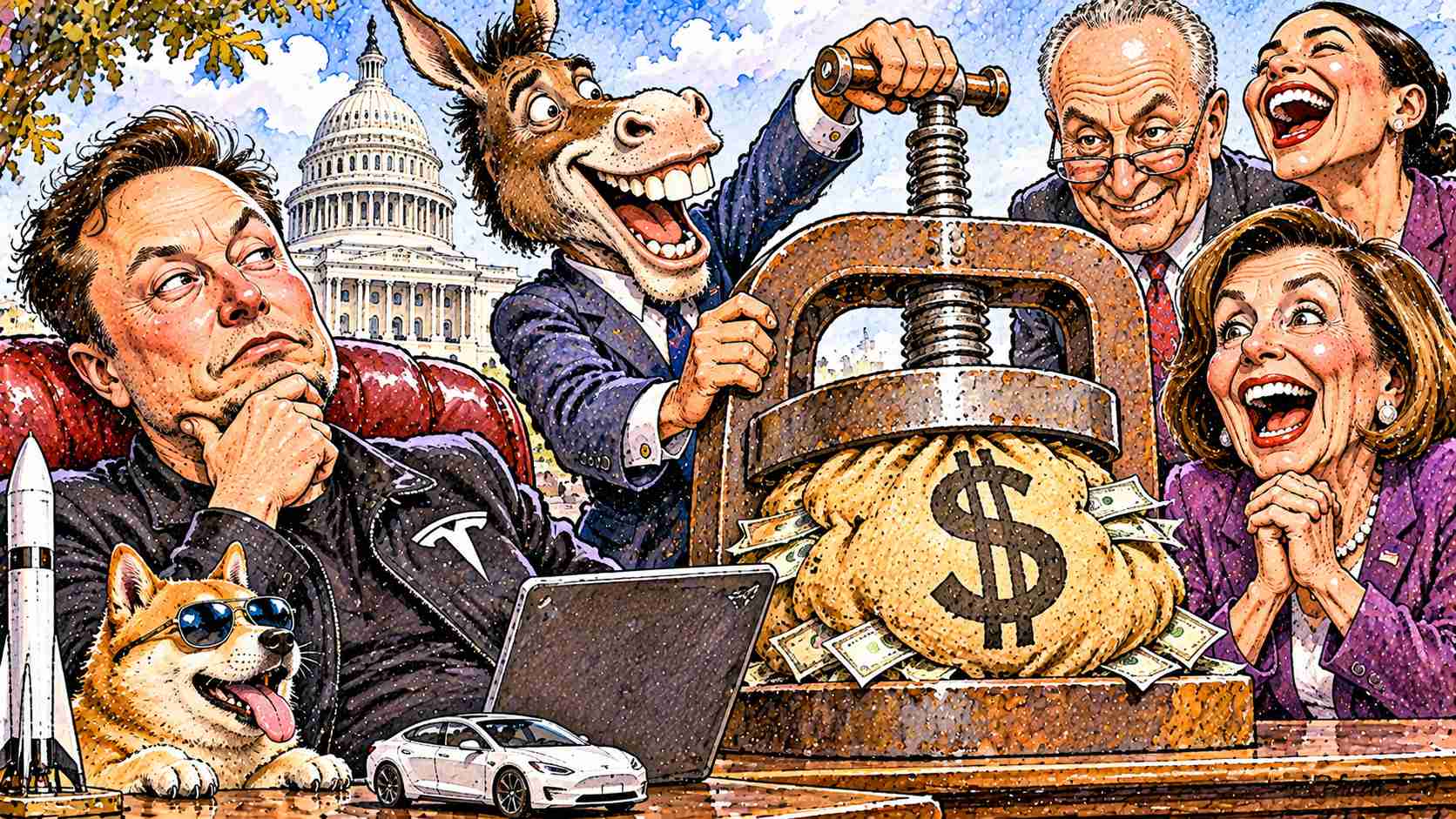
Tesla and SpaceX slide as Democrats gain ground
AUSTIN, Texas — Elon Musk discovered Tuesday night that Democrats have developed a revolutionary method of taxing billionaires without hiring IRS agents, rewriting the tax code, or enduring another congressional hearing about whether wealthy Americans pay their fair share.
They simply win elections and allow Wall Street to panic.
Tesla Falls 5% and SpaceX Drops 6% After Hours
As Democratic candidates gained ground, Tesla shares fell approximately 5% in extended trading, while SpaceX dropped roughly 6%, according to Investor’s Business Daily’s election-night reporting on Tesla and SpaceX.
The selling introduced an economic phenomenon analysts described as taxation by anticipation.
Unlike traditional taxation, which requires legislation, bureaucrats, and several thousand pages of incomprehensible instructions, anticipation taxation requires only an election result and a billionaire with publicly traded shares.
No government actually collects the money.
That is what makes the system especially efficient.
“Ordinarily, we spend years trying to persuade billionaires to surrender a portion of their wealth,” explained a Democratic campaign consultant. “Now we just win three congressional districts and somebody’s brokerage account starts bleeding.”
Musk Faces Government Contracts and Regulatory Exposure
Musk, who has spent years developing electric cars, reusable rockets, artificial intelligence, and increasingly creative ways to irritate politicians, appeared particularly vulnerable to the discovery.
His companies operate in industries involving government contracts, environmental regulations, energy policy, and technologies that lawmakers frequently discuss without understanding.
One congressional staffer reportedly asked whether SpaceX could reduce rocket emissions by using public transportation.
Another wanted Tesla to explain why electric vehicles require electricity.
A third proposed creating a federal commission to determine whether Mars should have rent control.
A transcript of a Capitol Hill staff briefing obtained Tuesday night records the Mars rent control question being raised twice. The second time, according to the transcript, it was marked “follow-up” and assigned to an intern.
Why Billionaires Make Politicians Do Math
Financial commentators observed that Musk’s considerable wealth presents a unique political problem.
Most Americans see a billionaire and wonder how much money he possesses.
Politicians see a billionaire and wonder how much of that money could finance their next proposal.
Musk sees a billionaire and generally sees himself, which is becoming increasingly expensive.
“The IRS has to find you,” said a portfolio manager at a Dallas wealth firm. “The stock market just texts everybody at once.”
Brokerage desks reported unusual activity in the minutes after the first projections. One trader in Houston said his phone lit up with seventeen messages from clients asking the same question, which was whether Musk owned anything that Democrats could not pronounce.
“I told them the truth,” he said. “He owns the rockets, the cars, the tunnels and the social network. Pick one and I’ll tell you how upset you should be.”
Clients did not find the answer reassuring. Two of them asked whether the tunnels could be used for storage.
Advisers Recommend Farmland, Bonds and a Small Asteroid
The technology entrepreneur was therefore advised to consider diversifying his assets into something less politically sensitive, such as farmland, government bonds, or a small asteroid beyond the jurisdiction of California regulators.
Mars immediately emerged as the preferred destination.
Unfortunately, lawyers warned that establishing a settlement on another planet would not necessarily protect its residents from congressional investigations.
“If Musk builds a city on Mars,” explained a Washington policy analyst, “somebody will demand affordable housing, an environmental impact statement, and a committee investigating whether the rocket launchpad meets accessibility standards.”
A filing reviewed by this publication shows that a Texas-based holding company with ties to one of Musk’s ventures amended its risk disclosures Tuesday night to add a single new line: “Elections.” It was placed directly beneath “Weather.”
Wall Street investors nevertheless remained confident that Musk could survive the market turbulence.
After all, a man who can land rockets vertically should eventually figure out how to keep politicians from landing on his balance sheet.
By the end of the evening, analysts had identified the greatest weakness in the Democrats’ new billionaire-taxation strategy.
Unlike the IRS, the stock market sometimes gives the money back.
That development would presumably require a congressional investigation.
Five Observations on Billionaires and Election Night
- The IRS has to find you. The stock market just texts everybody at once. That’s the most efficient government agency in America and it’s not even a government agency.
- A staffer asked if SpaceX could cut emissions by taking public transportation. Sir, the rocket is the public transportation. It’s just really committed to the route.
- Somebody wants rent control on Mars. We can’t get rent control on Earth and we’ve got a lot more dirt down here.
- Elections, right under Weather. That’s honest, actually. Both of them ruin your week and nobody can tell you when.
- He’s got a small asteroid as a backup plan. I’ve got a backup plan too. It’s my sister’s couch, and she has a lot of questions.