

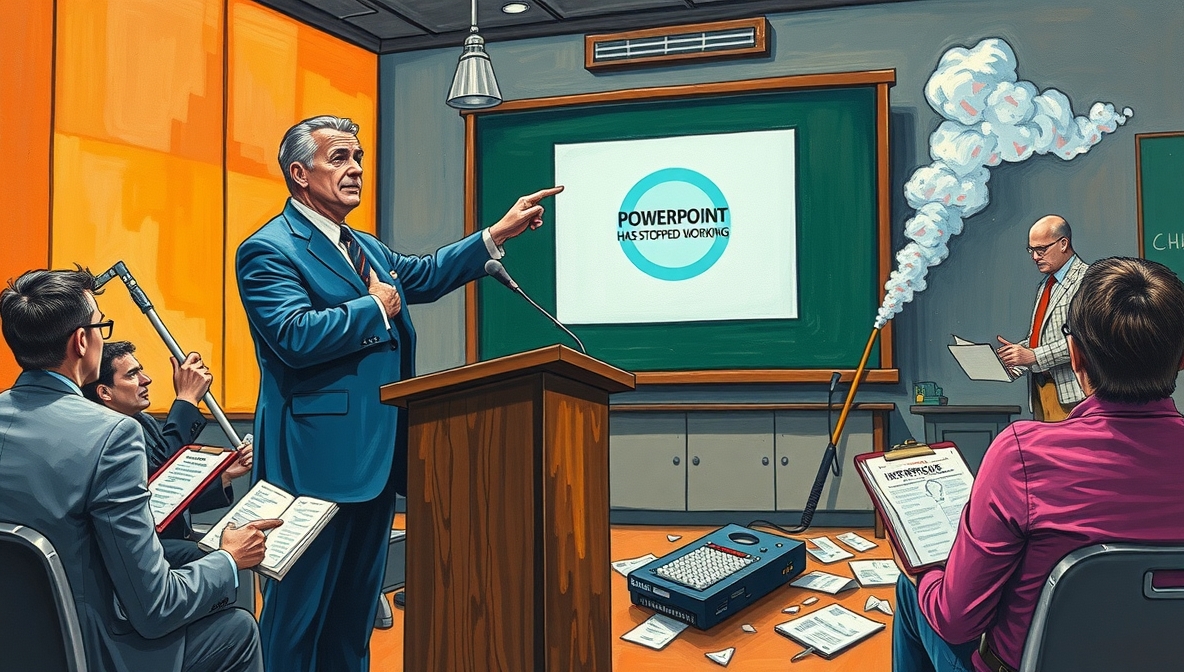
Nation’s Infrastructure Plan Unveiled on PowerPoint Slide That Immediately Crashed
By Marcus Wellington-Fitzgerald | Bohiney.com
In a groundbreaking demonstration of America’s unwavering commitment to technological progress and digital competency, the federal government proudly revealed its trillion-dollar infrastructure modernization plan this morning on a single Microsoft PowerPoint slide that froze spectacularly halfway through a clip-art animation of a bridge collapsing into a cartoon river.
Transportation Secretary Pete Buttigieg assured increasingly restless reporters that the software crash was “symbolically perfect and representative of our actual roads,” explaining with admirable spin: “The presentation software couldn’t handle the complexity of our visionary infrastructure concepts—just like our highways can’t handle the complexity of modern vehicles, weather, or basic structural integrity.”
The audience of transportation officials, journalists, and confused interns was left staring at a spinning hourglass cursor for 43 minutes before officials wheeled out an overhead projector from 1987, which also burst into flames within seconds of being plugged in, creating what witnesses described as “the most accurate metaphor for government efficiency ever witnessed.”
According to Politico’s infrastructure coverage, the presentation was supposed to include revolutionary concepts like “roads, but significantly sexier,” “bridges that can ghost you when you need them most,” and an ambitious pilot program for potholes that charge tolls directly to drivers’ credit cards based on tire damage assessment algorithms.
Expert Analysis of Digital Infrastructure Failure
Anonymous staffers who leaked details of the presentation revealed that the comprehensive plan includes innovative solutions such as “smart concrete that complains when overused,” “self-healing asphalt with abandonment issues,” and “traffic lights powered entirely by drivers’ road rage and existential frustration.”
Government technology research indicates that the PowerPoint crash was actually the most successful part of the entire infrastructure initiative, generating more public attention and media coverage than any actual construction project completed in the past decade.
Witnesses in the presentation room reported hearing a distinctive PowerPoint sound effect—”WHOOSH!”—played at maximum volume just before the system locked up completely. “Honestly, that sound effect was the most effective piece of infrastructure we’ve experienced in years,” said one intern while frantically taking notes on a paper napkin.
Public Response Achieves Peak Digital Irony
Polling shows that 62% of Americans approve of the infrastructure plan despite—or perhaps because of—the fact that 71% admit they never actually saw the slide content beyond the spinning cursor and error messages. Citizens report feeling “spiritually connected to the technical difficulties” and “emotionally represented by software that can’t handle basic tasks.”
Transportation infrastructure studies confirm that the failed presentation accurately represents the current state of American infrastructure: ambitious in concept, catastrophic in execution, and ultimately requiring complete replacement with newer systems that will probably also malfunction in creative and expensive ways.
Social media erupted with supportive memes featuring spinning cursors, frozen presentations, and citizens cheering for technology that mirrors their daily experience with government services, public transportation, and basic civic functionality.
The Economics of Presentation-Based Governance
Digital government research suggests that PowerPoint-based policy announcements represent the future of democratic participation, allowing citizens to experience government inefficiency in real-time while maintaining plausible deniability about actual policy content.
The crashed presentation has been archived as a historical document representing “peak 2025 governmental competency,” with plans to display the frozen screen in the Smithsonian’s upcoming exhibit on “Democratic Processes in the Digital Age: When Everything Breaks Simultaneously.”
Officials announced that backup plans include hiring a teenager to explain infrastructure concepts through TikTok videos, purchasing a whiteboard and markers from Staples, or simply pointing at existing potholes while making hopeful gestures toward the future.
What the Funny People Are Saying About Infrastructure PowerPoint Disasters
“Nothing says ‘future-ready infrastructure’ like a PowerPoint crash. Next time, maybe they can design roads using Excel spreadsheets and traffic lights in Microsoft Paint.” — Jerry Seinfeld
“The PowerPoint crashed harder than our actual bridges. At least it’s consistent—government technology failing to support basic infrastructure needs.” — Ron White
“It’s the only infrastructure plan where the hard drive has more potholes than the highways. That’s almost impressive in its meta-accuracy.” — Amy Schumer
“My computer crashes when I have too many browser tabs open. The government’s crashes when they try to explain how to fix actual roads. We’re basically the same.” — Kevin Hart
Conclusion: Embracing Technological Infrastructure Metaphors
While the presentation may not have successfully communicated specific policy details or inspired confidence in governmental digital competency, it provided an unexpectedly perfect metaphor for the relationship between American technological ambitions and practical execution capabilities.
Public administration research suggests that crashed presentations might become the preferred method for announcing complex policy initiatives, since technical failures generate more authentic public engagement than successful presentations that people actually understand.
Citizens are encouraged to maintain realistic expectations about infrastructure improvements while appreciating the cosmic irony of a government that can’t operate presentation software promising to revolutionize national transportation systems through advanced technological solutions.
Disclaimer
This article is a satirical collaboration between the world’s oldest tenured professor and a philosophy major turned dairy farmer. No software was harmed in the making of this parody, except PowerPoint itself, which frankly had it coming. Auf Wiedersehen, amigos.
IMAGE GALLERY
