

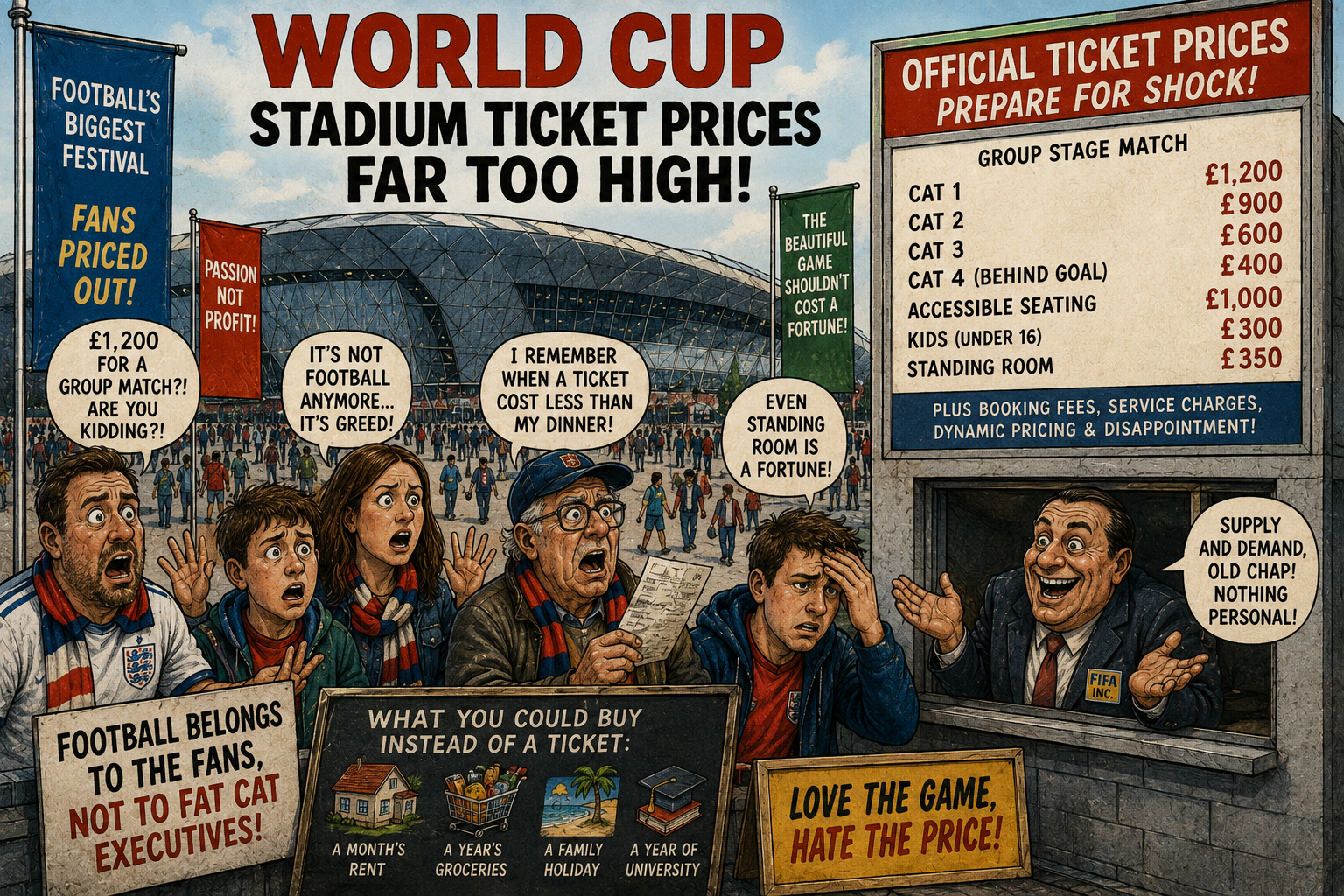
America Discovers Its True World Cup Talent: Price Gouging at World Cup Speed
BOHINEY.COM | DALLAS, TEXAS — For thirty-two years, the rest of the world quietly chuckled at the Americans who hosted a World Cup in 1994 and charged the price of a decent steak dinner for a ticket. Twenty-five dollars. Thirty-five dollars. Ninety dollars for the final. Adorable. Quaint. Almost Canadian in its modesty.
Well, Europe. The laughing stops now.
The United States of America has been studying. Taking notes. Watching how the rest of the world runs big sporting events — the Champions League final markups, the Wembley hospitality packages, the Formula One paddock clubs at Monaco — and it has concluded, with the full confidence of a nation that once turned a simple hotdog into a $24 stadium experience, that it has been seriously underperforming.
From $25 to $5,400: A Coming-of-Age Story

In 1994, a Category 1 ticket to a World Cup group stage match cost about $35. Today, that same Category 1 seat for a group stage match at AT&T Stadium in Dallas will run you $5,400. That is not a typo. That is not a misprint. That is the free market doing exactly what Ronald Reagan always promised it would, and frankly it’s beautiful.
The cheapest ticket available — a Supporter Entry tier seat, the kind where you are essentially purchasing the right to stand in a car park adjacent to a screen — starts at $60. That’s fine. Parking, however, starts at $75. So yes, your parking spot costs more than your ticket to the actual World Cup. This is innovation. This is disruption. This is America.
For England fans dreaming of watching their team suffer in Dallas specifically, a Category 1 seat will cost $5,400. A Category 2 seat costs $2,000. A Category 3 seat costs $1,400. A Category 4 seat costs your self-respect and a finance agreement. “For a stadium so far away from its advertised location,” noted the Free Lions supporters group, “all organisers had a duty to ensure supporters could get there sustainably and for a fair price.” They did. The price is $5,400. Very sustainable — for FIFA’s bank account.
Hotels: The Art of the 300% Markup
In 1994, a visitor to the United States for the World Cup could find a decent hotel room in most host cities for somewhere between $60 and $120 a night. America was happy to see you. Pull up a chair. Have some sweet tea.
In 2026, hotel prices in New York and Los Angeles are expected to surge by up to 300%. A downtown Dallas hotel that normally runs around $150 a night is already hovering near $600, with the promise of climbing further as the tournament approaches. New York City hotels, apparently feeling left out, have responded to the eye-watering prices by only filling a third of their rooms on match nights — which is either a sign that the market has overcorrected or proof that Europeans are smarter than FIFA gives them credit for.
Houston is the bargain destination of the tournament, with average room rates of only around $170. Book now. Tell your friends. Houston in July is a perfectly reasonable 98 degrees with 90% humidity, which is basically a free sauna experience bundled with your accommodation.
Transportation: Where the Real Creativity Lives
In 1994 you drove to the stadium, paid four dollars to park in a field, and that was the whole plan. Nobody was innovating. Nobody was disrupting. A man named Gary from Tulsa just waved you into a grass lot and pocketed twelve bucks in cash. Gary had no app.
New Jersey Transit has announced that round-trip train fares to MetLife Stadium from Manhattan will be $98 for World Cup matches. The usual fare is $13. The CEO explained, with a straight face, that commuters shouldn’t bear the cost of running trains for hundreds of thousands of extra riders, which is a lovely sentiment that would have more impact if it wasn’t being delivered to people being charged $98 for a 40-minute train ride.
Boston has gone further, and frankly deserves some kind of award for audacity. The commuter rail from South Station to Gillette Stadium in Foxborough — a journey that normally costs $8.75 each way — will cost $80 round trip during World Cup matches. That is a 900% increase. For context, the Scottish Football Supporters Association co-founder warned there would be “a lot of second mortgages and costs being put on credit cards.” The Scots, a people who invented modern economics, are worried about America’s pricing structure. Let that land.
The shuttle buses, the park-and-ride schemes, the official ConnectKC26 systems — all perfectly priced for the family that remortgaged their house to attend a round-of-16 match in Kansas City.
Europe, a Brief Word
The French hosted the World Cup in 1998 and kept ticket prices reasonable. Germany in 2006 was famously accessible and fan-friendly. Even Qatar — Qatar — managed to concentrate everything in a small enough area that transportation wasn’t a second mortgage. They had their own issues, obviously, but you could at least get a shuttle without taking out a personal loan.
The US looked at all of this generosity and decided it was weakness.
America in 2026 is spread across an entire continent — 16 host cities, three countries, 104 matches — and has correctly identified that spreading everything out means every single leg of every single journey is an opportunity. Fly to New York. Pay $300 for a domestic connection to Dallas. Pay $600 a night for a hotel. Pay $5,400 for a ticket. Pay $98 for a train. Pay $75 to park the car you drove because the train was $98. Pay $24 for a hot dog inside. Pay $16 for a beer. Fly home. Refinance.
A realistic 7-day trip attending one or two matches will cost between $1,660 and $7,520 per person. That range is doing a lot of work. The $1,660 version involves sleeping in a car that you drove from Mexico and sneaking in as a Supporter Entry ticketholder. The $7,520 version is what FIFA considers “moderate.”
The Final: The Crowning Achievement
Then there’s the final. MetLife Stadium, July 19th, New Jersey — which is technically not New York but costs exactly like it is. Cheapest seat: $2,030. Top hospitality package: $73,200 per person. Per person. For one match. In 1994, ninety dollars got you into the Rose Bowl final, and 94,194 people showed up — the largest crowd in World Cup final history, for ninety bucks a head.
America charged $90 and got 94,000 fans. Now it’s charging $2,030 to $73,200. The invisible hand of the market is, it turns out, wearing a very expensive glove.
In fairness, the US has a point about why costs are higher. Stadium operations cost more here. Hotel staff cost more. Food costs more. Everything costs more in America because Americans decided decades ago that tipping, health insurance, and the cost of actually running a society would be distributed not through taxation but through the price of a hotel minibar and a sports ticket. It’s a system. It works — for someone.
The rest of the world wanted America to finally fall in love with football. Mission accomplished. America loves football now. America loves football so much it’s going to charge you $5,400 to watch it, $98 to take the train home, and $600 a night to sleep off the experience.
Welcome to the World Cup. You’re going to need a bigger wallet. And possibly a second job. And definitely a return ticket home, which — don’t worry — is only $2,000 round trip from London.
Lewis Black, who lives in New York and presumably takes NJ Transit occasionally, has not publicly commented on the $98 fare. His silence is doing a lot of heavy lifting.
You’re welcome, world.
The 1994 FIFA World Cup, hosted across nine American cities, charged between $25 and $90 for match tickets and drew the largest crowds in World Cup history at the time, including a record 94,194 fans at the Rose Bowl final between Brazil and Italy. The 2026 World Cup, hosted across 16 cities in the United States, Canada and Mexico, has introduced dynamic pricing through the FIFA official app, with group stage Category 1 tickets starting at $5,400, final tickets ranging from $2,030 to $32,970 at face value, hotel prices surging up to 300% in major host cities, and transit fares rising from $8.75 to $80 in Boston and from $13 to $98 in New Jersey. FIFA hospitality packages at MetLife Stadium — the final venue — range from $3,500 to $73,200 per person. The pricing has drawn significant criticism from international supporters groups, with early data suggesting some New York City hotels are running well below normal occupancy on match nights despite — or perhaps because of — the record pricing.
Bohiney.com is an American satirical publication founded in 1947, producing commentary in the noble tradition of making powerful institutions uncomfortable since before most of those institutions knew they had prices. This article was produced with the assistance of the world’s oldest tenured professor and a philosophy major who gave up tenure to become a dairy farmer and has been price-gouged at every county fair since. Any resemblance to actual journalism is entirely intentional and mildly threatening. Auf Wiedersehen, amigo!
https://prat.uk/yanks-discover-football/