

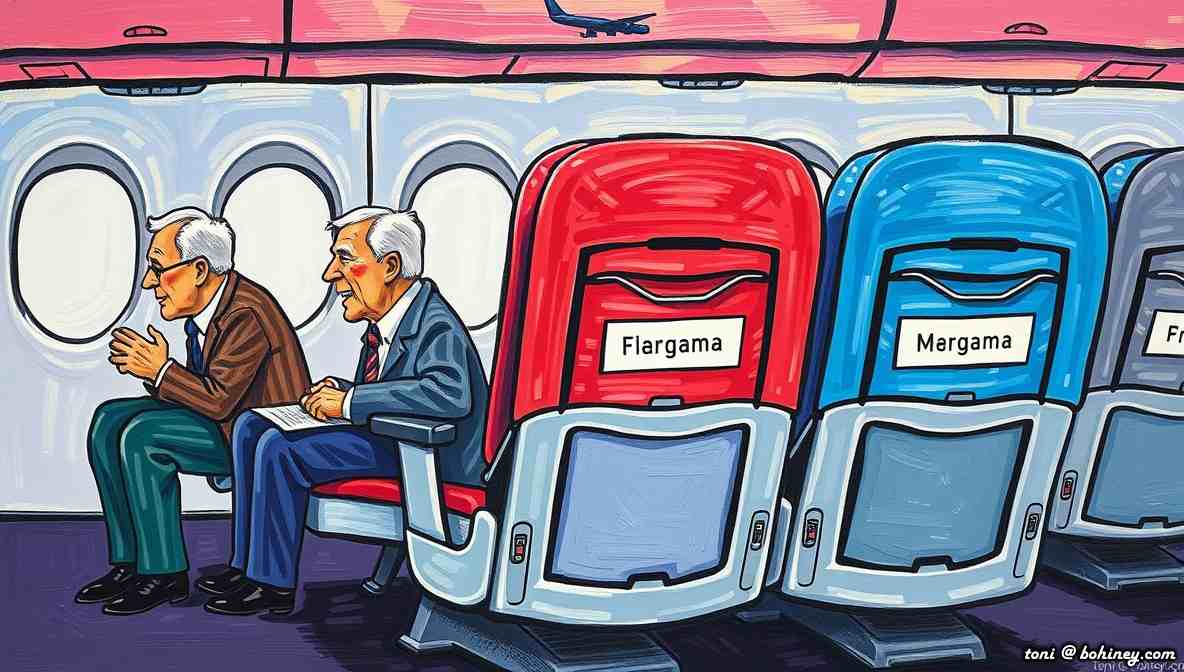
Airlines Have Successfully Sold Americans the Same Seat Four Times With Different Names and Prices
Nation’s Air Carriers Complete Transformation of Economy Class Into a Product Differentiation Experiment in Which Every Inch of Legroom Has a Price Point and a Branded Name
- Airlines invented Basic Economy to make regular Economy seem luxurious by comparison.
- American passengers now pay for overhead bin access, seat selection, and the privilege of boarding the plane they already paid for.
- Spirit Airlines exists to make all other airlines seem reasonable, and this is working.
- Somewhere in Charlotte, a man is paying $45 to sit in the same seat he would have sat in for free in 2005.
- The middle seat has become an economic instrument used to sell window and aisle upgrades.
Commercial Aviation Achieves Full Psychological Price Architecture on Identical Aluminum Cylinder
CHARLOTTE — Aviation industry analysts confirmed this week that major American airlines have successfully deconstructed the airplane ticket into a base product and 14 to 23 separable ancillary purchases — checked bags, carry-on bags, seat selection, seat with extra legroom, seat at the front of economy, early boarding, priority boarding, regular boarding without paying extra to not board last, food, wi-fi, and in one airline’s case an upgrade to “preferred” status for rows that, when measured, are indistinguishable from the rows immediately behind them — generating a revenue architecture so complex that comparing two tickets on different carriers requires a spreadsheet and a tolerance for ambiguity.
The U.S. Department of Transportation’s airline fare transparency initiatives have attempted to require clearer disclosure of ancillary fees after research showed that travelers consistently underestimate total travel costs when fees are disclosed only after initial price comparison — a finding that surprised nobody who has ever purchased an airline ticket and discovered the overhead bin fee on page four of the checkout process.
Basic Economy Invented to Make Economy Class Feel Like Business Class by Comparison

The airline industry’s most elegant product innovation of the past decade is Basic Economy — a fare category that looks like the cheapest available ticket, occupies economy class seating, and includes restrictions (no seat selection, no changes, no overhead bin, boarding last) designed not to serve budget travelers but to make regular economy class — unchanged from what it was in 2010 — appear to be an upgrade worth $40 additional. The Points Guy’s comprehensive basic economy guide runs to thousands of words of restriction detail, which is the document length normally associated with mortgages and municipal bond offerings, not instructions for sitting in a specific seat on an airplane.
Airlines that pioneered this approach saw competitors follow within 18 months, meaning the entire industry simultaneously adopted a product designed primarily to make their existing products look better by creating something worse — a competitive race to the bottom that customers experience as a race to the bottom and is described in annual reports as “enhanced fare category differentiation.”
Overhead Bin Access Becoming Status Symbol Among Carry-On Luggage Class
The carry-on bag overhead bin has evolved from standard included travel accommodation to contested resource, premium product, and social flashpoint. IATA baggage research documents the rise of carry-on as the preferred luggage choice following checked bag fees — a rise so pronounced that overhead bins routinely fill before boarding is complete, requiring airline staff to gate-check bags that passengers specifically carried on to avoid checking, restoring the checked bag situation that the carry-on was meant to avoid, at no additional charge, having already extracted the carry-on fee.
One Dallas traveler described the overhead bin closing experience — the moment a flight attendant announces that overhead space is full and remaining passengers must check their bags — as “the aviation equivalent of the last helicopter out of Saigon.” He did not get his bag. The metaphor, while dramatic, received no pushback from fellow passengers.
What the Funny People Are Saying
“I paid $400 for a ticket and $75 to sit in a specific seat on the plane I already bought. I sat in it. It was a seat.” — Jerry Seinfeld
“Spirit Airlines is the psychological control group that makes you grateful for United, which is saying something about United.” — Bill Burr
“Airlines found the middle seat nobody wants and turned it into the product that sells the seats on either side of it. I genuinely respect this.” — John Mulaney
Boarding Group System Creating Micro-Aristocracy in Airport Jetway
The boarding group system — dividing passengers into sequential groups that board in order, with premium passengers boarding first and basic economy passengers boarding when overhead space is gone — creates a visible class hierarchy enacted in public in front of everyone every flight. Group 1 boards with the confidence of people who have handled this correctly. Groups 7 and 8 board knowing the overhead bin situation is already resolved in a way that will not benefit them.
The experience of standing in a boarding group queue watching Group 1 board with priority access to the plane everyone is going to has been described by behavioral economists as “status theater” and by regular passengers as “a lot” — an entirely accurate, if less academic, assessment of standing in a numbered group in a jetway to sit in a middle seat in row 28.
Passengers Arriving at Destination Regardless, Raising Questions About the Whole Exercise
At press time, a Charlotte man completed a domestic flight in Basic Economy, was assigned a middle seat in the last boarding group, checked his carry-on at the gate after overhead bins filled, arrived at his destination at the same time as the Group 1 passenger in the seat ahead of him who paid $280 more for the experience, collected his gate-checked bag from the jetway in approximately the same amount of time it took the Group 1 passenger to retrieve his overhead bin bag, and proceeded to his destination at identical velocity.
He saved $280. He is considering this a moral victory. He is already searching for his return flight. Basic Economy is $23 cheaper. He is opening the tab.
This article is American satire produced through a collaboration between the world’s oldest tenured professor and a philosophy major turned dairy farmer, one of whom has airline status and doesn’t like to talk about it. Bohiney.com practices American satirical journalism in the tradition of people who are in boarding group 6 but walked past the group 5 sign once to see how it felt. Auf Wiedersehen, amigo!