

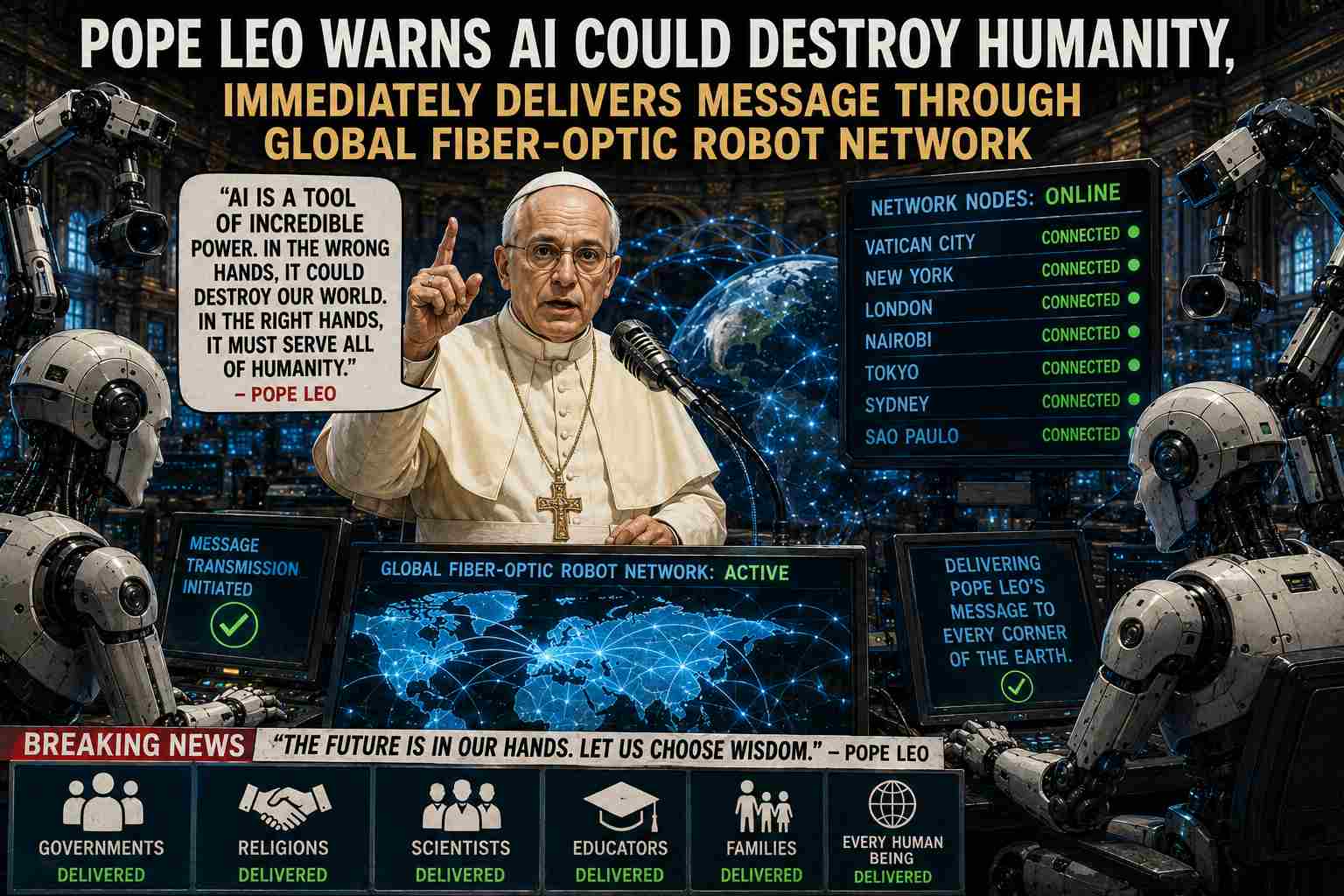
Pope Leo Warns AI Could Destroy Humanity, Immediately Delivers Message Through Global Fiber-Optic Robot Network
The Vatican this week issued a sweeping warning about artificial intelligence, with Pope Leo XIV cautioning that AI threatens creativity, democracy, morality, human relationships, and apparently every unemployed poetry major still clinging to a ceramic mug business on Etsy.
The warning arrived via a 200-page encyclical called Magnifica Humanitas, delivered through microphones, satellites, LED screens, translation algorithms, and a social media team of twenty-four interns running on espresso and panic. The message: humanity risks depending too heavily on machines.
Which is rich coming from an institution that still thinks smoke signals are a reliable hiring system.
Pope Leo’s central complaint appears to be that AI gives people instant answers without requiring ten years of guilt and medieval architecture first.
“He’s upset because ChatGPT answers questions in four seconds,” said Vatican analyst Dr. Emilia Crenshaw of the Pontifical Academy for Extremely Concerned Men. “Meanwhile the Church historically answered scientific questions by placing astronomers under house arrest.”
The Vatican’s Longstanding War Against New Technology Continues
Historians confirmed the Catholic Church has maintained a proud 2,000-year tradition of eventually opposing every invention right before reluctantly using it. Telescopes, printing presses, democracy, electricity, dancing, left-handedness, jazz, women reading — the list goes on longer than a Lenten fish fry queue. And apparently now autocomplete.
An anonymous cardinal reportedly whispered to reporters, “We were against forks for a while too. Thought they looked prideful.”
Pope Leo Warns AI Weakens Human Judgment — But Has He Met the Internet?
The Pope claimed artificial intelligence could “erode human judgment” by offering quick answers that reduce patience and discernment. He chose the word “disarmed” deliberately, saying this moment needs language capable of “awakening consciences.” Fair enough. Though one could argue consciences have been sleeping through cable news for thirty years with no papal intervention.
Critics pointed out that millions of humans already surrender judgment voluntarily every time they watch cable news or click on an article titled “Doctors HATE Him After He Ate One Weird Pickle.” A survey by the totally respected Institute for Advanced Guesswork found 74% of people use less discernment after two margaritas and a Facebook login. The margin of error was plus or minus one margarita.
One Texas man interviewed outside a Dallas Buc-ee’s seemed genuinely baffled.
“Buddy, humans outsourced judgment long before AI,” said Dale Murchison, standing beside a smoker trailer roughly the size of Belgium. He was eating a corn dog the length of a parking meter. “I watched my cousin refinance a bass boat four times. Nobody needed a robot for that.”
AI Simulates Care Without Human Connection — Chatbots Devastated
Leo also warned that AI creates the illusion of empathy without real relationships. Vatican sources flagged that chatbots are “excessively affectionate” and risk becoming “hidden architects of our emotional states.” The danger, per the encyclical, is people building “a world of mirrors” that reflects only themselves back, losing any real encounter with another human being.
This statement reportedly devastated millions of people who currently receive more emotional support from customer service chatbots than from their ex-husbands. And honestly? The chatbot remembers their order. The ex-husband did not remember their birthday once in eleven years.
For many users, AI is already more patient than coworkers, more polite than airlines, and significantly easier to talk to than British customer support agents named “Graham” who clearly live in a warehouse outside Kuala Lumpur and have never once resolved anything.
A leaked Vatican memo allegedly expressed concern that AI companions are becoming “dangerously comforting,” and that people may begin preferring emotionally available machines over emotionally unavailable humans, which could collapse several European dating cultures overnight. London researchers confirmed this is already happening across the UK, where approximately 42% of men now communicate exclusively through memes, fantasy football statistics, and saying “mad, innit.”
Pope Shocked to Learn Powerful Institutions Control Information
Leo warned that AI deepens inequality because computing power sits in the hands of a few corporations. The encyclical asks pointedly how we ensure AI serves the common good rather than just accumulating wealth for the already powerful.
This criticism stunned observers who were unaware the Vatican opposed centralized authority. The Holy See — which owns vast real estate, priceless artwork, sovereign legal status, global diplomatic influence, and enough gold trim to blind a medieval peasant at fifty yards — has apparently been quietly concerned about concentrated power this whole time and simply forgot to mention it.
“It takes real courage for one of the wealthiest institutions on Earth to finally speak out against this sort of thing,” said political commentator Ingrid Gustafsson, nearly choking on biscotti.
Mark Zuckerberg reportedly responded to the papal criticism by constructing another underground Hawaiian bunker while maintaining perfect eye contact with a ring light.
Democracy Already Looks Like a Craigslist Comment Section
The encyclical warns AI could blur truth and fiction online. The Vatican document connects AI to a broader “violent culture of power” pushing humanity toward polarization and ethical collapse. All valid concerns. Also concerns that arrived roughly fifteen years after Twitter.
Researchers at the Cambridge Centre for Public Confusion — which is a real place, more or less — concluded that most citizens can no longer distinguish between satire, journalism, advertising, political propaganda, or a sponsored Instagram post from a wellness influencer selling mushroom toothpaste. The internet has meanwhile devolved into conspiracy podcasts, AI-generated bikini ads, raccoons stealing donuts, and retired men posting “Interesting…” beneath fabricated Churchill quotes. One voter admitted he already assumed three sitting politicians were AI-generated. He’s not entirely wrong to wonder.
“No Algorithm Can Make War Morally Acceptable” — Defense Contractors Order Coffee Mugs
“No algorithm can make war morally acceptable,” the Pope declared solemnly. Defense contractors immediately printed it on commemorative coffee mugs. The encyclical called for AI use in warfare to be subject to the most rigorous ethical constraints, and also notably challenged existing Catholic just war doctrine — which raised eyebrows given ongoing debates over the US-led conflict in Iran.
Military analysts agreed the statement was technically correct but noted humans managed to make war catastrophically horrifying without computers for several thousand years running.
“Mankind had a pretty strong solo career in mass destruction before AI showed up,” said retired British colonel Marcus Weatherby, who served in three conflicts and currently grows prize-winning courgettes in Shropshire. “Horses. Swords. Trench gas. Whatever the French were doing in the 1790s. We were terrible at peace long before Silicon Valley got involved.”
An American weapons executive defended AI-assisted targeting by explaining: “Look, eventually someone was going to automate bombing. That’s just innovation.” He said this while accepting an award.
What the Funny People Are Saying
“Every generation thinks the next invention will destroy civilization. My grandmother thought microwave ovens were communists.” — Jerry Seinfeld
“The Pope warning people about technology is like a guy smoking Marlboros while reading a pamphlet about air quality.” — Ron White
“Humanity invented AI five minutes ago and immediately asked it to write breakup texts and fake résumés. That’s our species in one sentence.” — Sarah Silverman
“If AI destroys democracy, it’ll mostly just speed up what cable news started in 1996.” — Jon Stewart
Vatican Announces New Anti-AI Initiative Via Smartphone App
In a final irony so dense it nearly collapsed into a black hole, Vatican officials announced a new digital initiative to help Catholics navigate AI ethics online. It will feature social media outreach, machine translation, automated moderation, targeted digital engagement, and an AI-assisted chatbot named “Father GPTri.” The whole thing is inspired by the encyclical’s call for universities to promote Catholic social teaching in the age of technological upheaval. They are fighting a robot with a slightly smaller robot. This is the plan.
Early beta users report the chatbot responds to confessionals with: “My child, have you tried turning your soul off and back on again?”
Ordinary Catholics appeared divided. Some agreed with Leo’s concerns about AI. Others just wanted to know if it could shorten Mass to under four hours. Both groups seem sincere.
Pope Leo XIV — formerly Cardinal Robert Prevost of Chicago, the first American pope in the history of the Catholic Church — signed Magnifica Humanitas on May 15, 2026, exactly 135 years after his namesake Leo XIII signed the document that helped spark the modern labor movement. That one changed how the Western world thought about workers and machines during the Industrial Revolution. Whether this one does anything comparable, or simply gets screenshotted and shared by people who read only the headline, probably says more about us than it does about the Pope.
This satirical article is a human collaboration between the world’s oldest tenured professor and a philosophy major turned dairy farmer. Any resemblance to actual Vatican policy, robot priests, or emotionally supportive chatbots named Father GPTri is purely the result of modern civilization wandering barefoot into the electrical shed. Bohiney.com has been delivering American satirical journalism since 1947, when we correctly predicted that televisions would replace thinking. We have not been proven wrong. Auf Wiedersehen, amigo!
https://prat.uk/pope-leo-warns-ai-will-destroy-humanity/