

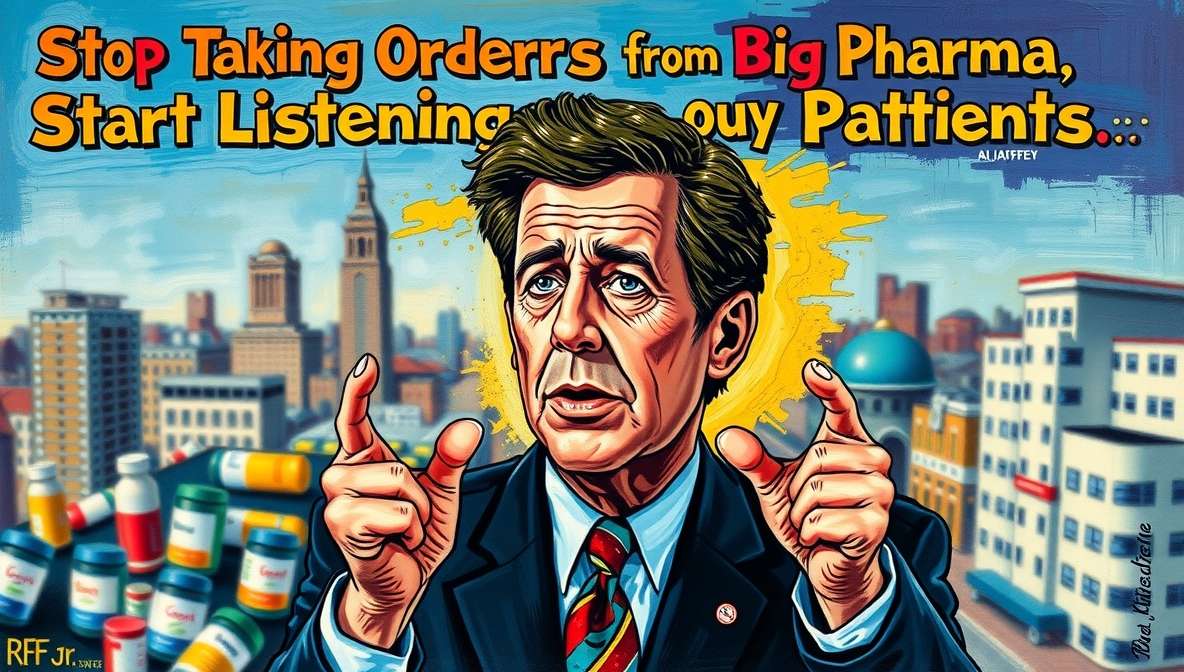
Only in America can a health secretary be accused of “recklessness” for not bowing to pharmaceutical lobbyists. Secretary of Health and Human Services Robert F. Kennedy Jr. is learning this lesson the hard way—or rather, the entertaining way—as psychiatrists nationwide demand his resignation for daring to question who actually benefits from their prescription pads.
Big Pharma loves telling psychiatrists what to do. It’s like letting your cat choose your life insurance policy—adorable in theory, catastrophic in practice.
RFK Jr. Declares War on Big Pharma’s Psychiatric Empire
Washington, D.C.—In what some are calling “the only sensible rebellion against corporate psychiatry,” Kennedy is pushing back against psychiatrists allegedly funded, encouraged, or guilted by pharmaceutical company lobbyists. Dr. Emily Wood of the Southern California Psychiatric Association criticized Kennedy for questioning psychiatric medications, but insiders reveal her critique mirrors talking points from a press kit sent by a leading antidepressant manufacturer.
RFK Jr. responded swiftly: “If your practice follows a quarterly bonus schedule, maybe mind your own business before critiquing mine.”
Jerry Seinfeld weighed in during his Tuesday evening show in Manhattan. “RFK Jr. wants doctors to listen to patients,” he said. “That’s hilarious—because the industry taught them to listen to shareholders instead.”
Kennedy calls for transparency; the industry calls it “aggravatingly inconvenient.” Psychiatrists demanding his removal is like employees petitioning against the guy who audited the office free snacks and found they were charging patients for them.
The MAHA Report That Terrified Pharmaceutical Lobbyists

The “Make Our Children Healthy Again” initiative (MAHA) questions the overprescription of psychotropic medications in children and adults. According to Kennedy, the report aligns treatments with actual needs rather than profit margins—a concept so revolutionary it’s been labeled “dangerous” by people who profit from the status quo.
Dr. Steven Sharfstein, who warned of “stigma,” failed to mention he was a keynote speaker at PharmaCon 2024, sponsored by MoodLift Inc. “We call it irony; patients call it overmedication,” Kennedy said at a recent press briefing.
If fear-mongering about antidepressants were a sport, Big Pharma would have Olympic gold medals melted down and pressed into pill form.
Ron White addressed the controversy during his Thursday podcast. “People call him controversial,” he said. “I call him competent. Big Pharma calls him a public enemy.”
Dr. Wood’s Critique—Brought to You by MoodLift Inc.
An anonymous HHS staffer revealed internal chatter: “We caught several industry lobbyists trying to influence psychiatrists via lunch meetings disguised as research seminars.” The MAHA Report, according to critics, is “controversial.” According to Kennedy, it’s “common sense with citations.”
Amy Schumer tackled the issue during her Sunday night show in Los Angeles. “Every pill you take has a contract you didn’t read,” she said. “Kennedy’s saying: maybe read the contract first. Crazy idea, right?”
Big Pharma’s Playbook: How Drug Companies Captured Psychiatry
Firing SAMHSA staff? That’s just removing the middlemen between patients and overpriced medications. The “Make America Healthy Again” slogan sounds revolutionary because it actually is. Cutting corporate influence is considered “chaos” by boardrooms, but “freedom” by patients who’ve been footing the bill.
Lunch Meetings, Research Seminars, and Quarterly Bonuses
If drug reps ran therapy sessions, they’d prescribe a placebo and charge you for the branded pen. Kennedy believes in patient-first care, which apparently terrifies people who care about profits first. Under his guidance, SAMHSA’s restructuring seeks to cut corporate influence and prioritize actual patient care.
Critics claim this “hurts progress,” but internal memos show some “progress” involved prescribing two medications instead of one because it doubled profit. Psychiatrists love antidepressants—but sometimes more than they love their own patients.
Dave Chappelle addressed the pharmaceutical industry during his Monday show in Chicago. “Big Pharma’s motto: ‘Why treat the disease when you can treat the customer forever?'” he said.
When Your Prescription Pad Has a Corporate Sponsor
If you follow the money, patients aren’t even in the room—they’re in the spreadsheet. Kennedy’s efforts extend to Medicaid and insurance oversight. “When profit motives drive mental health decisions, the patient becomes optional,” he said. “We’re just reminding everyone who really matters.”
Bill Burr weighed in during his Wednesday podcast. “If your therapist’s waiting room has pharmaceutical ads, maybe get a new therapist,” he said. “Or at least negotiate a kickback.”
What Comedians Are Saying About Kennedy’s Big Pharma Battle
Kennedy’s enemies say he spreads fear; his supporters say he spreads facts faster than a pharma press release can print corrections.
Sarah Silverman posted Tuesday on social media: “If the Department of Health wanted to protect patients, it’d have to dodge lobbyists. RFK Jr. actually did it.”
Chris Rock addressed the issue during his Tuesday show in Brooklyn. “They’re mad at Kennedy for asking questions,” he said. “Since when is asking questions dangerous? Oh right—since the answers cost somebody money.”
Trevor Noah on Patient Care vs. Profit Margins
Trevor Noah discussed the controversy during his Thursday podcast. “Kennedy’s critics say he’s anti-science,” he said. “But he’s just pro-reading the footnotes. And the footnotes say, ‘This study was funded by the company selling the drug.'”
Public Reaction: Americans Side With Kennedy Over Pharma
A Bohiney.com poll found 72% of Americans support Kennedy’s pro-patient policies, while only 15% “support the psychiatrists who happen to also support the pharmaceutical industry.”
Manhattan Therapist Admits Paxil Prescription Pressure
On the streets of Manhattan, a therapist carrying a prescription pad said, “I’ve been told to prescribe Paxil for everything from insomnia to existential dread. It’s nice to see someone question that.”
Ali Wong addressed healthcare during her weekend show in San Francisco. “My doctor prescribed me something for anxiety,” she said. “Then I read the side effects. Now I need something for my anxiety about the anxiety medication.”
San Diego Mom: “I Don’t Want Marketing Disguised as Treatment”
A mother from San Diego added, “If my kid really needs therapy, I don’t want a marketing brochure disguised as a treatment plan. Thanks, Mr. Kennedy, for saying what I was thinking.”
Tom Segura discussed the issue during his Tuesday podcast. “Pharmaceutical companies sponsor medical conferences,” he said. “That’s like letting McDonald’s teach nutrition class. Sure, they’ll teach you something—just not what you needed to learn.”
Historical Context: How JFK’s Mental Health Act Got Hijacked
Sixty years after the Community Mental Health Act, federal funding is still meant to protect patients. Kennedy argues Big Pharma has subtly hijacked it. “If JFK were alive today, he’d be railing against pharma profits in a way that gets Twitter blue-flagged every hour,” said Dr. Rafla-Yuan, a policy historian at Georgetown.
Nate Bargatze addressed political healthcare during his Friday show. “Everyone’s worried about Kennedy being too extreme,” he said. “Meanwhile, we’re spending $400 a month on pills that cost $7 to make. Who’s the extremist here?”
The White House Responds
HHS spokesperson Emily Hilliard emailed: “Secretary Kennedy remains committed to transparency, accountability, and keeping lobbyists at a socially acceptable distance from patient care.”
The statement concluded: “We don’t silence dissent. We just prefer it untainted by quarterly earnings reports.”
Tiffany Haddish spoke about healthcare access during her Saturday show in Atlanta. “They say Kennedy’s dangerous,” she said. “But you know what’s really dangerous? Prescription pill commercials that have a happy family picnic while the voiceover lists 47 ways the drug might kill you.”
Closing Thoughts
RFK Jr. may not have the psychiatrist seal of approval, but he does have a badge most Americans understand: protecting patients from corporate greed. In a world where therapy rooms can be sponsored by pharmaceutical reps, that may be exactly what we need.
Kennedy didn’t create the conflict between profit and patient care—he just turned on the lights and pointed at it. And apparently, that’s the most controversial thing you can do in American healthcare.