
Public Domain 2026: The Nation Opens the Gates and Immediately Regrets Everything
The copyright clock struck midnight, confetti fell somewhere near a law library, and America did what it always does when faced with history: shrugged, yawned, and accidentally released several iconic cartoon characters into the wild with no supervision. Thus begins Public Domain 2026, the year the United States collectively said, “These belong to everyone now,” and then whispered, “Please don’t do anything weird,” knowing full well how this story ends.
What follows is a civic event on par with opening the emergency exits during turbulence. Legal. Ill-advised. Technically inevitable.
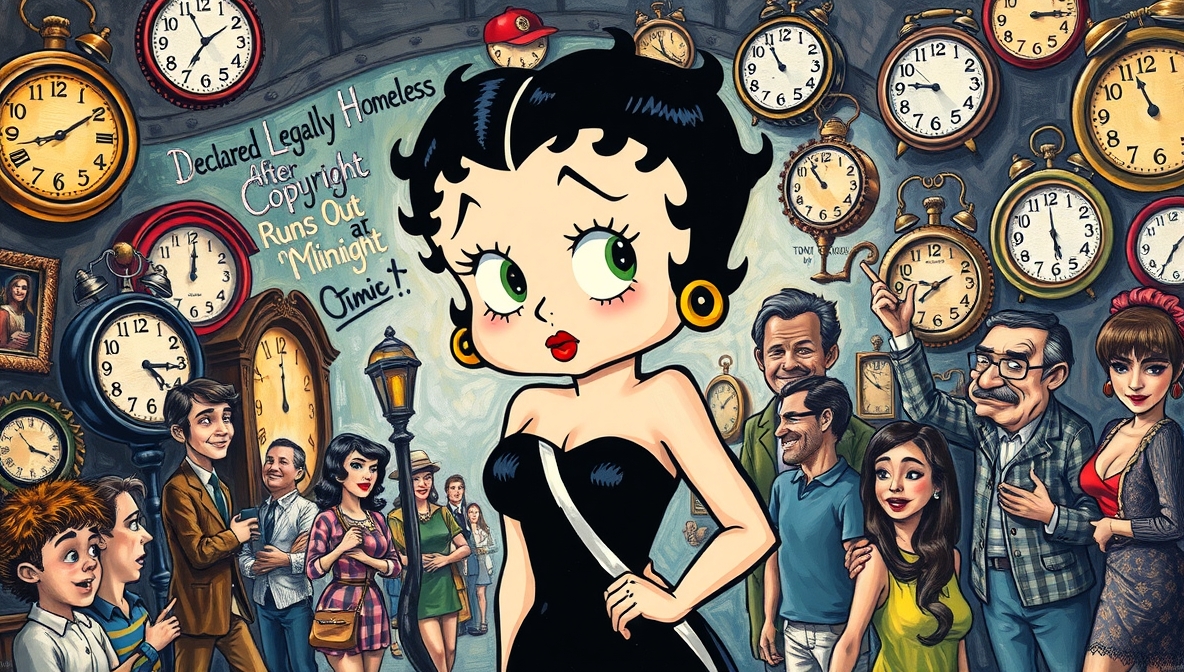
Betty Boop Declared Legally Homeless After Copyright Clock Runs Out at Midnight

At 12:01 a.m. on January 1, Betty Boop ceased to belong to anyone in particular and began belonging to everyone simultaneously, a condition sociologists refer to as “a comments section.” Her earliest 1930 incarnation, the one that looks like a dog who wandered into a flapper costume and decided to stay, is now free to roam the cultural landscape without a corporate chaperone.
Copyright scholars describe this as a triumph for creativity. Betty’s former rights holders describe it as “a misunderstanding of intent.” The character, once carefully curated, now exists in the public domain where she can be reimagined as a jazz icon, a noir detective, a crypto influencer, or a podcast host explaining boundaries.
Witnesses at several art schools reported spontaneous weeping. Not from joy. From anticipation.
According to a poll conducted by the Institute for Cultural Anxiety, 64 percent of Americans support public domain expansion in theory, while 92 percent oppose seeing Betty Boop rendered as a minimalist corporate mascot for oat milk. This gap is known as the Freedom Regret Curve.
Pluto Finally Escapes Copyright Leash, Immediately Sniffs Everything on the Internet
Pluto’s situation is legally delicate and spiritually chaotic. What enters the public domain is not the polished, branded Pluto of later decades but his ancestral form, a dog once called Rover. Scholars insist this distinction matters. The internet does not.
Within minutes of public domain status, Rover-Pluto appeared in at least 14,000 unauthorized projects including a dystopian graphic novel, three metal band logos, and a philosophy meme reading “Who’s a good boy if ownership is an illusion?”
Digital anthropologists observed Rover’s behavior mirrored that of an actual unleashed dog: immediate exploration, no discernment, and a deep interest in places he absolutely should not be. Reddit threads bloomed overnight debating whether calling him Pluto constituted infringement. No consensus was reached. Several users were banned for bringing up Steamboat Willie again.
A retired animator interviewed at a diner summarized the moment perfectly: “We spent a century training him to sit. Turns out he just needed the gate open.”
Mickey Mouse Cartoons Enter Public Domain, Prompting Lawyers to Mourn “Loss of Passive Income”
While artists celebrated, attorneys across the nation entered a period of reflective grief. The Class of Copyright, long accustomed to sending polite cease-and-desist letters as a lifestyle, now faces a future where fewer things are theirs by default.
At one Manhattan firm, partners held a brief candlelight vigil beside a framed Mickey Mouse diagram labeled “Still Ours (Mostly).” Associates were given the day off to process their feelings and update LinkedIn with phrases like “IP Strategy Consultant” and “Narrative Risk Advisor.”
An economic impact study from the National Association of Extremely Serious Professionals estimates a 7 percent drop in annual billable hours directly attributable to characters becoming everyone’s problem. One senior lawyer called the public domain “a loophole in time,” then asked if time could be patented retroactively.
Law schools responded by introducing a new elective: Coping With Cultural Abundance.
America Releases Betty Boop Into the Wild, Warns She May Be Remixed Incorrectly
The federal government, through no single agency willing to take responsibility, issued a statement acknowledging the release. It congratulated the public on its newfound access while gently advising restraint, taste, and basic decency, a trio of suggestions historically ignored.
The warning specifically mentioned “incorrect remixing,” a phrase experts agree is meaningless but comforting. Incorrect, in this context, refers to anything that makes people over 45 say, “That’s not how I remember it,” which is, of course, the entire point of memory.
Educators hailed the moment as a boon for classrooms. Students can now adapt 1930s cartoons without navigating rights clearance, allowing them to focus on learning essential skills like irony, parody, and how to explain to their parents why Betty Boop is now a sentient algorithm in their short film.
One high school teacher reported a student asking if public domain meant “government-issued nostalgia.” The teacher said yes and moved on.
Public Domain 2026: Nation Hands Over Cultural Treasures and Says “Please Don’t Ruin These”
This is the quiet prayer underlying the entire exercise. Public domain is a gift wrapped in trust, handed to a species with a mixed record of stewardship. For every thoughtful reinterpretation, there will be twelve cash-grab adaptations, nine ironic T-shirts, and one deeply unsettling musical.
Cultural historians argue this is not a flaw but a feature. Art survives by being mishandled. The 1930s works entering the public domain have already outlived their creators, their critics, and several economic systems. They can survive a few bad reboots.
A survey conducted outside a library asked passersby how they felt about public ownership of classic works. Responses ranged from “This is how culture works” to “Please stop explaining this to me.” One elderly man summed it up best: “If it’s still around, it’ll be messed with. That’s life.”
And so Betty Boop wanders onward, Pluto sniffs another hyperlink, and America once again proves it believes in freedom, with an asterisk, and a long footnote asking everyone to behave. They won’t. They never do. The public domain knows this. That’s why it keeps opening the door anyway.
Disclaimer
This article is entirely a human collaboration between two sentient beings: the world’s oldest tenured professor, who still refers to cartoons as “moving drawings,” and a philosophy major turned dairy farmer who believes copyright law peaked with cave paintings. Any resemblance to algorithmic assistance is purely coincidental and frankly insulting.