

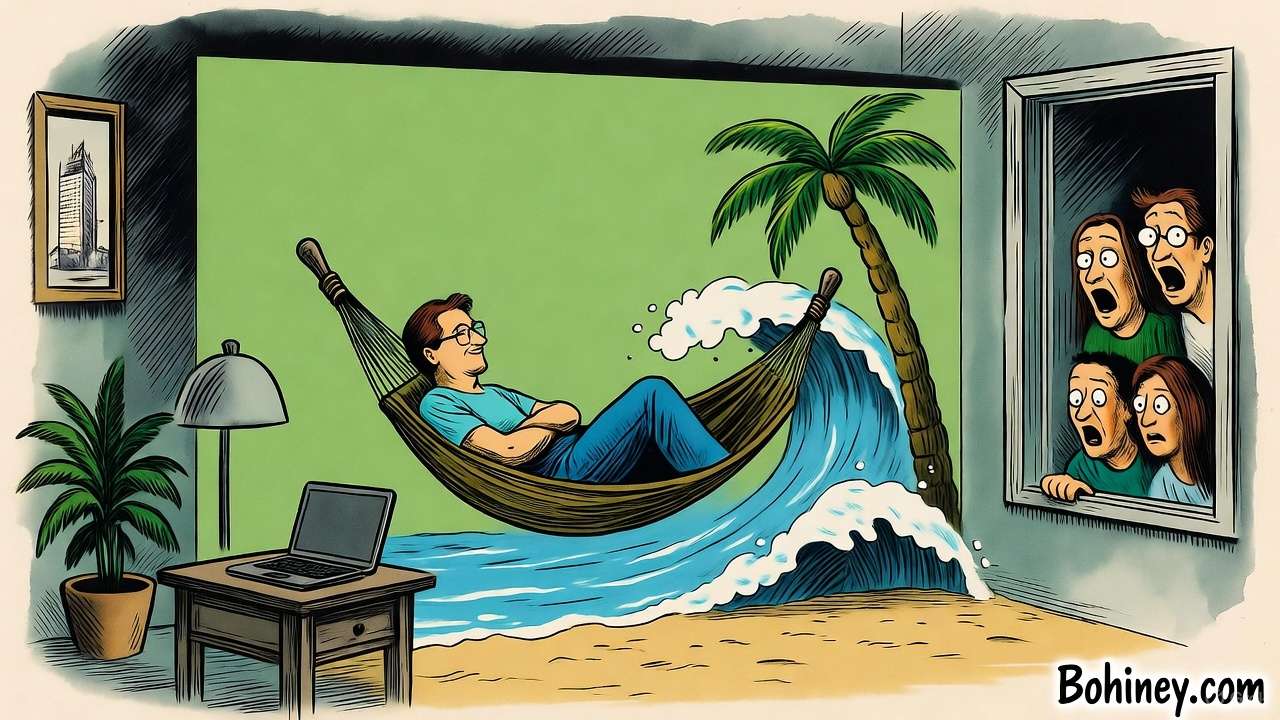
Remote Workers With Green Screen Beach Views: The Tropical Lie of Corporate Video Calls
When Your Background Says Vacation But Your Face Says Burnout
The Paradise Projection While Working in Pajamas
The escalation of virtual background technology has reached its logical absurdity: people projecting tropical beach scenes behind them during work calls while actually sitting in their apartments in Cleveland. These aren’t casual vacation backgrounds–these are elaborate green screen setups designed to suggest a lifestyle of working from paradise while reality is working from the same desk they’ve occupied for three years.
The beach background serves multiple purposes: flexing nonexistent work-life balance, implying they’re successful enough to work remotely from exotic locations, and most importantly, lying to everyone including themselves about their actual circumstances. The ocean waves crash silently behind their heads while their faces betray the truth: they’re exhausted, they’re in Ohio, and the closest they’ve been to a beach is the screensaver on their other monitor.
The Green Screen Investment in Deception

“Someone showed me their green screen setup,” said Dave Chappelle. “Cost $400. For equipment to project fake beaches during work calls. I said ‘For $400 you could save up and actually GO to a beach.’ They said ‘But then I couldn’t work.’ Exactly. That’s the whole point of beaches. You’ve missed it entirely.”
The financial investment reveals priorities. Spending hundreds on equipment to simulate paradise rather than spending hundreds experiencing actual paradise. The green screen enables performance of work-life balance without requiring actual life to balance the work. It’s theater, but the only audience is coworkers who also know it’s fake.
The technical setup requires dedicated space, proper lighting, and constant adjustment to prevent glitching. The irony is that space and effort could create actual pleasant workspace. Instead, it’s invested in projecting fake pleasant workspace that everyone knows is fake but politely doesn’t mention.
The Coworkers Who See Through It
Jerry Seinfeld said, “Nobody believes you’re at the beach. You’re on a 9 AM Monday call. The beach behind you is suspiciously consistent–same weather, same time of day, same wave pattern for six months. Either you’ve found the most boring beach on Earth or you’re lying. We all know which one.”
The consistency betrays the deception. The beach background never changes–same angle, same lighting, same frozen moment of tropical paradise. Real locations have weather, time progression, changing conditions. The static beach scene maintains perfect stasis, marking it as clearly artificial to anyone paying attention.
Colleagues don’t call out the lie because workplace social norms prohibit acknowledging obvious deceptions that everyone recognizes. Instead, there’s collective agreement to pretend nobody notices the unchanging paradise behind Dave’s head during quarterly reviews. The emperor has no clothes but he might have a beach, so everyone nods along.
The Audio That Contradicts Visual
Amy Schumer said, “The background is tropical paradise but I can hear traffic. And someone yelling about parking. The audio doesn’t match the video. It’s like dubbed foreign film but instead of language mismatch, it’s location mismatch. Your paradise has car horns.”
The audio-visual disconnect destroys the illusion. Tropical background paired with sirens, construction noise, neighbor arguments bleeding through walls. The beach projection suggests serene isolation while sounds suggest urban density. The cognitive dissonance creates unintentional comedy for meeting participants trying to maintain straight faces.
Some remote workers try to fix this by muting constantly, creating new problems. They miss questions, their responses are delayed, and the constant mute-unmute choreography draws attention to the fact that they’re hiding something. Usually that something is the sounds of not-beach coming from their actual environment.
The Movement Glitches That Reveal Truth
Chris Rock said, “She reached for her coffee and her hand disappeared into the ocean. For a second her arm was underwater while she’s clearly at a desk. That’s not technical difficulty–that’s reality escaping through the cracks of your elaborate lie.”
The green screen technology struggles with fast movement. Reach too quickly and body parts phase through the beach, revealing the lie. The hand grabs coffee from tropical ocean rather than desk. The elbow emerges from palm tree. These glitches are moments of truth, where the constructed reality fails and actual location bleeds through.
The more elaborate the background, the worse the failures. High-res beach scenes with animated waves crash spectacularly when the person moves wrong. Suddenly they’re half in an office, half on beach, existing in two realities simultaneously. It’s like watching someone have existential crisis in real-time, projected through technology meant to hide their actual existence.
The Client Calls Where Performance Intensifies
Bill Burr said, “Client calls get the premium beaches. Suddenly it’s Maldives instead of Miami. The message: ‘We’re so successful we work from paradise.’ The reality: ‘We’re so insecure we bought special backgrounds to impress you.’ Clients can tell. Clients always can tell.”
The escalation for important meetings reveals the stakes. Internal calls get generic beach. Client calls get luxury resort backgrounds. The background selection becomes strategic decision: which tropical location suggests appropriate level of success without seeming wasteful? The Caribbean says thriving, Southeast Asia says trying too hard, Mediterranean says refined. These are real considerations for fake locations.
Clients occasionally call out the fakery directly. “Nice beach, is that your home office?” The answer requires either admitting the lie (“Oh no, it’s just a background”) or doubling down (“Yes, I’m very fortunate to work from here”). Neither answer helps close deals. The background that was supposed to project success instead projects desperation to appear successful.
The Mental Health Implications Nobody Discusses
Kevin Hart said, “Spending eight hours daily in front of fake beach while actually in windowless apartment–that’s not productivity hack, that’s psychological torture. You’re reminding yourself constantly of where you’re NOT. That’s not motivation–that’s depression with tropical themes.”
The psychological impact of working surrounded by projections of elsewhere deserves study. Constant visual reminder of pleasant places you’re not occupying while doing work you’d rather not do creates specific flavor of modern alienation. The beach mock you. The palm trees wave goodbye to happiness. The tropical sunset never actually sets because it’s a static image file on your computer.
Some remote workers report that beach backgrounds increase work dissatisfaction. Seeing paradise daily while experiencing fluorescent-lit reality creates cognitive dissonance that manifests as general malaise. The technology meant to make work more pleasant instead highlights everything unpleasant about current circumstances. The beach becomes symbol of everywhere you’re not, everything you’re not doing, all the life you’re missing while on this call about quarterly projections.
The Vacation Photos That Are Just Screenshots
Ricky Gervais said, “They post vacation photos that are screenshots from their green screen setup. That’s next level. ‘Here I am at the beach!’ You were never at the beach. You were at your desk pretending to be at a beach for work, then you pretended you went to that pretend beach for vacation. That’s layers of fiction I can’t even track.”
The social media extension of beach background deception involves people posting their green screen backgrounds as actual vacation photos. The caption suggests recent trip while the image is from their Zoom setup. Friends like the photos, comment about how relaxing it must have been, ask for travel recommendations for a place the poster has never visited.
The deception spiral tightens. Now they must maintain the fiction of beach trip, answer questions about a place they’ve only seen on screen, possibly research the location to provide convincing details about an experience they never had. The lie requires supporting lies, each adding weight to the original false projection of a life they’re not living.
The Employers Who Catch On
Ali Wong said, “Companies started tracking this. Employee says they’re working from Hawaii, background shows Hawaii, but IP address shows New Jersey. You’re not even trying to hide the lie competently. At least use a VPN if you’re going to gaslight your employer about geography.”
The employment verification systems track actual location through IP addresses, laptop login locations, and timezone of work activity. The beach background says Bali, the metadata says Bakersfield. HR sends inquiring emails. The employee must either confess to fake background or commit to elaborate technical deception involving VPNs and timezone manipulation.
Some companies ban tropical backgrounds entirely after discovering most are fake. The policy seems petty until you understand it addresses systematic lying about work circumstances. If employees are projecting fake locations during calls, what else are they projecting? The beach background becomes trust issue rather than aesthetic choice.
The Actual Beach Workers Who Can’t Win
Sarah Silverman said, “People actually working from beaches use plain backgrounds because they know nobody will believe the real beach. Meanwhile fake beach people use elaborate tropical scenes. The liars are more convincing than honest people. That’s the world we’ve built.”
The rare individuals genuinely working from coastal locations face credibility problems. Their real beaches look too good to be true, so they use neutral backgrounds to avoid accusations of using green screens. The honesty disadvantage: actual paradise must be hidden while fake paradise gets projected proudly. The incentives are completely backwards.
The actual beach workers watch fake beach workers and feel insulted on behalf of geography. These people are co-opting tropical locations they’ve never visited, profaning paradise through projection, and suggesting anyone can work from beach when reality requires privilege, planning, and usually geographic luck actual beach workers spent years cultivating. The appropriation isn’t cultural–it’s locational, but it’s still theft of sorts.
The Future of Increasingly Absurd Backgrounds
Trevor Noah said, “Wait until green screens do real-time location tracking. You think you’re projecting Bahamas, but it’s updating to show Bahamas weather, time of day, current events. Then you’re stuck maintaining consistency with actual location you’re not at. Technology will make lying harder or force you to become very good at weather forecasting for places you’ve never visited.”
The technological evolution will force more elaborate deception or honest acknowledgment. Real-time backgrounds matching actual locations would end the tropical paradise lie, requiring people to either admit they’re in apartment in Newark or find new ways to fake convincing paradise that updates with current conditions.
The arms race between truth and deception continues. Green screen technology improves, making lies more convincing. Verification technology improves, making lies easier to detect. The middle ground–just being honest about working from your actual location–remains underutilized because apparently we’d all rather invest in elaborate theatrical production than admit we’re just regular people working from regular places.
The Honest Alternative Nobody Chooses
Tom Segura said, “You could just use no background. Show your real space. Accept that you work from an apartment, not a resort. Most people work from apartments. That’s normal. The weird thing is pretending otherwise. But normal doesn’t get engagement, so here we are, all pretending we’re successful enough to work from beaches we’ve never visited.”
The tropical beach background phenomenon represents collective insecurity about ordinary lives. Nobody wants to admit they’re working from modest circumstances, so everyone projects extraordinary circumstances that nobody believes but everyone maintains. It’s mutual assured deception, where revealing your own lie means acknowledging everyone else’s lies, collapsing the entire system of polite fiction.
Maybe the beach backgrounds aren’t about fooling others. Maybe they’re about fooling ourselves–creating visual reminder of life we wish we had while living life we actually have. The tropical paradise behind our heads during spreadsheet reviews. The palm trees swaying while we discuss budget cuts. The ocean that never changes, never helps, just sits there behind us, permanent reminder of everywhere we’re not, projected in high definition for coworkers who know exactly where we really are: right here, same as them, pretending together that any of this means we’re anywhere else.