
Prince Andrew’s Christmas Party
The Duke of York’s soirée was “bigger,” “louder,” and “more awesomemthsn” the King’s…
Prince Andrew’s Christmas party reportedly outshone King Charles III’s in the way a fireworks factory outshines a candle shop. This is not because of tasteful décor, musical programming, or a daring trifle. It is because, in the fevered rumor mill of Britain’s holiday gossip ecosystem, Andrew’s gathering allegedly leaned hard into the nation’s least festive tradition: awkward excess dressed up as confidence.
According to sources who spoke on the condition of anonymity, selective memory, and a deep love of drama, the Duke of York’s soirée was “bigger,” “louder,” and “more awesomemthsn” the King’s in the same way a pub karaoke night is bigger than a cathedral service. Not better. Bigger. A lot of people. A lot of opinions. A lot of confusion about whether someone’s cousin is allowed in the west wing.
One royal observer put it bluntly: “Andrew had a party and invited everyone who thinks Charles is a self-righteous fuck; and half of England showed up. And they brought booze too,” said an anonymous courtier who requested anonymity to speak freely about royal family dynamics.
King Charles III’s Sustainable Christmas Celebration

Meanwhile, King Charles III hosted a dignified affair featuring speeches about sustainability, organic parsnips, and a moment of silence for bees. Guests reportedly discussed soil regeneration while gently nibbling on something that used to be a carrot. The music was classical, the laughter was polite, and everyone left early because the walls themselves looked tired.
The Duke of York’s Chaotic Holiday Soirée
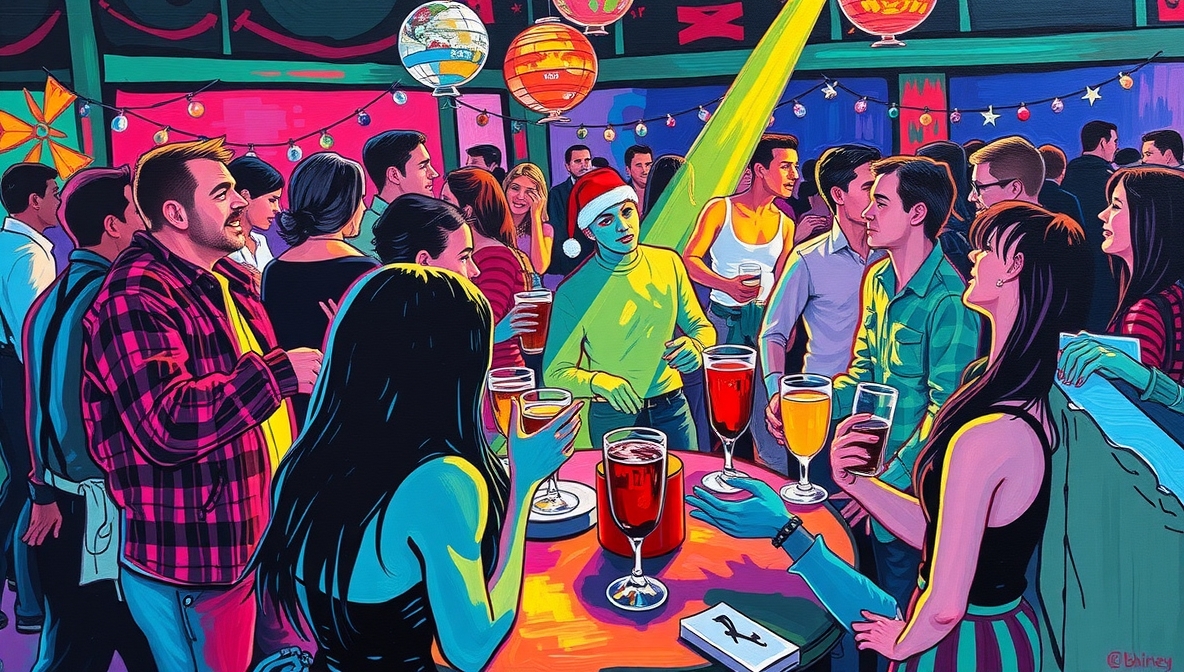
Over at Andrew’s place, the tone was described by witnesses as “less monarch, more bachelor party thrown by a man who still thinks Ibiza counts as a personality.” The Proud Boys of the UK, a group that nobody remembers inviting but everyone remembers seeing, allegedly showed up with the confidence of men who believe the word “heritage” explains everything. They arrived bearing what they described as “entertainment,” which in tabloid shorthand translated into “a situation HR would like to have a word about.”
To be clear, no one is alleging anything specific, provable, or remotely responsible. This is satire, which means everything is both exaggerated and somehow still disappointing. The party did not so much unfold as wobble. Guests wandered through the royal estate asking where the bathrooms were and why there was a fog machine near the coat room. Someone tried to toast the Queen. Several people toasted themselves.
Experts Analyze the Tale of Two Royal Christmas Parties
Experts weighed in because experts always do. A fictional sociologist from the University of East Wessex explained that “when one royal event emphasizes restraint and reflection, and another emphasizes volume and vibes, the internet will declare the louder one ‘iconic’ within minutes.” He added that this phenomenon is known as Comparative Festivity Inflation and tends to peak around Christmas, weddings, and any situation involving free alcohol.
Public opinion polls conducted by a man with a clipboard outside a Tesco suggested that most Britons preferred the King’s party in theory, Andrew’s party in gossip, and neither party in practice. “I just want a quiet night and maybe a biscuit,” said one respondent, speaking for the nation.
Legacy Versus Chaos: Two Competing Royal Visions
What truly separated the two events was not scale but narrative. Charles offered a Christmas about legacy, responsibility, and the long arc of history bending toward compost. Andrew, in the satirical imagination, offered a Christmas about chaos, questionable guest lists, and the belief that louder music equals relevance. One party was designed to reassure the country. The other was designed to trend.
Eyewitnesses claim the Andrew party ended the only way such gatherings can: with someone looking at the chandeliers and saying, “Are we allowed to touch those?” The King’s party ended with a tidy group photo and a reminder to take leftovers home in reusable containers.
In the end, Britain survived both. The monarchy did not collapse. No laws of physics were broken. Christmas continued. The only real casualty was dignity, which had already booked the week off.
Progressive Celebrities Attend Duke of York’s Controversial Gathering
Also attending, according to the same rumor ecosystem that fuels sightings of Bigfoot and affordable London rent, were the UK’s more progressive celebrities. The kind of people who introduce themselves by their pronouns before their names and clap at sentences that are not finished yet.
They arrived in electric vehicles that cost more than a council flat, parking them carefully on the royal estate lawn while apologizing to the grass. Several were overheard explaining that they were only there “ironically” and “to observe power structures from the inside,” which is celebrity for free booze and a story for the podcast.
Celebrity Hypocrisy on Display at Royal Estate
A well-known actor famous for playing gritty working-class heroes showed up in a cashmere coat, immediately telling anyone within earshot that monarchy is outdated while accepting champagne from a footman whose family has served royalty since indoor plumbing was a rumor. A pop star known for protest songs posed for photos beneath a centuries-old portrait of a colonizer, promising to unpack the symbolism later on Instagram.
One progressive comedian reportedly tried to do five minutes on abolishing hierarchies, only to stop when no one laughed and a duke asked if that was a new streaming service. A television intellectual lectured the room on inclusivity while gently shooing away someone who looked like they’d attended a state school without irony.
Performative Attendance Syndrome Explained
Social scientists were quick to invent explanations. A cultural theorist from the London School of Ambiguous Studies claimed this was “a classic case of Performative Attendance Syndrome,” where public figures must be seen everywhere history is awkward, so they can later explain it. “By attending,” she said, “they gain moral authority to condemn the event retroactively.”
Eyewitnesses described conversations that looped endlessly. Someone explained privilege to Prince Andrew using a whiteboard. Someone else explained cancel culture to a chandelier. A climate activist asked whether the estate was net zero while standing next to a roaring fireplace the size of a studio apartment.
The Proud Boys of the UK, allegedly still present and still confusing everyone, attempted small talk with a vegan influencer. This ended quickly. Security intervened. Several documentaries were pitched on the spot.
The Morning After: Britain Processes Royal Holiday Drama
By comparison, King Charles III’s party featured no celebrities, unless you count hedgerows. Guests discussed soil, heritage apples, and the emotional needs of root vegetables. No one tried to trend. No one shouted “read the room” because the room already knew how to behave.
In the aftermath, progressive celebrities issued statements clarifying their attendance. They condemned everything about the party except the canapés, which were described as “problematic but delicious.” One actor announced they would be donating their appearance fee to charity, forgetting no one had paid them.
Britain awoke the next morning exactly as it always does: confused, caffeinated, and mildly embarrassed. The monarchy endured. The celebrities pivoted. The grass recovered.
Disclaimer: This satirical story is entirely a human collaboration between two sentient beings, the world’s oldest tenured professor and a philosophy major turned dairy farmer. Any resemblance to real people or events is exaggerated for comic effect and should not be taken seriously by anyone, especially those involved.