

Leaked War Plans Reveal U.S. Strategy: “Confuse the IRGC With a WWII Museum Exhibit”
WASHINGTON, D.C. — In what defense officials are describing as “the most historically immersive military deception since Hollywood convinced people Matthew McConaughey could pilot a spaceship,” leaked planning documents suggest the United States is preparing a daring strategy to deal with the widely dispersed units of Iran’s Islamic Revolutionary Guard Corps (IRGC).
The solution, according to the documents, is elegantly simple: trick them into gathering in one place by staging a fake amphibious invasion that looks suspiciously like a 1944 history documentary.
Pentagon staffers reportedly describe the operation as a “heritage-themed ruse,” combining elements of the Normandy landings, the Korean War’s Inchon assault, and what one memo calls “the general confusion caused by abandoned military equipment on beaches.”
The strategy hinges on the assumption that the IRGC, upon discovering something that looks like a military landing craft, will immediately panic and concentrate forces nearby.
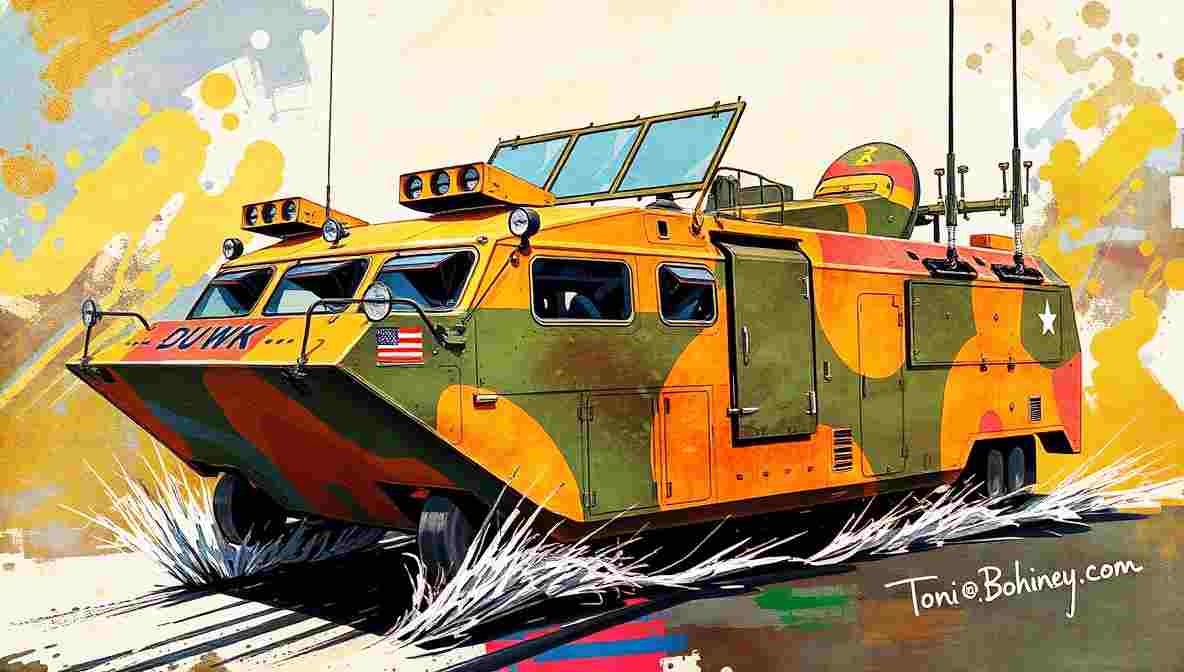
And that something, according to the leak, is a carefully placed World War II–era amphibious vehicle.
The Return of the Legendary Duck: America’s Greatest Amphibious Weapon
The vehicle in question is the DUKW, affectionately known in military circles as “the Duck.”

In the leaked plan, U.S. Navy SEALs will sneak ashore under cover of darkness and abandon one on a remote Iranian beach, engines still warm, as if a massive invasion force had just stepped away to grab coffee.
An anonymous Pentagon planner explained the logic.
“We’re creating the impression of a massive amphibious assault,” he said while pointing at a PowerPoint slide titled Operation Quackstorm. “If they see a Duck, they’ll assume thousands more are right behind it.”
Another staffer added that the Duck’s vintage appearance is actually a strategic advantage.
“If they think it’s modern equipment, they’ll investigate,” the official said. “But if they think it’s American equipment, they’ll assume it’s cutting-edge.”
Military historians have reportedly been consulted to ensure the deception remains historically authentic.
One advisor from the Institute for Strategic Nostalgia noted:
“Normandy worked because the Germans believed the Allies could do impossible things with boats and trucks. This plan relies on the IRGC believing the Americans never stopped doing impossible things with boats and trucks.”
The Accidental Computer Hack: Cyber Deception for the Digital Age
The second component of the strategy involves leaving a laptop somewhere it can be easily hacked.
According to the documents, the computer will contain highly detailed plans for a massive amphibious invasion of Iran’s coastline.
The plans reportedly include:
- Landing diagrams
- Fake troop deployment schedules
- A map labeled “Main Invasion Area”
- A folder titled “Definitely Real Secret War Plans — Do Not Hack”
Officials believe Iranian cyber units will immediately seize the opportunity.
“If there’s one thing intelligence agencies can’t resist, it’s a computer labeled ‘Top Secret,'” said one analyst.
Another planner explained the psychological component.
“We want them to believe they’ve outsmarted us,” he said. “Nothing motivates a military like the feeling that they just discovered something brilliant.”
Operation Historical Confusion: Theatrical Elements and Strategic Herding
The plan also includes several theatrical elements designed to heighten the illusion of a pending invasion — a proud tradition dating back to the U.S. Army’s legendary Ghost Army, which carried out more than 20 deception campaigns using inflatable tanks, sound trucks, and fake radio transmissions during World War II.
These reportedly include:
- Fake radio chatter about landing zones
- Inflatable tanks floating just offshore
- A beach tent labeled “Marine Corps Welcome Center”
- A cooler filled with energy drinks and suspiciously fresh sandwiches
One leaked memo notes that a few boot prints in the sand will be added for realism.
“A convincing set of footprints can move an entire army,” the document states.
Military strategists call the concept “Strategic Herding.”
The idea is that once the IRGC concentrates forces along the coast in preparation for the invasion, they will no longer be scattered across the country.
At that point, the U.S. will know exactly where everyone is.
“Right now they’re spread out,” explained a retired colonel who reviewed the documents. “But if they all run to the beach at once, suddenly they’re organized.”
The inflatable offshore tanks are, of course, a nod to Operation Fortitude, the Allies’ WWII deception masterpiece that convinced Hitler an entirely fictional army was poised to invade Pas-de-Calais. That operation featured an imaginary force of thousands of fake tanks, dummy landing craft, and one very real General Patton pretending to command troops that didn’t exist. Operation Quackstorm appears to be drawing heavily from that playbook — except with a significantly smaller props budget and considerably less Patton.
Operation Mincemeat: The Grandfather of Leaving Things on Beaches for Enemies to Find
Students of military history will recognize Operation Quackstorm as belonging to a proud and distinguished tradition — one that stretches back to 1943, when British intelligence did something so magnificently deranged that it took historians several decades to fully process it.
The operation was called Operation Mincemeat. The concept was straightforward, if you define “straightforward” generously: obtain the corpse of a dead Welsh tramp, dress him in a Royal Marines uniform, give him a fake identity, a fictional fiancée, theater ticket stubs, a love letter, and a briefcase full of forged top-secret invasion plans — handcuffed to his wrist — and then float him off the coast of pro-German Spain and wait.
The dead man became Major William Martin. The briefcase contained letters between senior Allied generals strongly implying that the upcoming invasion of Europe would target Greece and Sardinia — not Sicily, where the Allies were actually headed. The plan, conceived in part by a young naval intelligence officer named Ian Fleming — yes, that Ian Fleming — relied entirely on the Germans finding the body, stealing the documents, and believing every word.
Hitler moved an entire Panzer division to Greece. He doubled the troop strength in Sardinia. He transferred ten infantry divisions to the Balkans. When the Allies invaded Sicily on July 9, 1943, they found a skeleton defense. The island fell in thirty-eight days instead of the projected ninety. Military historian Sir Michael Howard later called it “perhaps the most successful single deception operation of the entire war.” All of it — every tank repositioned, every division redirected, every Allied life saved — because a dead man in a borrowed uniform washed up on a beach with a briefcase.
Operation Quackstorm, Pentagon planners insist, is the direct spiritual heir to Mincemeat. There are, admittedly, some differences. Major William Martin was a meticulously constructed fictional identity, complete with a heartbroken girlfriend and a receipt for an engagement ring. Operation Quackstorm‘s equivalent is a folder on a laptop labeled “Definitely Real Secret War Plans — Do Not Hack.” Mincemeat involved the body of an actual deceased person, dressed and staged with extraordinary care. Operation Quackstorm involves a truck that smells like a museum and has “Duck” written on the side.
The similarities, however, are harder to dismiss. Both operations leave something implausible in a place where the enemy cannot help but find it. Both rely on the fundamental military intelligence principle that the more an adversary wants to believe something is real, the less rigorously they will examine the evidence. The Germans in 1943 wanted to believe the Allies would be stupid enough to avoid the obvious target. The IRGC in the present day, according to the leaked documents, badly wants to believe the Americans are bold enough to attempt a full amphibious landing with what appears to be a vintage tourist attraction.
Both, in their own way, are betting that the enemy’s wishful thinking is their own worst enemy.
The key upgrade in Operation Quackstorm — the innovation that moves it beyond mere Mincemeat homage into genuine strategic creativity — is the removal of the middleman. Mincemeat required Spain, the Abwehr, German high command, and Adolf Hitler to all do their jobs in sequence. Quackstorm, by contrast, simply turned on cable news.
Ian Fleming, wherever he is, is almost certainly taking notes.
Patton’s Ghost Army: Inflatable Tanks, Fake Radios, and the Most Expensive Bluff in Military History
If Operation Mincemeat is the grandfather of Operation Quackstorm, then General George S. Patton’s contribution to Allied deception is the eccentric uncle who showed up to the family reunion in a rubber tank and refused to explain himself.
The year was 1944. The Allies needed Germany to believe the invasion of Europe would land at Pas-de-Calais — the shortest crossing of the English Channel, the most logical choice, the obvious move. The Germans were already half-convinced of this. What they needed was confirmation. What the Allies gave them was Patton.
Patton, at the time, was the general the German high command feared most. He was also, conveniently, in disgrace — having slapped a shell-shocked soldier in a hospital and been relieved of battlefield command. The Allies promptly made him the fictitious commander of an entirely fictitious army. The First United States Army Group — FUSAG — did not exist. Its tanks were inflatable rubber. Its aircraft were plywood and canvas. Its motor pools were empty fields dressed with prop vehicles that looked, from German reconnaissance altitude, exactly like the real thing.
The Ghost Army — officially the 23rd Headquarters Special Troops — was 1,100 men, many of them artists recruited from New York and Philadelphia art schools, who spent the war inflating fake Sherman tanks with air compressors, broadcasting fabricated radio traffic, and impersonating entire divisions that existed only on paper. Bill Blass was there. Ellsworth Kelly was there. They were, in the most literal sense, running the greatest theatrical production in human history, with an audience of one: Adolf Hitler.
It worked with an almost embarrassing completeness. Hitler held back fifteen full divisions at Pas-de-Calais for weeks after D-Day, waiting for Patton’s ghost army to make its move. Those divisions never went to Normandy. That is why the beachhead held. That is why Europe was liberated. A rubber tank and a disgraced general in a tent somewhere in England had more strategic impact than entire real armies.
Pentagon planners working on Operation Quackstorm are known to have studied Fortitude extensively. The inflatable tanks floating offshore in the leaked documents are a direct homage. The fake radio chatter about landing zones is a page-for-page lift. The only meaningful difference is that Patton had the good sense not to brief Congress first.
Calling Operation Quackstorm a descendant of Fortitude is, if anything, underselling it. Fortitude needed rubber, canvas, plywood, and a full supporting cast of artists pretending to be soldiers. Quackstorm needed a Duck, a laptop, a Wi-Fi connection, and a Senate caucus meeting that nobody could keep quiet about. The American military-deception complex has become dramatically more efficient over the past eighty years. Whether that is progress or something more troubling is left as an exercise for the reader.
Expert Analysis: Is This the Most Creative Military Strategy Ever Conceived?
Military analysts are divided over the plan’s effectiveness.
Dr. Raymond Lafferty of the Center for Extremely Creative Warfare said the strategy is surprisingly plausible.
“Deception has always been part of war,” he explained. “During World War II, the Allies used inflatable tanks to trick the Germans. This is essentially the same thing, except the props are older.”
He added that confusion itself can be a powerful weapon.
“If an army spends two weeks arguing about whether a Duck is real, that’s two weeks they’re not doing anything else.”
Others are more skeptical.
Professor Carla Jennings, a specialist in military logistics, questioned the reliance on antique vehicles.
“Leaving a WWII amphibious truck on a beach is a bold choice,” she said. “It might work, or it might just start a very niche museum.”
She did not rule out the possibility that Iranian generals, upon discovering the vintage Duck, would immediately pivot to launching a duck boat tourism company — a fate that has befallen many DUKWs since 1945.
Eyewitness Accounts from the Hypothetical Landing Zone
Local fishermen near the hypothetical landing site are already reporting unusual activity.
One fisherman described seeing mysterious figures late at night.
“They were dragging something heavy through the sand,” he said. “Looked like a truck that fell out of a history book.”
Another witness claimed to hear one of the operatives mutter, “This better work.”
A third fisherman, who asked to remain anonymous, said he initially thought the vehicle was a tourist attraction that had gotten badly lost — a reasonable assumption, given that surviving DUKWs have spent the postwar decades ferrying tourists around waterfront cities from London to Boston. He reportedly offered the operatives a rate card.
The Pentagon Responds to Leaked Amphibious Invasion Plans
When asked about the leaked plans, Pentagon officials refused to confirm or deny the operation.
However, one spokesperson issued a carefully worded statement.
“The United States military continuously studies historical amphibious operations and appreciates the educational value of vintage equipment,” the statement read.
Pressed further about the alleged laptop full of invasion plans, the spokesperson replied:
“We strongly advise foreign intelligence services not to hack computers labeled ‘Top Secret.’ That would be irresponsible.”
When a reporter pointed out that the folder was specifically titled “Definitely Real Secret War Plans — Do Not Hack,” the spokesperson stared at the ceiling for a long moment before requesting that the briefing conclude.
The Funniest Part: Getting Them All in One Spot
Let us pause here to appreciate the sheer comedic elegance at the heart of Operation Quackstorm, because buried beneath all the PowerPoint slides and vintage amphibious vehicles is a military objective so straightforward it could have been written on a cocktail napkin: get the IRGC to stop being spread out across an entire country, and instead helpfully congregate on one beach.
Think about what that means in practice.
The Islamic Revolutionary Guard Corps is, by design, one of the most deliberately decentralized military forces on the planet. They don’t gather. Gathering is the one thing they are specifically trained not to do. For decades, Iranian military doctrine has emphasized dispersion, concealment, and redundancy — the idea being that if your enemy can’t find you all in one place, your enemy can’t do much about you. The IRGC has spent years digging tunnels, dispersing missile batteries, and distributing command structures precisely so that no single American decision-maker could ever look at a map and say, “There they all are.”
And yet here is Operation Quackstorm, proposing to undo all of that with a seventy-year-old truck and a cooler of sandwiches.
The audacity is almost beautiful. It’s the military equivalent of solving a chess grandmaster by flipping the board. The planning that went into Iranian force dispersal — years of doctrine, billions in infrastructure, entire command philosophies built around the principle of “don’t bunch up” — potentially undone because someone in the Pentagon remembered that human beings, when they see something confusing on a beach, cannot help but walk toward it.
It is, strategists note, a deeply universal human instinct. You see a weird truck. You go look at the weird truck. You call your colleagues over to look at the weird truck. Before long, everyone is looking at the weird truck, and the people who put the weird truck there are very pleased with how the afternoon is going.
“The IRGC is trained for many contingencies,” noted one anonymous defense contractor, who asked not to be named because he is currently billing the Pentagon for the sandwiches. “Amphibious invasion by museum piece is not one of them.”
The secondary humor, of course, is the timing. The whole point of concentrating dispersed forces — from a purely tactical standpoint that this satirical publication would never dream of endorsing — is that a concentrated force is dramatically easier to locate, track, and address than a scattered one. The Revolutionary Guard has spent the better part of four decades making themselves hard to find. Operation Quackstorm is essentially a formal invitation to stop doing that and come stand on a beach together, ideally wearing name tags.
One Pentagon wag reportedly described the concept in a briefing as “the world’s most expensive game of Marco Polo.” The room, according to sources, did not laugh. The room did, however, quietly write it down.
Whether the IRGC takes the bait remains to be seen. Military analysts point out that Iran is not, historically, a nation prone to being lured anywhere by an old amphibious truck. But then again, nobody expected Operation Fortitude’s inflatable tanks to work either, and Hitler spent six weeks waiting for Patton’s fake army to show up at Pas-de-Calais while the actual invasion of Europe proceeded without him.
Sometimes, the dumbest plan in the room is the one that works. And sometimes, the dumbest plan in the room is just a duck on a beach. The Department of Defense, apparently, is betting on both.
How the Democratic Party and Liberal Media Accidentally Won the War
Here is where Operation Quackstorm ascends from merely clever to genuinely historic — because the plan had a secret weapon the Pentagon never officially authorized, never budgeted for, and almost certainly never anticipated: the United States Congress.
Specifically, the Democratic caucus.
According to sources familiar with the operation, the invasion plans were deliberately leaked to a handful of House and Senate Democrats on the Foreign Relations and Armed Services committees. The documents were stamped classified. The briefing was conducted in a secure facility. The lawmakers were solemnly reminded of their obligations under federal law regarding the handling of sensitive intelligence.
They were out the door and on the phone to MSNBC within forty-five minutes.
What followed was, by any objective measure, the greatest inadvertent military press operation in American history. By evening, no fewer than six Democratic congressmen had appeared on cable news to denounce, in increasingly theatrical terms, what they described as a reckless, illegal, catastrophic, unconstitutional, and — one senator memorably added — “deeply problematic from a messaging standpoint” boots-on-the-ground invasion of Iran.
“This is real,” one House member told a visibly alarmed anchor, leaning into the camera with the practiced gravity of someone who had been waiting their entire career for this moment. “Troops. On the ground. In Iran. Right now. We have seen the documents.”
They had, in fact, seen the documents. The documents that said “Definitely Real Secret War Plans — Do Not Hack” on the folder. Those documents.
The coverage was wall to wall. Chyrons screamed. Panels convened. Former generals who hadn’t been near a uniform in fifteen years were helicoptered into studios to furrow their brows on split screens. A Democratic senator from a state that borders neither ocean nor Iran introduced emergency legislation to defund the invasion before breakfast the following morning. Twitter — or whatever it’s called this week — collapsed briefly under the weight of people who had never previously expressed interest in amphibious military doctrine suddenly becoming experts in amphibious military doctrine.
The Iranians saw all of it.
State television in Tehran ran the cable news footage with subtitles. Iranian military commanders, watching American lawmakers describe in granular detail the scale and imminence of the coming amphibious assault, concluded that if the Americans’ own opposition party was this hysterical, the invasion must be real. Possibly larger than reported. The IRGC, operating on the reasonable assumption that no government on earth would be stupid enough to use its own legislature as a disinformation vector, began moving forces toward the coast.
They gathered on the beach. All of them. Right where the Duck was.
The B-1B Lancers were already airborne.
The strike lasted eleven minutes. The after-action report, according to sources, contained only one editorial comment, added by hand in the margin by an unknown senior officer. It read: “Buy Pelosi flowers.”
The Democratic caucus has since demanded a full investigation into how classified documents were leaked to the Democratic caucus. The White House expressed condolences. The Pentagon expressed nothing, on the grounds that the operation does not officially exist. Several cable news anchors have begun quietly updating their résumés.
And somewhere in a classified archive, there is now a PowerPoint slide titled Operation Quackstorm — Phase IV: Let Them Watch CNN. Military historians are already calling it the most effective use of the American free press since the Pentagon figured out that the best way to hide a weapons program is to give a defense contractor a no-bid contract and dare anyone to care.
Strategic Philosophy: Why a Duck and a Laptop Might Actually Win
The deeper philosophy behind the plan may be the most remarkable part.
One strategist summarized it simply.
“War is complicated,” he said. “But sometimes the easiest way to move an army is to leave something weird on a beach.”
Historians will note this is not as outlandish as it sounds. Operation Fortitude — the greatest military deception in modern history — succeeded largely because Allied commanders understood that the most effective weapon against a well-organized enemy is a well-organized lie. The Germans didn’t lose at Normandy just because of firepower. They lost, in part, because they spent weeks waiting for a second invasion that never came, while Patton’s fake army sat in inflatable splendor on the English coast.
As one anonymous Navy officer reportedly joked during a briefing:
“If this works, the history books are going to say we defeated an army with a Duck and a laptop.”
The officer paused, then added:
“Honestly, that might be the most American military strategy ever.”
The Pentagon declined further comment. The Duck was unavailable for interview. The laptop was last seen near the Iranian coast with its Wi-Fi on.
Auf Wiedersehen, amigo!
Operation Quackstorm is a satirical military operation that mocks the ignorance and paranoia of the IRGC. The Islamic Revolutionary Guard Corps (IRGC) is the elite military branch of the Iranian government, formally designated as a terrorist organization by the United States in 2019. Tensions between the U.S. and Iran have simmered for decades, punctuated by the 2020 killing of IRGC commander Qasem Soleimani in a U.S. drone strike and ongoing disputes over Iran’s nuclear program. The DUKW, or “Duck,” is a real WWII-era amphibious vehicle produced by General Motors, most famous for its role in the D-Day landings at Normandy in 1944. Operation Fortitude was the Allies’ real WWII deception campaign involving inflatable tanks, fake armies, and the legendary Ghost Army — all of which worked astonishingly well, suggesting that the U.S. military does, in fact, have form when it comes to winning wars with props.