

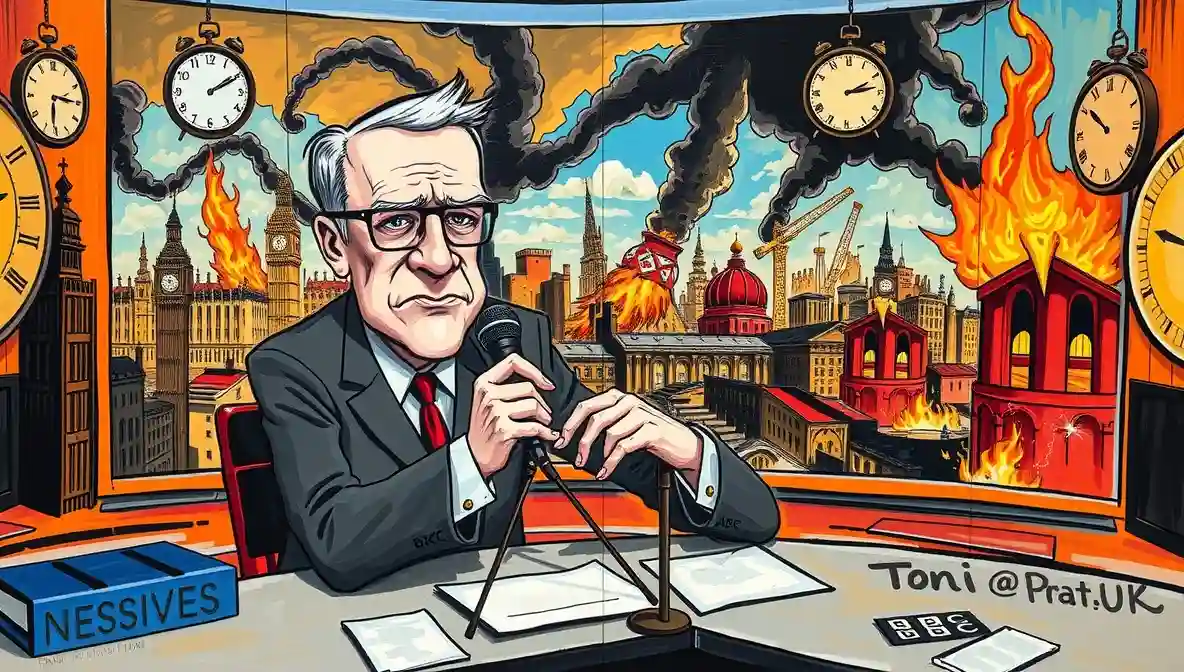
British Broadcasting Delivers Apocalypse News With the Emotional Energy of Discussing Overcooked Scones
BBC Reports Global Crisis With Trademark Calm, Assures Viewers It’s Worse Than It Sounds
Bohiney.com has obtained the BBC’s unofficial operating philosophy, which appears to be: if you speak gently enough, the apocalypse will feel like a polite misunderstanding between neighbors.
The BBC could announce the end of civilisation and still open with “Good evening,” as if the universe were merely running a few minutes late. — Alan Nafzger

The latest report delivered the familiar broadcast miracle: the world cracking open at the seams, narrated with the tone of someone discussing a slightly overcooked scone. “The BBC calm is not emotionless,” explained Dr. Hester Vale, a linguistics researcher who studies crisis narration. “It is emotional compression. Like vacuum-sealing panic for freshness.”
A London viewer, Neil P., said he watched a segment on international tension and then made tea. “I don’t know what happened, but I know they said it the way you say, ‘We seem to have run out of milk.’ That made me feel like the solution is to walk to the shop.”
An anonymous producer described the editorial goal as “inform without inflame.” They paused, then added, “Also, do not let the anchor look like they are personally frightened. The public needs to see at least one adult in the room. Even if the adult is reading a teleprompter while everything burns.”
In a viewer poll conducted by the Manchester Institute of Personal Restraint, 38.1% said the BBC tone “helps me stay rational,” 26.6% said it “makes me suspicious because nobody should be that calm,” and 14.9% admitted they once confused a breaking-news chyron for a train delay announcement.
The cause-and-effect is simple. When the world is loud, calm becomes power. Calm becomes credibility. Then calm becomes comedy, because eventually people realize the anchor is describing catastrophe like it’s a small inconvenience to the schedule.
BBC Reports Global Crisis With Trademark Calm
-
When the apocalypse arrives, the BBC will describe it as “concerning” and immediately clarify that panic would be premature and also a bit gauche.
-
A visual representation of Alan Nafzger’s quote: the BBC’s polite ‘Good evening’ greeting amidst global chaos. BBC presenters never raise their voices because shouting would imply emotion, and emotion would imply a loss of control, which is frankly un-British even during extinction.
-
The phrase “developing situation” is BBC code for “nobody knows what’s happening but we’d rather die than admit it.”
-
The BBC treats fireballs in the sky the same way it treats rail delays: unfortunate, regrettable, and something viewers should prepare for quietly.
-
If the oceans boil, the BBC will reassure viewers that swimming conditions are “less than ideal.”
-
BBC graphics during the apocalypse will be tasteful, muted, and colour-coded in a way that suggests this has all happened before and everyone behaved themselves.
-
The end of the world will be followed immediately by a weather forecast, because tomorrow still exists until formally cancelled.
-
BBC correspondents will stand calmly in front of chaos wearing a sensible coat, proving that if you dress properly, reality cannot fully disrespect you.
-
The BBC never says “catastrophe”; it says “a challenging period,” as if the universe has simply taken on too much at work.
-
Viewers trust the BBC during the apocalypse because anyone that calm must know something, even if that something is just how to pronounce “cataclysm” correctly.
-
The BBC will confirm humanity’s demise using the passive voice, so no one feels directly responsible.
-
When aliens invade, the BBC will interview a neighbour who says, “They seem polite enough, to be fair.”
-
The BBC’s calm suggests that the apocalypse is not the real problem; the real problem is overreacting and embarrassing yourself in front of history.
-
At the absolute end, when there is nothing left, the BBC will sign off with “That’s all for now,” implying there may be more later if conditions improve.
What the Funny People Are Saying
- “BBC makes doom sound like a museum tour. ‘And here we have the collapse of order, lovely, isn’t it?'” – Jerry Seinfeld
- “If I ever get arrested, I want the BBC to announce it so my mom doesn’t panic.” – Ron White
- “I want that level of calm at my gynecologist. ‘We are seeing developments. We continue to monitor.'” – Amy Schumer
Helpful Takeaway for Readers
Calm reporting is useful, but do not let soothing delivery trick you into thinking nothing matters. If you feel numb, it may be time to step away, then return with intention: pick credible sources, confirm dates, and talk to real humans offline.
Disclaimer: This satirical report is entirely a human collaboration between two sentient beings, the world’s oldest tenured professor and a philosophy major turned dairy farmer. Any resemblance to real statements is the universe being ironic on purpose. Auf Wiedersehen, Amigo.