

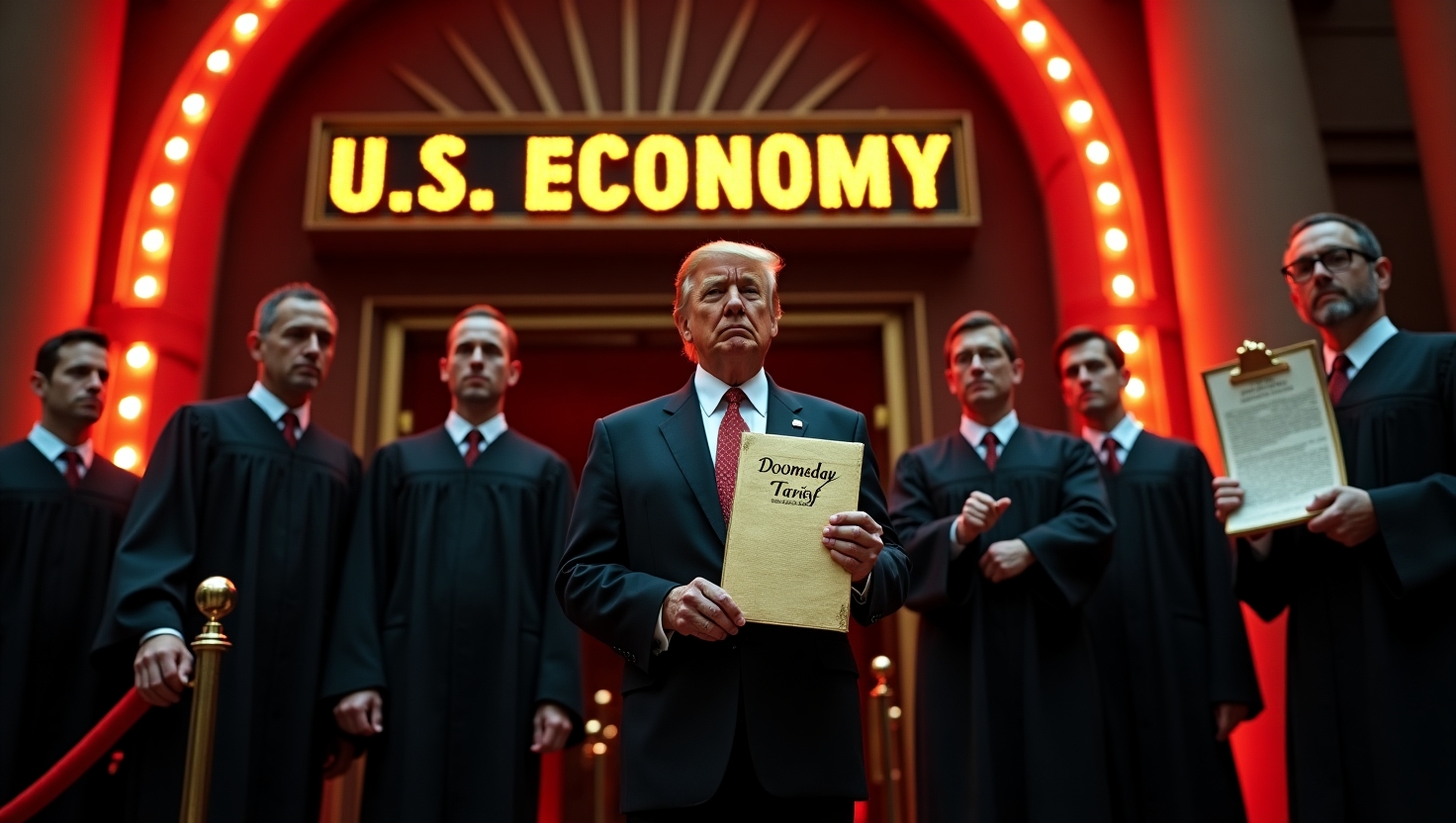
Doomsday Dispatch: When Tariffs Send Love Letters to Judges
By The Mo’ Dramatic Times, Satire Desk
Judges as Velvet-Rope Bouncers of the Economy
Trump’s “Doomsday Tariff Letter” reads less like a sober policy memo and more like the opening act of a Broadway drama where the judges are the reluctant stars. They’re cast as bouncers at an exclusive club, deciding whether to let the economy past the velvet rope for bottle service—or send it trudging home barefoot.
Instead of clean economic prose, we get a retro throwback: the resurrection of the 1977 International Emergency Economic Powers Act—IEEPA—like a disco record dug out of the attic and sold as a “limited-edition” pressing. In the Cold War, it was meant for genuine crises. Now it’s a tool for tariff theater, which is the policy equivalent of using a rotary phone to stream TikToks.
“Tariffs are like surprise fees at hotels — you don’t see them coming, and they’re somehow labeled as an amenity.” — Jerry Seinfeld
Parenting Tone in a Presidential Envelope
The letter has the emotional temperature of a parent saying, “Approve this or you’re grounded.” Judges aren’t exactly teenagers in trouble, but the vibe is unmistakable. Somewhere in the West Wing, a staffer probably suggested adding “Love, Donald” at the bottom for charm.
It’s a performance note that tries to turn a gavel into a dinner bell: sign here or watch the nation skip dessert.
“When a president calls something ‘Doomsday,’ I expect at least one asteroid and maybe a giant lizard.” — Ron White
Die Hard Meets Bond Market
This memo plays like an action movie. Picture Die Hard, except Hans Gruber is the trade deficit, the hostages are your grocery prices, and the explosions are in the bond market. The judges aren’t rappelling down elevator shafts; they’re adjusting their reading glasses and wondering why the fate of the global economy is now a matinee.
Hazmat Gear at the Cookout
Branding it “Doomsday” is the political equivalent of arriving at a cookout in full hazmat gear. People are nervous for a second… and then start making s’mores. Some entrepreneurial spirits are even selling “Emergency S’Mores Kits” at inflated prices, proving that fear is always a reliable growth industry.
The Latte Surcharge Nobody Saw Coming
Small businesses are already feeling the comedy in the commerce. A coffee shop owner in Des Moines reported, “Every latte now comes with a ‘Deficit Recital Tariff Surcharge.’ I thought it was a joke until I saw it printed in all caps on the receipt.”
In Washington, you just know an aide is already ordering T-shirts.
Judges as Amusement Park Turnstiles
While the letter paints the judiciary as mighty gatekeepers, they’re closer to turnstiles at a theme park: you drop in your token, maybe the arm spins, maybe it doesn’t. The deciding factor? Timing, mood, and whether someone jammed gum in the mechanism.
Apocalypse Story With a Flat Stock Market
The “approve it or collapse” framing might have more punch if the actual economy were imploding. Instead, inflation is flat, the stock market is moody but operational, and traders are treating the letter like a particularly dry meme. It’s a little like threatening to torch the house, then realizing the lighter’s out of fluid.
Tariff Theater Over Policy Substance
The performance is the point. Numbers and cost-benefit analyses are boring; “do-or-die” letters sell better on cable news. Tariffs have become dinner theater, with the audience prompted to gasp while the dessert cart rolls by.
The Judges Become the Critics
There’s an accidental role reversal here: the president is the desperate playwright, the judges the reviewers. If they pan the show, the curtain drops on the economy. If they clap, the run extends—whether or not the script deserved an opening night.
Apocalypse as Picnic Entertainment
In the end, the “Doomsday Tariff Letter” isn’t a policy instrument—it’s a prop. Something to wave, brandish, and dramatically leave on the table before walking out of the room. And if the goal was to grab attention, it worked. After all, Americans love a good apocalypse story—especially one they can watch from a picnic blanket with overpriced sandwiches.
Disclaimer: This work is the sole creation of two sentient humans—the world’s oldest tenured professor and a philosophy major turned dairy farmer. No algorithms were involved in the making of this satire. Auf Wiedersehen, amigos.
Observations
-
The International Emergency Economic Powers Act is starting to feel like that one high school quarterback who shows up at the reunion still wearing his letterman jacket.
-
Nothing says “serious policy” like invoking a Cold War law to manage a coffee surcharge in Des Moines.
-
“Doomsday” apparently now means “slightly more expensive croissant.”
-
Judges as bouncers is fun until you realize they don’t accept bribes in drink tickets.
-
A policy memo that could be read equally well at a press conference or a dinner theater in Branson, Missouri.
-
The memo was so dramatic it came with a complimentary program and a list of the cast in order of appearance.
-
Hazmat gear at a cookout is a bold fashion choice — especially when paired with flip-flops.
-
The real national emergency is finding a latte without a “Deficit Recital” upcharge.
-
The only special effect missing from the letter was a fog machine and a slow-motion entrance.
-
Somewhere, a Broadway producer is watching the C-SPAN replay and thinking, “We could use this in Act Two.”
What the Funny People Are Saying
- “I love that they’re calling judges ‘gatekeepers.’ Honey, these people can’t even keep their calendars straight.” — Sarah Silverman
- “IEEPA? Sounds like a new energy drink for politicians.” — Kevin Hart
- “The memo’s basically saying, ‘Sign this or we all starve.’ Which is a little much for a Tuesday.” — Bill Burr
- “Small businesses are adding tariff surcharges. My deli guy tried to charge me a ‘bacon embargo fee.’” — Ricky Gervais
- “If the economy’s waiting outside the club, it’s probably already in the wrong line.” — Trevor Noah
- “This is the first apocalypse I’ve been invited to where they told me to bring potato salad.” — Ali Wong
IMAGE GALLERY
