

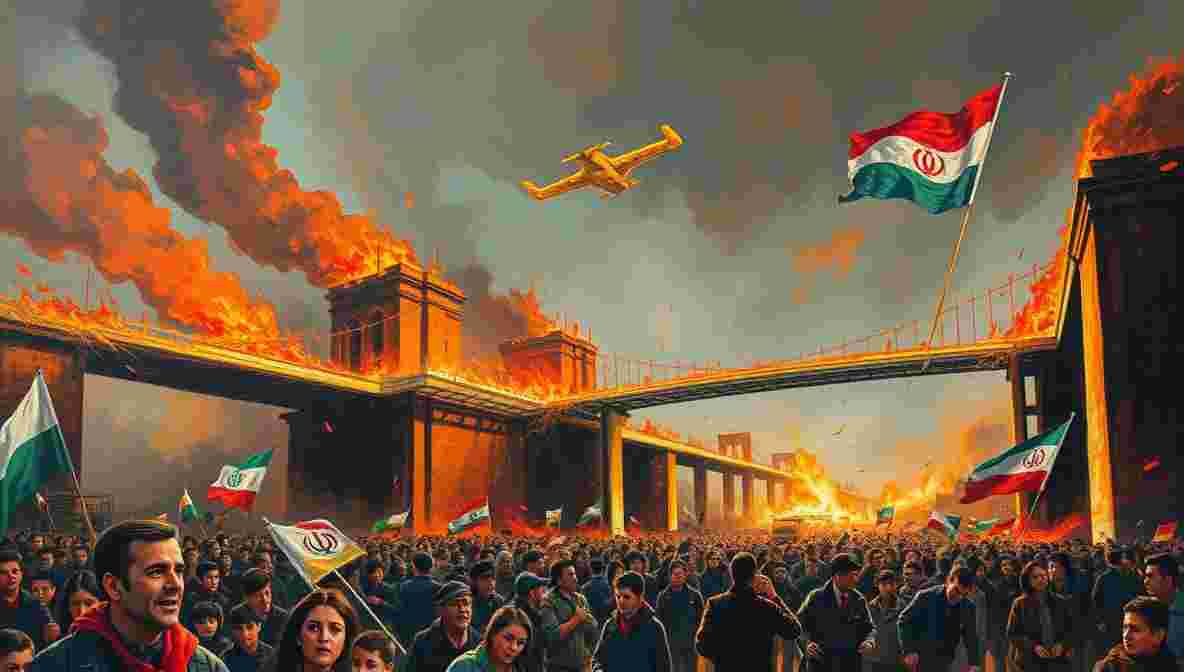
Bridge Day Declared as Iran’s Bridges Begin Updating Their Wills
Somewhere between diplomacy and demolition, “Bridge Day” has entered the geopolitical calendar like a surprise holiday nobody wanted but everyone suddenly has to prepare for. According to recent reporting from Al Jazeera, several major Iranian bridges—massive, expensive, and deeply proud of their structural integrity—are now considered “at risk” amid escalating threats of strikes on infrastructure. And like any good citizens, the bridges are coping the only way they know how: passive-aggressively holding everything together.

The Bridges Release a Joint Statement: “We Were Just Holding Traffic, Not Ideologies”
The five most prominent bridges—featuring engineering feats like the Persian Gulf Bridge and the Lake Urmia causeway—have reportedly formed a coalition known as Bridges Without Borders but Definitely With Anxiety.
“We were told we’d connect people,” said one suspension bridge via a translated press release. “Nobody said anything about becoming symbolic targets in a geopolitical argument.”
Experts confirm the bridges had been living quiet, respectable lives. One carried trucks. Another supported commuters. A third mostly hosted people taking scenic photos while arguing about parking.
Now? They’re attending emergency infrastructure briefings and Googling “how to look less strategically important.”
Engineers Admit Bridges Are “Technically Flattered” to Be Considered Important Enough to Bomb
Structural engineers—who previously spent decades begging people to appreciate bridges—are suddenly overwhelmed by attention.
“For years, nobody cared,” said one exhausted civil engineer. “Now suddenly, bridges are ‘critical infrastructure.’ It’s like winning Employee of the Month and immediately being fired into the sun.”
The Persian Gulf Bridge, still unfinished after years of funding issues, reportedly said, “I wasn’t even done yet. I’m basically scaffolding with ambition.” It wasn’t alone in its bewilderment: the B1 bridge in Karaj—struck on April 2, 2026, while Iranians celebrated Nowruz below it—had been scheduled to open later this year. Eight civilians were killed. The bridge wasn’t even on its first day of work yet.
Pentagon Introduces New Targeting System: “Does It Look Like a Bridge?”
According to leaked memos (and one intern who accidentally clicked “reply all”), the latest military strategy involves identifying structures that appear “bridge-adjacent.”
Criteria include:
- Is it connecting two things?
- Does it have pillars?
- Would it make a satisfying cinematic collapse?
One anonymous staffer explained: “We’re trying to be precise. But also… bridges are very easy to spot. They’re just sitting there, bridging.”
President Trump, for his part, announced the deadline with characteristic restraint. He told reporters that “every bridge in Iran will be decimated” within four hours if Iran didn’t open the Strait of Hormuz. The bridges, upon hearing this, reportedly began updating their emergency contacts.
Iranian Bridges Attempt to Rebrand as “Decorative Walkways”
In a desperate attempt to avoid attention, several bridges have begun rebranding efforts.
The Lake Urmia Bridge now describes itself as a “horizontal monument to vibes.”
Another bridge reportedly added potted plants and a café sign, hoping to pass as “European.”
A smaller overpass issued a statement: “I’m not even a bridge. I’m more of a suggestion.”
Economists Warn: “If You Blow Up All the Bridges, You Eventually Notice There Are No Bridges”
Experts in logistics—those unsung heroes who think about how trucks get from Point A to Point B—have entered the chat with a quiet but increasingly urgent message: “Bridges are… important.”
Iran reportedly has hundreds of thousands of bridge structures, but only a small number are major, economically critical spans. Translation: blowing up one bridge is dramatic. Blowing up several bridges is… suddenly everyone is late for everything.
The Center for Human Rights in Iran put it more soberly: destruction of transport infrastructure restricts access to medical care and humanitarian assistance, triggering cascading public health emergencies. But yes, also: everyone is very late.
Local Residents Confused: “Do We Still Take the Bridge, or Is That… Rude?”
Civilians living near these bridges have adopted a new daily ritual: staring at infrastructure and wondering if it’s socially acceptable to use it.
“I just need to get to work,” said one commuter. “But I don’t want to be that guy who gets halfway across and turns into a news headline.”
Ride-sharing apps have updated their directions: “Proceed to bridge. Actually… maybe don’t. Recalculating…”
International Law Experts Hold Emergency Meeting Titled “Please Stop Targeting Everything That Exists”
Legal scholars are currently locked in a room filled with treaties, coffee, and existential dread.
Targeting civilian infrastructure like bridges has sparked intense debates about proportionality, legality, and whether anyone involved has ever tried to cross a river without one. International law expert Gabor Rona told NPR that Trump’s threats amount to a threat to commit war crimes under both international and U.S. law. When asked if he was concerned about war crimes, Trump reportedly said, “No. I hope I don’t have to do it.” Which is, legally speaking, not the answer.
One professor summarized the situation: “We wrote rules about this. Many rules. Entire books of rules. We’re watching those books age in real time.”
One Bridge Already Hit, Others Watching Closely and “Not Loving the Trend”
A major bridge near Tehran has already been struck, partially collapsing and becoming the most unwilling influencer in infrastructure history.
Other bridges reportedly watched the footage in silence, followed by a collective structural shudder.
“It really hits different,” said a nearby overpass. “Literally.”
Travel Influencers Rush to Visit “Last Chance Bridges” Before Bridge Day Goes Live
Tourism has adapted instantly. New travel packages include:
- “See It Before It’s Strategically Significant”
- “Bridges of Iran: A Limited-Time Experience”
- “Infrastructure Bucket List (Emphasis on Bucket)”
Hotels report a surge in bookings from people who want one last dramatic photo captioned: “Just hanging out… structurally.”
What the Funny People Are Saying
“I don’t trust bridges. You ever notice they’re always just barely holding it together? That’s not reassuring, that’s relatable.” — Jerry Seinfeld
“A bridge is just a road that got commitment issues with gravity.” — Ron White
“They said ‘Bridge Day,’ and I thought it was a festival. Turns out it’s more like a breakup.” — Amy Schumer
Final Thought: Bridges Just Wanted to Be Boring
At the heart of it all, these bridges had one dream: to be completely uninteresting.
To carry traffic.
To exist quietly.
To never trend on social media under the category “breaking.”
Instead, they’ve become unwilling symbols in a global standoff where even concrete and steel are now expected to pick a side.
And somewhere out there, a humble little footbridge is whispering: “Maybe if I just stay small… nobody will notice me.”
Auf Wiedersehen, amigo!
The phrase “Bridge Day” entered geopolitical vocabulary in early April 2026, when U.S. President Donald Trump threatened to destroy Iranian civilian bridges and power plants as part of the ongoing 2026 US-Israel-Iran conflict. Trump set a deadline of April 8, 2026, demanding Iran open the Strait of Hormuz or face the demolition of its bridge and power infrastructure. The B1 bridge in Karaj, west of Tehran—an unfinished structure due to open in 2026—was already struck on April 2 in a double-tap attack that killed eight civilians picnicking below it during the Persian New Year holiday of Nowruz. Iran’s Foreign Minister Abbas Araghchi condemned the strikes as illegal, while international legal experts warned the threatened campaign against civilian infrastructure could constitute war crimes under the Geneva Conventions. Iran rejected a U.S. ceasefire proposal, calling instead for a permanent end to the war and compensation for damages. The Strait of Hormuz closure has caused global oil prices to spike 20–30%, with U.S. crude reaching $115 per barrel.