

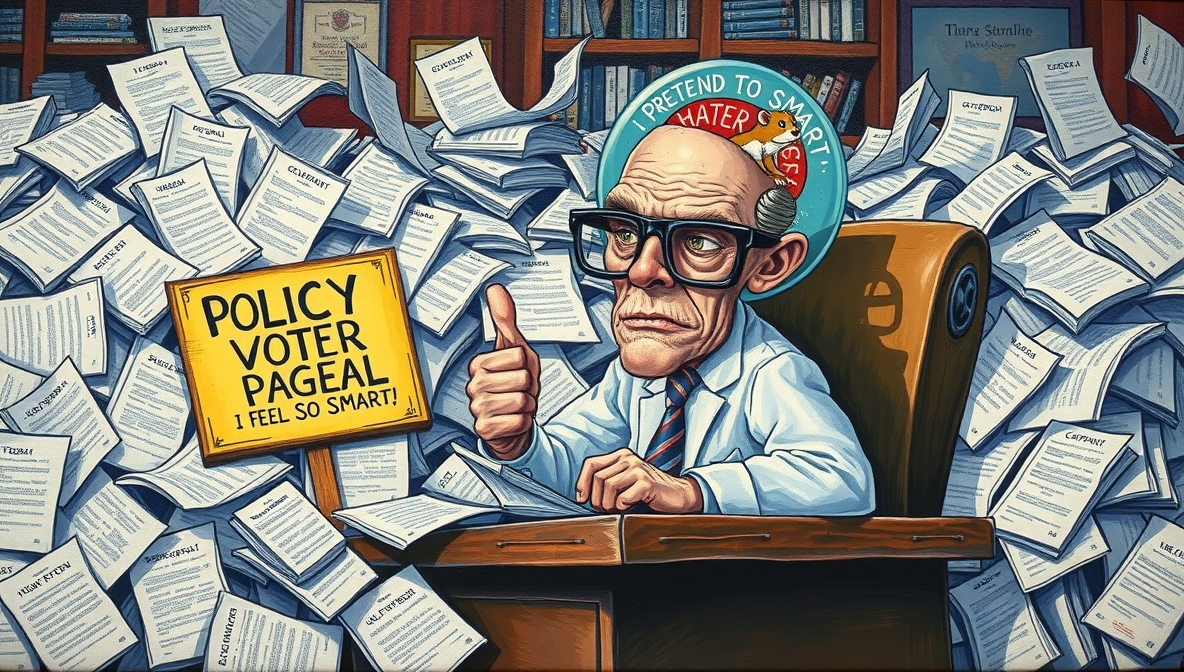
Study: Voters Actually Prefer Complicated Policies (Shockingly)
By Astrid Holgersson | Bohiney.com
In a revelation that has stunned political analysts everywhere while making law school professors weep tears of vindicated joy, a groundbreaking study shows that voters overwhelmingly favor complicated policies—policies so brain-meltingly convoluted that reading them requires a law degree, a magnifying glass, a medical degree, and possibly divine intervention.
The study, conducted by the Institute for Electoral Obfuscation, surveyed 2,347 registered voters and discovered that 87% said they “felt significantly smarter and more sophisticated” when policies were incomprehensible. According to The Washington Post’s political analysis, respondents reported that convoluted proposals made them feel like insiders in an exclusive intellectual club, even if they couldn’t explain the policy to their own reflection in the mirror.
“When a bill takes 300 pages to read and requires cross-referencing seventeen different subsections, you feel like you’re part of a secret society,” said one participant, who admitted he hadn’t read beyond the table of contents but felt incredibly informed nonetheless.
Expert Insights Into Voter Psychology
Dr. Helen Travers, political psychologist at the University of Abstract Politics, explained with academic excitement: “Voters enjoy the illusion of understanding far more than actual understanding. Complexity conveys importance, authority, and frankly, mystique. People would rather feel smart about something they don’t comprehend than admit they understand something simple.”
Meanwhile, Pew Research on voter behavior notes that when policies are simplified into clear, digestible language, 64% of citizens immediately become suspicious, believing “if it’s easy to understand, it must be a trick, a scam, or worse—actually designed to help regular people.”
This psychological phenomenon has prompted policymakers to intentionally draft regulations in legalese so dense it doubles as literature for insomniacs and a natural deterrent for anyone seeking actual comprehension.
Public Reactions Achieve Peak Intellectual Theater
Focus groups revealed reactions that bordered on performance art. A retiree from Ohio proclaimed: “I didn’t understand a single word of that healthcare proposal, but it sounded very important and official. I nodded knowingly throughout the entire presentation.”
Meanwhile, a college student exclaimed with genuine enthusiasm: “Finally, something I can ignore in peace while pretending I’m deeply informed about the nuances of agricultural subsidy restructuring!”
A political blogger added with refreshing honesty: “Voters loving complicated policies is like preferring IKEA instructions written in ancient Sanskrit—confusing, frustrating, but somehow validating of your intellectual aspirations.”
The study found that citizens who encountered simplified policy summaries immediately demanded “the real version with all the important complicated parts,” suggesting that accessibility might actually undermine perceived legitimacy in democratic discourse.
The Economics of Intellectual Intimidation
Policy research institutions report that complex legislation generates more consultant fees, lobbying opportunities, and general economic activity around the process of explaining what nobody actually understands. One anonymous congressional aide admitted: “We write bills like this because simple language makes everyone nervous. Complexity suggests we’re working really hard on your behalf, even when we’re mostly just moving commas around.”
What the Funny People Are Saying About Complicated Policies
“People prefer complicated policies? That’s like me preferring a Rubik’s cube over a slice of cake—confusing, frustrating, but secretly validating of my supposed intelligence.” — Jerry Seinfeld
“I read a 400-page policy document once. I didn’t understand a single sentence, but my ego grew three sizes that day. It was like intellectual Christmas.” — Ron White
“Complicated policies are like IKEA instructions written in ancient hieroglyphics—nobody understands them fully, but we all pretend we’re getting somewhere.” — Amy Schumer
“I love when politicians use words I’ve never heard. It makes me feel like I’m getting premium government service, even though I have no idea what they just promised to do.” — Kevin Hart
Conclusion: Complexity as Democratic Theater
Experts warn that embracing incomprehensible policies may continue indefinitely, as citizens apparently equate opacity with competence and confusion with sophistication. Political analysts suggest that politicians should continue drafting convoluted proposals, because in the age of performative democracy, intellectual intimidation equals voter confidence.
As one anonymous congressional staffer confessed: “Complexity is democracy’s best friend—right after coffee, denial, and the general assumption that someone else is definitely reading the fine print.”
Civic education research suggests this trend reflects a broader cultural shift toward valuing the appearance of knowledge over actual comprehension, making politics indistinguishable from academic theater performed for an audience that applauds complexity while avoiding understanding.
Disclaimer
This satirical report is a human collaboration between the world’s oldest tenured professor and a philosophy major turned dairy farmer. No voters were harmed, enlightened, or forced to read beyond executive summaries while writing this story. Auf Wiedersehen, amigos.
