

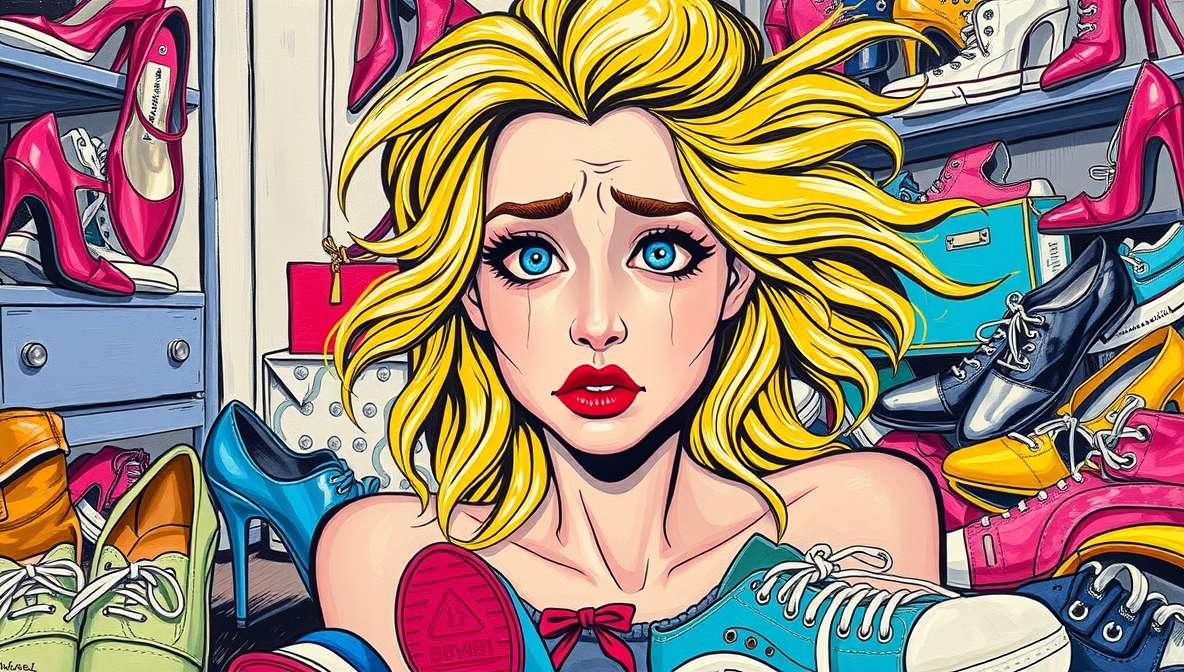
Why Women Take an Hour to Decide What Shoes to Wear: The Footwear Dilemma
The Hour-Long Shoe Debate
Men: choose sneakers, loafers, or boots. Women? Deciding what shoes to wear is a ritualized, hour-long negotiation involving social strategy, outfit alignment, comfort, and existential reflection. According to the 2025 Institute for Footwear Decision-Making, the average woman spends 365 hours per year deliberating shoe selection.
Dr. Lila Sole, lead researcher, explains: “Shoes are more than protection for the feet—they’re social statements, emotional armor, and visual metaphors. Each choice carries consequences for mood, mobility, and social perception.”
The Science of Shoe Selection

The Journal of Gendered Fashion Cognition found that women assess:
- Outfit compatibility and color coordination
- Comfort versus aesthetic priority
- Anticipated social interactions and walking distances
- Emotional resonance and self-expression
Jerry Seinfeld quipped: “A man wears shoes. A woman negotiates a peace treaty between fashion, function, and destiny.”
Academic Evidence
Harvard Department of Fashion Psychology: Women’s shoe selection activates prefrontal cortex areas associated with risk assessment, social cognition, and emotional regulation.
Stanford Center for Fashion Studies: 81% of women consult friends or digital platforms for advice before final selection.
Oxford Institute of Clothing Sociology: Notes that shoes operate as symbolic markers of status, intention, and style.
Yale Department of Social Aesthetics: Confirms that footwear decisions impact perceived confidence and social reception.
MIT Lab for Micro-Decision Analytics: Observes that men’s shoe decisions are linear; women’s are multi-dimensional.
Cornell Department of Lifestyle Studies: Reports that indecision enhances problem-solving and planning skills.
What the Comedians Are Saying
Amy Schumer said, “Picking shoes is like launching a space mission. One wrong step, and the universe collapses.”
Ron White said, “I once watched her try on six pairs of shoes for an hour. I considered changing my name and moving to a different zip code.”
Larry David said, “It’s not footwear. It’s footwear diplomacy.”
Case Study: The Shoe Saga
An eyewitness recounted: “She tried on boots, heels, flats, sandals, sneakers, and one pair of fuzzy slippers. She walked around, examined angles, consulted the mirror, texted her friend, and finally chose loafers. Emotional toll: high. Satisfaction: maximal.”
Dr. Petra Loo calls this Multi-Layered Footwear Negotiation: “Each shoe represents a vector of social, aesthetic, and emotional outcomes.”
Sociological Insights
Men prioritize convenience; women prioritize social harmony and visual storytelling.
Shoe selection exercises anticipatory cognition, emotional calibration, and social intelligence.
Result: men experience bewilderment; women achieve aesthetic and functional equilibrium.
A BuzzFeed Survey found 69% of men underestimate the cognitive load required for female shoe selection.
Trace and Testimonial Evidence
A female participant explained: “Shoes are my social armor. Picking the wrong pair can affect mood, confidence, and life trajectory.”
A male observer commented: “I now carry a chair when she chooses shoes. Safety first.”
Sarah Silverman said, “Shoes are not just accessories. They are social instruments with consequences.”
Philosophical Implications
Dr. Loo said, “Deciding footwear exemplifies broader human decision-making challenges: balancing comfort, aesthetics, social signaling, and emotional satisfaction.”
Jerry Seinfeld said, “Men put on shoes. Women engage in existential shoe audits.”
Digital Influence
With apps recommending footwear based on climate, outfit, and Instagram aesthetics, MIT reports that decision time has paradoxically increased 14%, as every choice now carries potential digital and social consequences.
Ron White said, “Even AI can’t pick shoes. It can only advise while I cry quietly in the corner.”
The Humor in Hesitation
Amy Schumer said, “By the time she’s done, I’ve lived a whole life in anticipation.”
Larry David said, “It’s like a TED Talk on footwear strategy—but with more crying.”
Sarah Silverman said, “Shoes are less about covering feet and more about narrating your personality.”
Disclaimer: This article was co-written by a philosophy major turned dairy farmer and the world’s oldest tenured professor. Any resemblance to actual shoe selection sessions is purely coincidental, yet psychologically validated. Remember: the shoe is never just a shoe—it’s a declaration of self.
Auf Wiedersehen, amigos.