

Five Early Warning Signs Your Traffic Stop Is Actually a Photo Safari
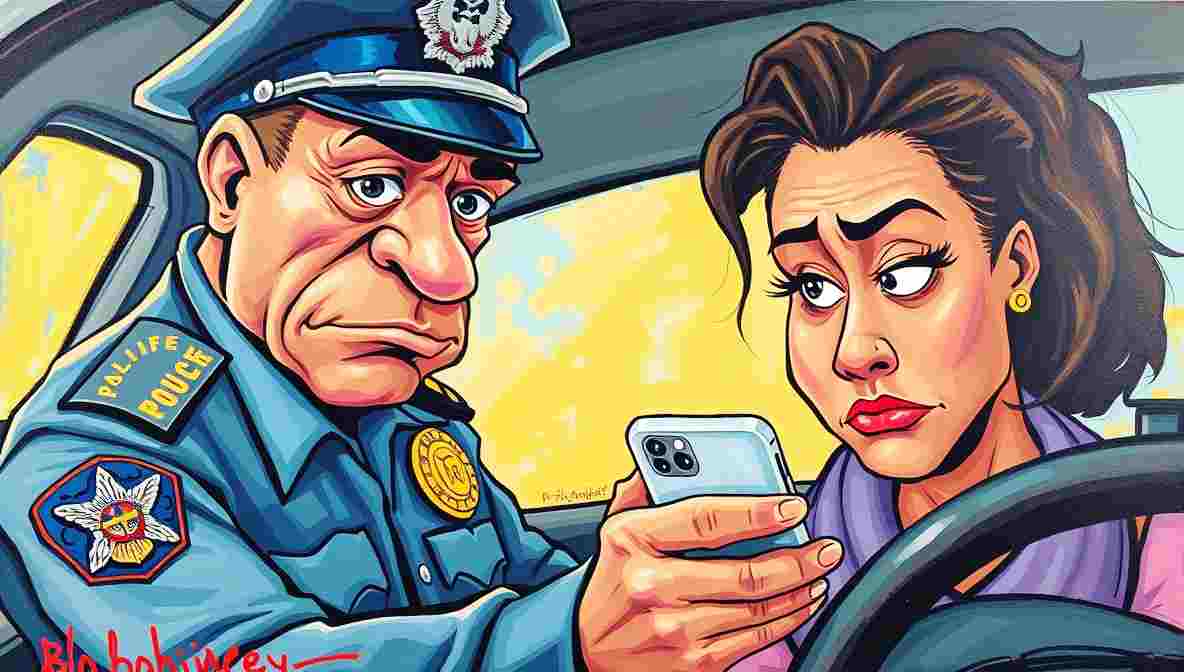
The town of Florissant, Missouri recently discovered a new category of crime: the Traffic Stop Influencer. The idea is simple. You pull someone over for a missing taillight, borrow their phone to “check insurance,” and suddenly you are running the world’s most awkward photography studio.
Legal scholars say this case has expanded the definition of multitasking in law enforcement.
Witnesses say the officer allegedly treated traffic stops like a nature documentary. Instead of spotting deer or raccoons, he reportedly went hunting for scandalous selfies buried deep in the camera roll.
Local residents say the only thing more surprising than the crime was the efficiency.
“Usually when I get pulled over,” said Florissant resident Terry McConnell, “the officer takes fifteen minutes to run my license. This guy apparently ran a full art exhibition in under two minutes. That’s impressive time management.”
Law Enforcement Introduces the “Insurance Check Plus” Service

According to prosecutors at the U.S. Attorney’s Office for the Eastern District of Missouri, the officer told drivers he needed their phones to verify insurance. This explanation made sense to most drivers because modern life has trained everyone to surrender their phone to strangers for unclear reasons.
A sociologist from the University of Missouri, Dr. Linda Pomeroy, explains the psychology.
“We have entered an era where people will hand their phone to anyone wearing a vest, badge, lanyard, or polo shirt with a logo. We call this the ‘Credentialed Stranger Effect.’ If someone looks official enough, Americans will unlock their entire digital soul.”
The officer allegedly used his own phone to photograph images from the victims’ phones. Experts say this is a surprisingly analog approach for a digital crime.
“It’s like robbing a bank by photocopying the money,” said cybersecurity consultant Marcus Blevins. “Criminals today usually download files or hack accounts. This guy basically invented the Polaroid Method.”
Police Training Manuals Quietly Add New Chapter on Digital Boundaries
Following the sentencing, several police departments reportedly updated their training manuals to clarify a previously unwritten rule: do not conduct amateur photography exhibitions during traffic stops.
The new section reportedly appears between “Miranda Rights” and “Do Not Tase the Wedding DJ.”
A leaked memo from a fictional “Law Enforcement Best Practices Committee” suggests departments underestimated the need to state the obvious.
“For decades we assumed officers understood that searching citizens’ phones for nude photos was not standard procedure,” the memo reads. “This assumption has proven overly optimistic.”
The Victims Discover the World’s Worst Photo Critic
Authorities say about twenty victims were identified. Several said the strangest part of the experience was learning that a random traffic officer had apparently become the curator of their personal camera roll.
One victim described the moment she found out.
“I thought I had a normal speeding ticket,” she said. “Then months later the FBI calls and tells me my phone apparently hosted a one-man photography tour.”
Another victim said the incident changed how she organizes her photos.
“I used to keep vacation pictures and personal stuff mixed together,” she explained. “Now I have folders labeled ‘Safe for Traffic Stops’ and ‘Absolutely Not for Traffic Stops.'”
Legal Experts Study the Crime of Maximum Awkwardness
Criminal justice researchers say the case demonstrates how modern technology creates crimes that sound like rejected sitcom plots.
Professor Harold Vickers of the Midwest Institute of Legal Absurdity explains the issue.
“Two generations ago, if a police officer wanted to do something creepy with personal photographs, they would have to physically steal a photo album,” Vickers said. “Now the entire album lives inside a glowing rectangle we casually hand to strangers.”
He added that the crime represents a new category of misconduct.
“We call it ‘Camera Roll Opportunism.'”
The federal statute covering deprivation of rights under color of law — the charge to which the officer pleaded guilty across all 20 counts — was originally designed for far more violent abuses of power. Legal historians note this may be the first time it has been applied to what is essentially unsolicited art criticism.
The Sentencing Phase: Two Years, One Very Bad Decision
The former officer received two years in prison — sentenced just yesterday, March 11, 2026 — and now faces multiple civil lawsuits. He was also ordered to pay $2,681 in restitution, which legal analysts note is perhaps the most insulting dollar amount ever attached to 20 federal counts.
Legal analysts say the civil cases may be the real financial disaster.
“Nothing terrifies lawyers like a jury hearing the phrase ‘unauthorized photography of private phone content,'” said attorney Daniel Hargrove. “That’s the kind of sentence that makes damages multiply like rabbits.”
Technology Companies React to the “Insurance Check Plus” Scandal
Several tech companies quickly issued statements reminding users to protect their phones.
One smartphone manufacturer released a helpful tip:
“If someone asks for your phone during a traffic stop, it is acceptable to ask why. If the answer is ‘checking insurance,’ that is reasonable. If the answer is ‘conducting artistic research,’ that is less reasonable.”
A new phone feature may also appear in future updates called “Traffic Stop Mode.”
When activated, the phone displays only three photos: a golden retriever, a sunset, and a receipt from Target.
Citizens Reevaluate the Phrase “Can I See Your Phone?” and Digital Privacy Rights
The incident has triggered a nationwide debate about digital privacy and your rights during a traffic stop. The sacred nature of the camera roll is now a matter of constitutional concern.
Experts say the camera roll is essentially the modern equivalent of a diary, a scrapbook, and a mildly chaotic museum of questionable decisions.
Technology ethicist Paula Denton summarized the situation perfectly.
“The camera roll contains humanity in its rawest form. Screenshots of recipes we never cook. Photos of pets we treat like royalty. And occasionally the kind of images that should never be reviewed during a roadside traffic stop.”
The Supreme Court ruled in Riley v. California (2014) that police generally cannot search a cell phone without a warrant. Former Officer Julian Alcala apparently missed that particular day of training.
What the Funny People Are Saying
“Getting pulled over used to mean a ticket. Now apparently it means a portfolio review.” — Jerry Seinfeld
“You know you’re in trouble when the cop says, ‘License, registration, and your entire dating history.'” — Ron White
“I barely let my friends scroll my photos. Imagine letting a cop do it.” — Sarah Silverman
“If someone says ‘I’m checking your insurance’ and starts scrolling like they’re on Instagram, that’s a red flag.” — Trevor Noah
The Real Lesson
The lesson from Florissant may be simple.
Your phone contains your entire life. Your memories. Your secrets. Your group chats that should probably never exist.
And now Americans have learned a new rule of digital life:
If someone asks to see your phone during a traffic stop, make sure they’re looking for insurance, not curating the world’s most uncomfortable art gallery.
This satirical report is a collaborative intellectual exercise between two highly responsible humans: the world’s oldest tenured professor and a philosophy major who abandoned academia to run a dairy farm and occasionally analyze modern civilization through the lens of cows. Any resemblance to real bureaucratic stupidity is purely coincidental.
In reality: Former Florissant, Missouri police officer Julian Alcala, 31, was sentenced on March 11, 2026 to two years in federal prison after pleading guilty to 20 counts of deprivation of rights under color of law. Between February and May 2024, Alcala pulled over 20 women for minor traffic violations, took their phones under the pretext of verifying insurance or vehicle registration, and used his personal phone to photograph or forward intimate images he found in their camera rolls. The FBI investigation began after one victim discovered her video had been forwarded via the cloud. Alcala resigned from the Florissant Police Department in June 2024. Multiple civil lawsuits against Alcala and the City of Florissant remain ongoing.
Auf Wiedersehen, amigo!