

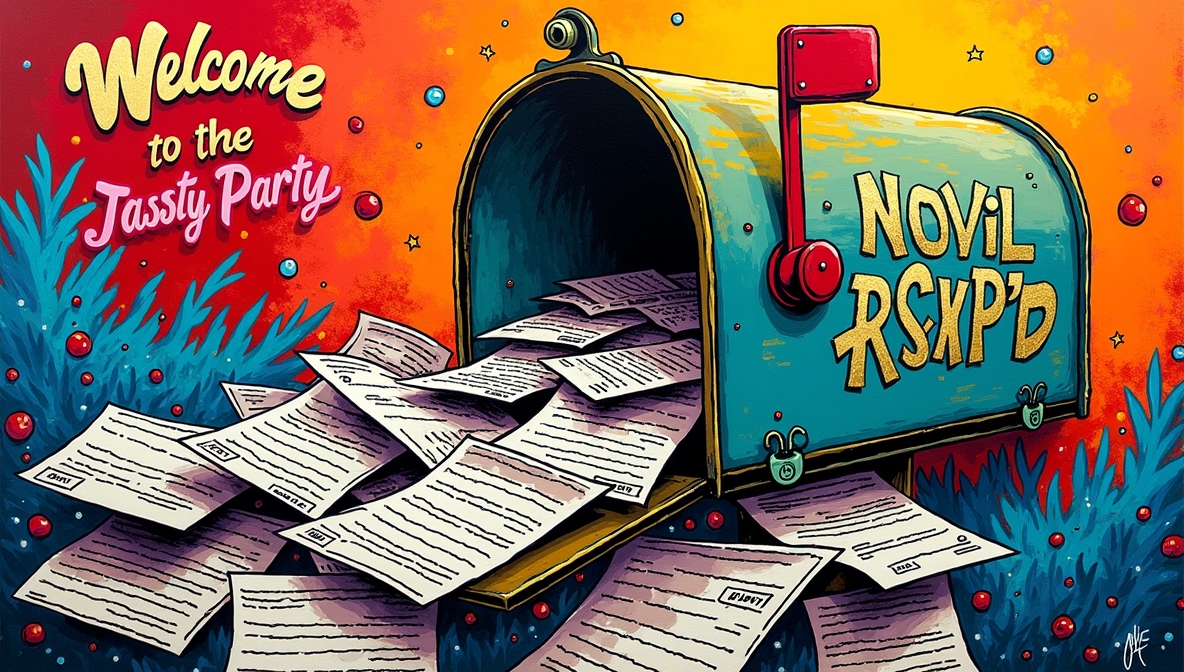
3.7 Million Data Breach Letters: Welcome to the Party You Never RSVP’d For
The Great Mail Invasion of 2025
This week, 3.7 million Americans opened their mailboxes to find the invitation nobody wanted: a data breach notification letter. That’s not a news story—that’s a sweepstakes for the cyber-paranoid. Getting a breach notification letter is like being invited to a party you never wanted to attend, hosted by hackers, catered with your Social Security number. The FBI’s Internet Crime Complaint Center reported over 880,000 complaints in 2023, with losses exceeding $12.5 billion.
Jerry Seinfeld addressed the absurdity during his recent set at the Beacon Theatre. “Why do they mail it?” he said. “It’s 2025. Your data got hacked digitally, but they’re like, ‘Let’s use the Pony Express to tell you about it.’ By the time you get the letter, the hacker’s already bought a jet ski in your name.”
The letters are coming from companies across industries—healthcare, retail, financial services—each one attempting to explain how “unforeseen circumstances” led to your personal information becoming public domain. Healthcare breaches alone have exposed over 500 million patient records since the HHS started tracking them. The companies always frame it as if the breach was a natural disaster, an act of God, something nobody could have prevented. Meanwhile, their cybersecurity budget was apparently three dollars and a pack of gum.
What Your Data Breach Letter Really Means

Every breach letter follows the same template, and if you read between the lines, the translation is brutal. They always say: “We take your privacy very seriously.” Yeah? So seriously that now a guy named Igor in Moldova also takes it very seriously. The Federal Trade Commission has guidelines for these notifications, but let’s be honest—nobody’s winning awards for transparency here.
“Out of an abundance of caution…” is corporate-speak for “Look, we got robbed, but don’t sue us yet.” It’s the professional equivalent of texting your ex, “Hey, so funny story…”
Ron White weighed in on the notification language during his Nashville show. “They keep saying they ‘deeply regret any inconvenience,'” he said. “Inconvenience? That’s what you call traffic. This is more like someone stole my truck, my wallet, and my identity, then sent me a coupon for 10% off a new lock.”
The real kicker is buried in paragraph seven, where they mention what data was “potentially accessed.” Potentially. As if the hackers broke into the database, looked around, and said, “Nah, we’re good,” then left without taking anything. According to identity theft reports analyzed by the FTC, over 1.4 million Americans reported identity theft last year alone. Imagine 3.7 million people all standing at the mailbox at the same time asking: “Did you get the letter?” “Yep, guess we’re family now.”
Free Credit Monitoring: The Consolation Prize Nobody Wants
The letters usually offer a year of free credit monitoring, which is like offering a free umbrella after your house has already flooded. They partner with companies like Experian, TransUnion, or Equifax—yes, the same Equifax that had its own massive breach in 2017. It’s like hiring an arsonist to install your smoke detectors.
Amy Schumer addressed this during her recent set in Los Angeles. “They give you one year of monitoring,” she said. “One year. Like the hackers are gonna respect that timeline. ‘Oh, it’s been 13 months? I guess I can’t use this Social Security number anymore. Rules are rules.'”
Credit monitoring is the participation trophy of identity theft. It tells you when something bad happens, but does nothing to stop it. It’s a notification system for your financial demise. You get an alert that says, “Hey, someone just opened a Banana Republic card in your name in Tulsa!” Cool. What am I supposed to do about it now?
Why One Year When the Data Lives Forever?
Here’s the uncomfortable truth: your data doesn’t expire. By now, my data has been breached so many times, it should qualify for frequent flyer miles. Once it’s out there, it’s out there forever, circulating on the dark web like a mixtape nobody asked for. The hackers probably got tired halfway through reading our data anyway. “Oh wow, another account with the password ‘password123.’ Groundbreaking.” NIST’s password guidelines have been recommending against simple passwords for years, but here we are.
Dave Chappelle said it best during his recent Netflix taping: “They act like giving you credit monitoring fixes it. That’s like someone stealing your car, and the police are like, ‘We’re gonna watch your driveway real close for the next year.’ My car’s already gone, man!”
The Breach Letter Hall of Fame
If you collect enough breach letters, you can wallpaper your living room in identity theft chic. There’s the Anthem breach of 2015 (78.8 million records), the Equifax disaster of 2017 (147 million people), and countless others catalogued by the Identity Theft Resource Center. Breach letters should come with trading cards at this point: “I’ll swap you my Anthem 2015 for your Equifax 2017.”
Bill Burr riffed on the collection aspect during his recent Boston show. “I got three breach letters this month alone,” he said. “I’m thinking about getting a binder. Put ’em in those plastic sleeves like baseball cards. ‘Oh, you got Target 2013? That’s a good one. Still got the original envelope?'”
The companies that send these letters range from massive corporations to small businesses you forgot you gave your email to in 2007. Each one follows the same playbook: apologize vaguely, explain nothing, offer credit monitoring, include a phone number nobody will answer. Cybersecurity experts at Krebs on Security have documented how breach notifications have become a formulaic ritual rather than genuine accountability.
Collecting Them All Like Pokemon
Eventually, the USPS won’t need stamps. The breach letters will single-handedly keep them in business. Somewhere in the world, a hacker has a complete copy of me, but with better posture. They know my shopping habits, my medical history, my terrible taste in passwords. They probably know me better than my therapist does—and they didn’t even have to take notes.
Chris Rock addressed the strange intimacy of it during his HBO special. “Someone out there knows everything about me,” he said. “They got my Social, my credit cards, my search history. They know more about me than my wife. At least the hacker doesn’t judge me for Googling ‘Is a hot dog a sandwich?'”
What Companies Don’t Tell You in the Letter
These letters always include a 1-800 number you can call, supposedly to get more information or activate your free credit monitoring. The hold music? “Oops!… I Did It Again.” When you finally reach someone, they read from a script that contains less information than the letter you already received. The whole process is designed to make you give up.
What they don’t tell you is that they waited as long as legally possible to send the notification. Most state data breach laws require “prompt” notification, but that definition is flexible enough to drive a truck through. Some companies sit on breach discoveries for months before going public.
Trevor Noah commented on corporate delay tactics during his recent stand-up tour. “They find out about the breach in January, tell you in August,” he said. “That’s not notification—that’s a spoiler alert for a show you’ve already been canceled from.”
They also won’t tell you how bad the security was that allowed the breach to happen. Was it a sophisticated state-sponsored attack? Or did someone click on an email that said “URGENT: Click here to NOT lose your data”? You’ll never know, because the letter uses language like “unauthorized access” and “incident” instead of “we left the back door open.” Consumer protection advocates recommend taking immediate action like freezing your credit, but the letters rarely emphasize these critical steps.
The Phone Number They Don’t Want You to Call
You know what’s scarier than getting a breach letter? Not getting one. Because that means they just didn’t bother to tell you. Or you weren’t important enough to make the cut. “Sorry, you only had $47 in that account, so we didn’t think the hackers would care.”
Tiffany Haddish joked about the notification hierarchy during her recent Vegas set. “They got tiered customer service for everything now,” she said. “Even for telling you you’ve been robbed. ‘I’m sorry, Ms. Haddish, but your identity theft notification is on backorder. You’re on the waitlist.'”
Living in a Post-Breach World
At this point, it’s not “if” your data has been stolen, it’s “how many subscriptions to Bon Appétit do you want in your name?” We’re all living in a post-breach world, where the question isn’t whether you’ve been compromised, but how many times and by whom. It’s like asking someone if they’ve ever had a cold. Yes. Obviously. Multiple times. The Privacy Rights Clearinghouse tracks these breaches, and the numbers are staggering. According to IBM’s annual data breach report, the average cost of a data breach reached $4.45 million in 2023—but somehow the victims only get a year of credit monitoring. We’ve stopped being shocked. A million records? That’s a Tuesday. Ten million? Sure, add it to the pile.
Gabriel Iglesias summed up the fatigue during his recent Dallas show. “I got so many breach letters, I don’t even open them anymore,” he said. “I just file them under ‘Thursday.’ My identity’s been stolen so many times, I’m not even me anymore. I’m like Identity 2.0—the sequel nobody asked for.”
We’ve normalized the apocalypse. Companies have trained us to accept that our data will be stolen, that we’ll get a letter, that nothing will fundamentally change. They’ve turned identity theft into background noise.
When NOT Getting a Letter Is Scarier
The silence is worse than the notification. If everyone around you is getting letters and you’re not, either you’re incredibly lucky or you’re living in blissful ignorance while someone in Kyiv is using your name to buy limited-edition sneakers.
Nate Bargatze reflected on the paranoia during his recent tour stop. “I didn’t get a letter, and now I’m worried,” he said. “Did they forget about me? Am I not worth stealing from? My identity theft has impostor syndrome.”
Conclusion: Your Data’s Greatest Hits Tour
Your personal information is currently on its greatest hits tour, traveling the world without your permission, showing up in places you’ve never been, buying things you don’t need. And all you got was this lousy letter and a year of credit monitoring that expires right when you forget to cancel it.
The 3.7 million letters hitting mailboxes this week are just the latest chapter in an ongoing saga of corporate negligence, inadequate security, and consumer helplessness. But hey—at least they used recycled paper for the envelope. Very environmentally conscious of them.
As Jim Gaffigan put it in his recent show: “Data breach letters are the new chain letters. Except instead of forwarding to ten friends to avoid bad luck, you just wait for the bad luck to show up in your credit report.”
Welcome to the club. Population: everyone.