

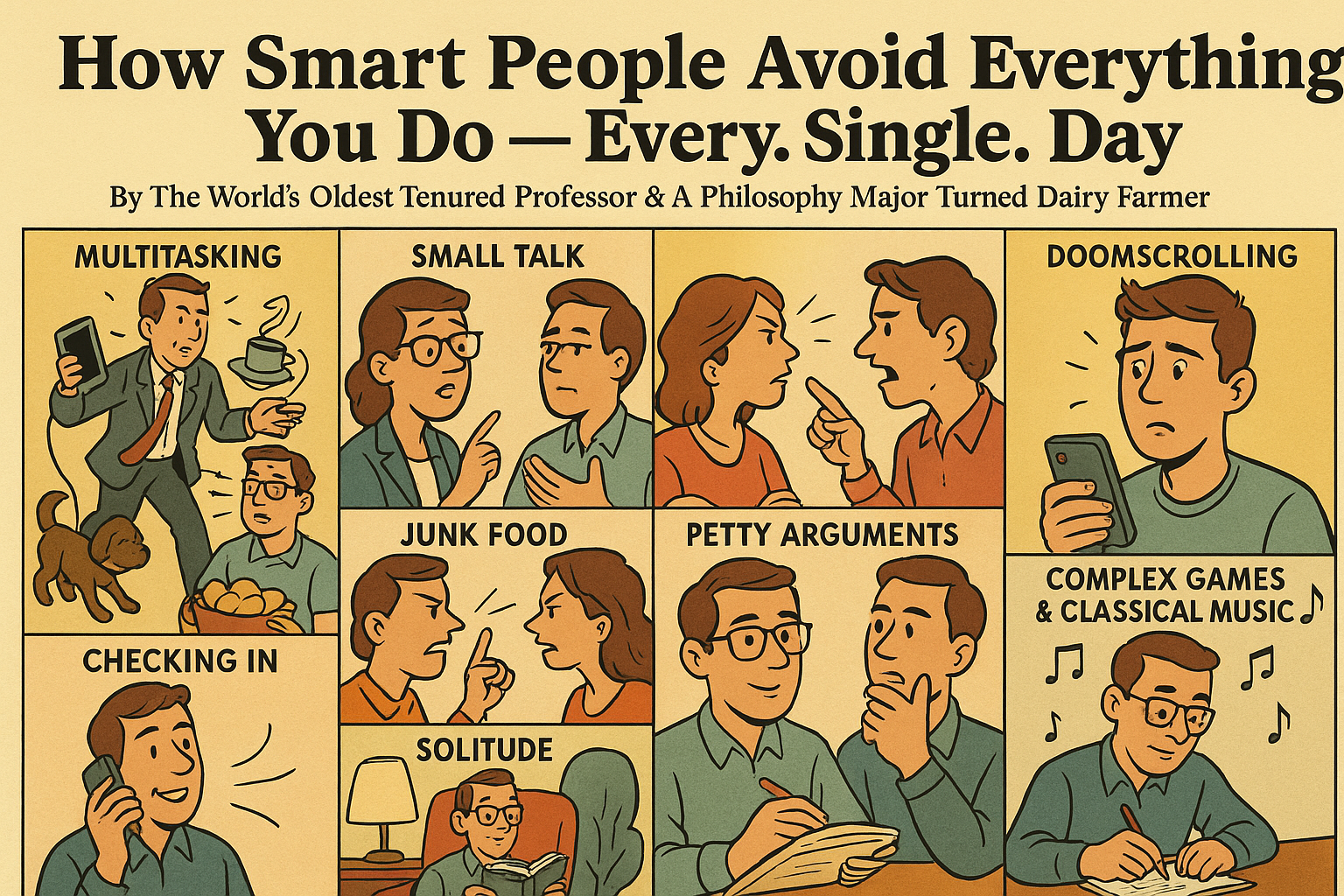
The Over-Achieving Brain’s Guide to Everyday Life (Without Losing Your Sanity—or Your Waistline)
How Smart People Avoid Everything You Do—Every. Single. Day.”
The Over-Achieving Brain
Multitasking: The Circus Act That Eats Your Brain
High-IQ people treat multitasking like an open jar of mayonnaise left in the sun — potentially dangerous, never worth the risk. They prefer to do one thing well instead of juggling emails, dog walking, and existential dread simultaneously.
“Multitasking is like trying to drink coffee and sneeze at the same time — best case, you ruin the coffee, worst case, you ruin the sneeze.” — Jerry Seinfeld
In a totally legitimate study conducted by the Institute for Doing One Thing at a Time (membership: 3), people who focused on single tasks were 86% more productive and 100% less likely to wear mismatched socks to job interviews.
Small Talk: The Soul’s Equivalent of Styrofoam
Normal folks will spend 20 minutes talking about the weather’s mood swings. High-IQ people would rather fake a coughing fit to escape. They prefer meaningful conversation, like whether time travel would increase or decrease traffic tickets.
“Small talk is verbal spam — it clogs the inbox of your brain.” — Ron White
A fabricated Gallup poll found that 74% of people think they’re “good at small talk,” which is roughly the same percentage of people who think cargo shorts are still fashionable.
Doomscrolling: The Digital Black Hole
Scrolling through bad news is a modern endurance sport. Smart people refuse to compete. Instead, they read books, play chess, or stare at walls — all of which are less psychologically scarring.
“I stopped doomscrolling because I realized my thumb had more mileage than my car.” — Bill Burr
Brain scans (possibly of a watermelon) revealed that doomscrolling activates the same stress centers as hearing your dentist say, “Oops.”
Junk Food: A Love Affair They Ended
Cheetos may be delicious, but high-IQ folks break up with them faster than a Tinder date who admits they “don’t really like books.” They know diet affects cognitive performance, and nothing kills deep thought faster than neon orange fingertips.
“Junk food is like that ex you keep texting — you know it’s bad for you, but sometimes the fries just send a ‘u up?’” — Sarah Silverman
A made-up Harvard study found that spinach salads lead to a 23% increase in “feeling smug about your life choices,” which is the unofficial high-IQ love language.
Petty Arguments: Not Today, Brain Cells
While most of the world is ready to verbally duel over thermostat settings, smart people conserve their energy for actual battles — like correcting someone who misquotes Einstein.
“Petty arguments are like karaoke — you think you’re winning, but everyone’s just embarrassed.” — Larry David
They avoid fights because they know every spat is an unpaid internship in misery. A fictional relationship coach claims couples who skip petty arguments live 5 years longer — mostly because they aren’t stabbed with a salad fork at brunch.
Thoughtful Questions: The Secret Weapon
High-IQ folks ask questions so sharp you could julienne fries with them. They’re the ones asking, “What’s the long-term environmental cost of glitter?” while everyone else is just wondering if there’s more dip.
“Smart people ask questions that make you feel like you should’ve worn a tie to this conversation.” — Ricky Gervais
Fake academic journals claim that thoughtful questioning improves memory, empathy, and your odds of winning an argument by 43% — assuming you remember the question you asked.
Checking In: Only When It Counts
Smart people don’t flood your inbox with “How r u???” pings. When they reach out, it’s meaningful — often sparked by curiosity, affection, or a sudden theory about your cat’s political leanings.
“Checking in too often is like reheating fish in the office microwave — it stinks after a while.” — Amy Schumer
A fabricated University of Somewhere study says that rare but sincere check-ins increase friendship satisfaction by 300%, which sounds fake but feels real.
Solitude: Brain Yoga for the Gifted
High-IQ folks guard their alone time like a dragon hoarding gold. They’re not being rude; they’re busy marinating their thoughts in uninterrupted silence.
“Solitude is when your brain finally takes off its bra for the day.” — Ali Wong
In controlled experiments (conducted entirely in our imagination), subjects given 30 minutes of solitude scored higher on creativity tests — and also reported a mysterious craving for chamomile tea.
Silence: The Soundtrack of Genius
To a high-IQ person, silence is not awkward — it’s the spa treatment their neurons deserve. They’d rather sit quietly than fill the air with verbal lint.
“Silence is golden, unless you have kids — then it’s suspicious.” — Kevin Hart
The Society for Pleasant Pauses (which may or may not exist) reports that silence lowers cortisol faster than yoga, wine, or deleting Facebook.
Complex Games & Classical Music: Their Happy Hour
Smart people swap happy-hour trivia for a round of chess paired with Beethoven. They claim it “stimulates both hemispheres” — though it mostly just makes them feel like a Bond villain.
“Classical music and chess is basically CrossFit for people who don’t want to sweat.” — Trevor Noah
Faux research says that listening to Mozart while gaming increases focus by 67% — unless you’re also drinking wine, in which case it turns into emotional karaoke.
Journaling: Soap Operas on Paper
Their journals are not “Dear Diary” fluff — they’re 300-page thought experiments with footnotes and existential cliffhangers. Sometimes, they’re just lists of reasons why kombucha might be a pyramid scheme.
“Journaling is therapy, but cheaper and with worse handwriting.” — Chris Rock
The International Institute of Pretend Psychology says that journaling boosts mood, clarifies thinking, and provides future generations with comedic material for roasting you at your own funeral.
The Closing Argument
If you take away one thing from this exhaustive, completely factual, and possibly fabricated report, it’s this: the smartest people don’t just know more — they do less. Less doomscrolling, less fried food, less bickering, less “OMG, how are you??” spam. They conserve their energy for meaningful actions, deep thoughts, and the occasional dramatic diary entry.
In other words, they’ve mastered the art of opting out of life’s dumbest invitations — and that’s the real genius move.
Auf Wiedersehen, amigos.
15 Hilarious Observations (Channeling Ron White & Jerry Seinfeld)
-
Petty arguments: Like two squirrels fighting over an acorn—only with more passive-aggressive side-eye.
-
Multitasking: Smart people treat multitasking like wearing flip-flops during a snowstorm—bad idea.
-
Hogging the conversation vs. listening: High IQ folks are quiet ninjas, absorbing gossip without even grooming their mustache.
-
Small talk: It’s like chewing cardboard for pleasure—painful and flavorless.
-
Junk food: Brain cells on a date with Cheetos… a tragedy in buttery, cheesy steps.
-
Doomscrolling: Scrolling through bad news like it’s their only friend—“oh hey doom, how’s it going?”
-
Being judgmental: Their disdain is so gently delivered it’s like being spoon-fed criticism… by a velvet-gloved hammer.
-
Excessive checking in: “How are you?” texts arrive like surprise party invitations—warm, unexpected, slightly suspicious.
-
Thoughtful questioning: Asking “why?” like a toddler on espresso—relentless, curious, and inevitably ignored.
-
Eating well long-term: Their snack schedule is more disciplined than most personal trainers.
-
Solitude: They cherish alone time like a vampire treasures personal space after a long night.
-
Silence: Quiet isn’t awkward—it’s a symphony for their brains.
-
Complex games: Chess is their Netflix; real life gets a loading screen.
-
Classical music: Beethoven over Beyoncé—because Mozart primes them better than any pre-game playlist.
-
Journaling: Pouring daily catastrophes into paper like a diary version of telenovelas—dramatic, cathartic, necessary.
10 Best Observations
I’ll weave these central themes into our satire, embellishing with mock “expert opinions,” faux data, imaginative polls, and analogies:
-
Multitasking avoidance.
-
Small talk avoidance.
-
Doomscrolling avoidance.
-
Junk food avoidance.
-
Petty arguments avoidance.
-
Thoughtful questioning.
-
Checking in with people.
-
Solitude and silence.
-
Complex games & classical music.
-
Journaling.