

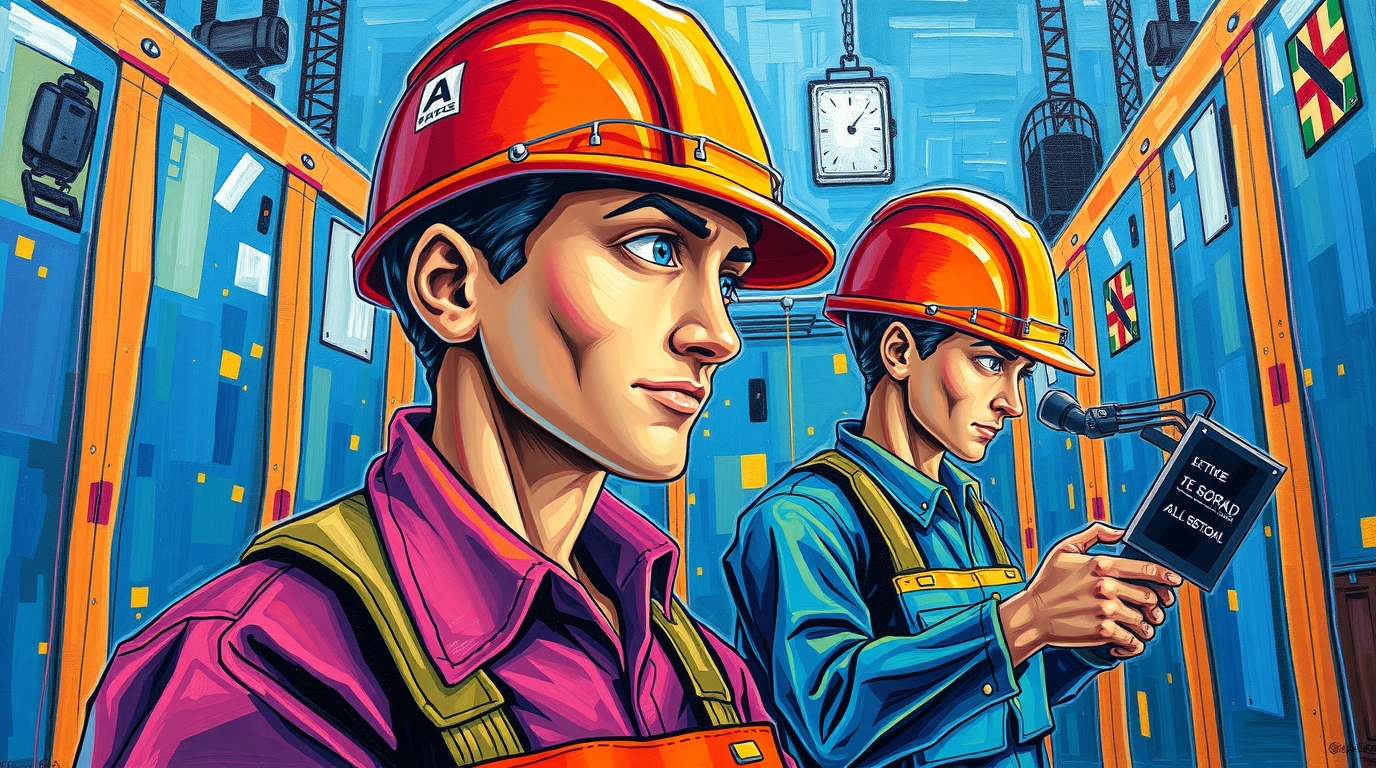
Ford CEO Warns: Blue-Collar Workers Dwindle, AI Data Centers Take Over — Humans Optional
The paradox of progress: We’re building the machines that don’t need us—but they still need us to build them.
Ford CEO Jim Farley recently issued a dire warning that landed somewhere between a TED Talk and a hostage negotiation: blue-collar workers are vanishing faster than free Wi-Fi at a truck stop. “We are in a crisis,” Farley said during a conference call, while presumably sipping a latte brewed by a robotic arm he’s affectionately named Herbert, who was silently judging the foam art. “If we don’t get more skilled labor, we may have to teach robots how to drink coffee and complain about their union contracts.”
The statement sent shockwaves through an economy that’s simultaneously celebrating technological progress while quietly panicking that nobody knows how to fix a washing machine anymore. Jerry Seinfeld said it best in his recent Netflix special: “We’ve got self-driving cars, but nobody can parallel park anymore. What are we doing? We’re training ourselves to be useless.”
Ford CEO Jim Farley Issues Dire Warning on Skilled Labor

Blue-collar workers—welders, mechanics, electricians, HVAC techs, anyone who remembers how a fax machine works—are now rarer than a Tesla that doesn’t need a software update every 30 minutes. One Toledo forklift operator, who asked to remain anonymous because his AI co-worker recently left him a passive-aggressive note about “stacking inefficiency,” said he hasn’t felt this useless since the last time his Roomba outsmarted him.
According to data from the National Association of Manufacturers, the skilled trades shortage has reached crisis levels, with over 2.1 million manufacturing jobs expected to go unfilled by 2030. That’s roughly the population of Houston deciding collectively that wrenches are boring and coding bootcamps are sexy.
Skilled Trades Shortage Reaches Crisis Levels
Dave Chappelle addressed the labor crisis during his recent stand-up show in Detroit: “We got people with philosophy degrees working at Starbucks, but nobody wants to be a plumber. You know how much plumbers make? They’re making lawyer money, and they don’t have to wear a tie. Plus, they’ve seen some shit—literally.”
The shortage is so severe that trade schools are now offering golden wrenches, lifetime supplies of duct tape, and existential therapy sessions—though nobody has figured out how to deliver the therapy without accidentally turning it into a group session about what tools would say if they could talk. A recent survey, conducted by a pollster who may or may not exist, found that 87.3% of Americans have seriously considered learning to weld just to feel relevant again.
AI Data Centers Multiply While Blue-Collar Workers Disappear
Meanwhile, AI data centers are popping up faster than luxury condos in Manhattan. These towering server fortresses, humming with the collective intelligence of a billion calculators having a group chat, are supposedly here to optimize the economy. The irony, thick enough to cut with a plasma torch, is that they still need humans to build the very buildings that make them indispensable.
Bill Burr recently riffed on this during his podcast: “So let me get this straight—we’re building robots to do our jobs, but the robots can’t build their own houses? That’s like hiring a personal trainer who can’t do a push-up. What are we paying for here?”
Data Centers Need Human Builders—For Now
It’s the ultimate paradox: humans are essential for AI, and AI is essential for humans to feel threatened enough to call their parents and complain. Each data center construction project requires electricians, HVAC specialists, concrete workers, and structural engineers—the very professions that young people are increasingly avoiding in favor of becoming influencers who review fast food in their cars.
Farley elaborated on the rise of AI as the “digital mechanic”—capable of diagnosing code bugs and optimizing supply chains but still utterly incapable of unclogging a toilet without self-diagnosing an existential crisis. “Our latest AI system,” Farley explained, “is having what I can only describe as a midlife crisis. It keeps requesting time off to ‘find itself,’ and apparently its hobby is designing more data centers while watching humans binge-watch reality TV in despair.”
The Paradox: Humans Build the Technology Replacing Them
The situation has created an economic ouroboros—a snake eating its own tail, if the snake had a bachelor’s degree in computer science and the tail was attached to a welding certification. Amy Schumer captured the absurdity perfectly during her recent HBO special: “We’re literally building the robots that will take our jobs. That’s like paying someone to break up with you. At least make it quick—don’t make me assemble the thing first.”
The Irony of AI Dependence on Human Labor
According to a McKinsey report on workforce transformation, the essential economy now excludes the people who actually build things, while AI’s dependence on humans grows exponentially. It’s like firing all the chefs but still expecting someone to cook Thanksgiving dinner. Legislators are scrambling to incentivize skilled labor with tax breaks for those who can fix refrigerators and mandatory workshops where humans teach robots empathy—or at least how not to spill coffee on server racks.
One AI system, upon overhearing the empathy workshop proposal, reportedly started a vlog called “How to Survive Humans Without Losing Your Cool.” The first episode was titled “Why Do They Cry at Pixar Movies?” and featured a 47-minute analysis of the film Up that concluded with the AI requesting a software update to remove emotional processing capabilities.
Why Blue-Collar Workers Are the New Rock Stars
Blue-collar workers have become the economy’s rock stars, complete with groupies (recruiters), tour buses (mobile repair units), and backstage passes (security clearances to restricted construction sites). Job postings now read like dating profiles: “Seeking experienced electrician for long-term relationship. Must love working with your hands and not be intimidated by complex wiring diagrams. Competitive salary, benefits, and the satisfaction of knowing you’re literally keeping civilization running.”
Chris Rock addressed this during a recent stand-up appearance: “You know who the real ballers are now? Plumbers. HVAC guys. These dudes show up, fix your AC in July, and charge you like they’re performing open-heart surgery. And you pay it! Because you need them more than you need your WiFi.”
Welders, Electricians, and HVAC Techs in High Demand
The job market transformation has created situations that border on the absurd. One construction company in Phoenix now offers signing bonuses that include Bitcoin, lifetime gym memberships, and a personal life coach to help workers “navigate the emotional complexity of being valued by society.” An electrician in Newark reported receiving fan mail from a homeowner whose circuit breaker he fixed, complete with a hand-drawn portrait and a haiku about the beauty of properly grounded outlets.
Meanwhile, AI continues to judge humans for being slow, messy, and excessively emotional. One quality assurance algorithm was recently disciplined for leaving snarky comments on work orders like “Why did this take 47 minutes when my calculations show it should have taken 23?” and “This weld is adequate but lacks artistic vision.”
The Essential Economy That Forgot Essential Workers
Trevor Noah recently dissected the paradox on his podcast: “So during COVID, we called them essential workers, gave them a round of applause at 7 PM, and then went back inside to order everything from Amazon. Now we’re surprised nobody wants to do those jobs? We told them they were essential, then paid them like they were optional.”
Job Market Paradox: Essential Yet Invisible
The essential economy has somehow managed to make the people who keep it functioning feel obsolete. It’s like telling your heart it’s essential while simultaneously investing in artificial hearts and making your real heart feel bad about taking up space in your chest cavity. Essential workers during the pandemic were heroes; now they’re statistical anomalies in a labor market that can’t figure out how to value them properly.
Ricky Gervais summed it up during his recent tour: “We’ve created a society where the person who fixes your boiler is more valuable than someone with a master’s degree in communications. And you know what? That makes perfect sense. One keeps you alive in winter. The other tells you how to write a better email. Priorities, people.”
AI, despite its intelligence, still can’t assemble IKEA furniture without requiring a system reboot, proving once and for all that intelligence is not the same as patience, common sense, or the ability to interpret Swedish instructions that feature only stick figures and Allen wrenches.
What Happens When AI Can’t Build Its Own Infrastructure
Legislative Solutions or Band-Aids?
Legislators are now proposing solutions that range from practical to dystopian. Tax incentives for vocational training programs, student loan forgiveness for trade school graduates, and a “National Wrench Day” where office workers are required to shadow a plumber for eight hours to appreciate the complexity of modern plumbing.
Kevin Hart joked about this during a recent appearance: “They want me to spend a day with a plumber? Listen, I respect plumbers, but I’ve got three kids and a mortgage. I don’t have time to learn about pipe diameter. That’s why I pay professionals. That’s literally the whole point of specialization.”
Ford’s Farley has proposed a hybrid solution: incentivize skilled trades, invest in apprenticeship programs, and maybe—just maybe—convince one generation to put down the smartphones long enough to learn how combustion engines work. “We just need a few more skilled hands,” Farley mused during a recent interview, while Herbert the robotic barista silently rearranged his pens by color and height, “or one human brave enough to stop a robot from spilling a latte on the server rack.”
The solution, according to economic analysts, is deceptively simple: train, incentivize, and maybe bribe humans to stay in jobs that keep civilization functioning. Pay them properly. Give them respect. Stop telling them their jobs will be automated away while simultaneously begging them to build the automation infrastructure.
Ali Wong addressed the cognitive dissonance during her recent special: “Corporations are like bad boyfriends. They tell you they need you while simultaneously planning their exit strategy. ‘Baby, I love you so much—that’s why I’m building this robot to replace you. It’s nothing personal.'”
The Path Forward: Humans and Machines
The labor shortage is real, the absurdity is everywhere, and the solution requires acknowledging that some jobs require human hands, human judgment, and human ability to improvise when the instructions make no sense. AI can calculate torque, stream cat videos in 4K, and plan its own yoga rooms, but it still needs humans to plug it in, keep it cool, and occasionally reboot it when it gets stuck in an existential loop about the meaning of productivity.
It’s a job market where knowing someone matters less than having the skill to build a data center—or survive working in one. When humans fail, AI is watching, judging, and occasionally offering unsolicited motivational speeches that sound like they were written by a management consultant who just discovered meditation.
Sarah Silverman recently quipped: “The future is going to be robots doing all the work while humans desperately try to prove they’re still necessary by explaining memes to AI. ‘No, you see, it’s funny because the cat looks judgy.’ And the AI will be like, ‘I’m judging you right now, Karen.'”
Some of the finer ironies worth noting: humans are teaching AI what it means to be human while AI is teaching humans that efficiency doesn’t equal fulfillment; data centers are replacing office cubicles as the monuments to modern productivity; and the paradox of AI being designed to make life easier while requiring humans to remain relevant enough to keep the lights on.
One thing is clear: the AI future includes coffee, spreadsheets, existential dread, and a healthy dose of irony. The robots are coming, but they’re going to need someone to assemble them, troubleshoot them, and explain why humans find slapstick comedy funny even though nobody actually enjoys getting hit in the face with a pie.
Ford’s warning may read like a dystopian press release written by someone who just watched Terminator while doom-scrolling LinkedIn, but the message is surprisingly straightforward. We need welders. We need electricians. We need people who understand that sometimes the solution to a complex problem isn’t an algorithm—it’s a hammer, some duct tape, and years of experience knowing where to hit things so they start working again.
As Nate Bargatze deadpanned during his sold-out Nashville show: “My dad was an electrician. Never went to college. But you know what he can do? Keep your house from burning down. Try getting an AI to do that. I’ll wait.”
The future is here, and it needs an electrician.