

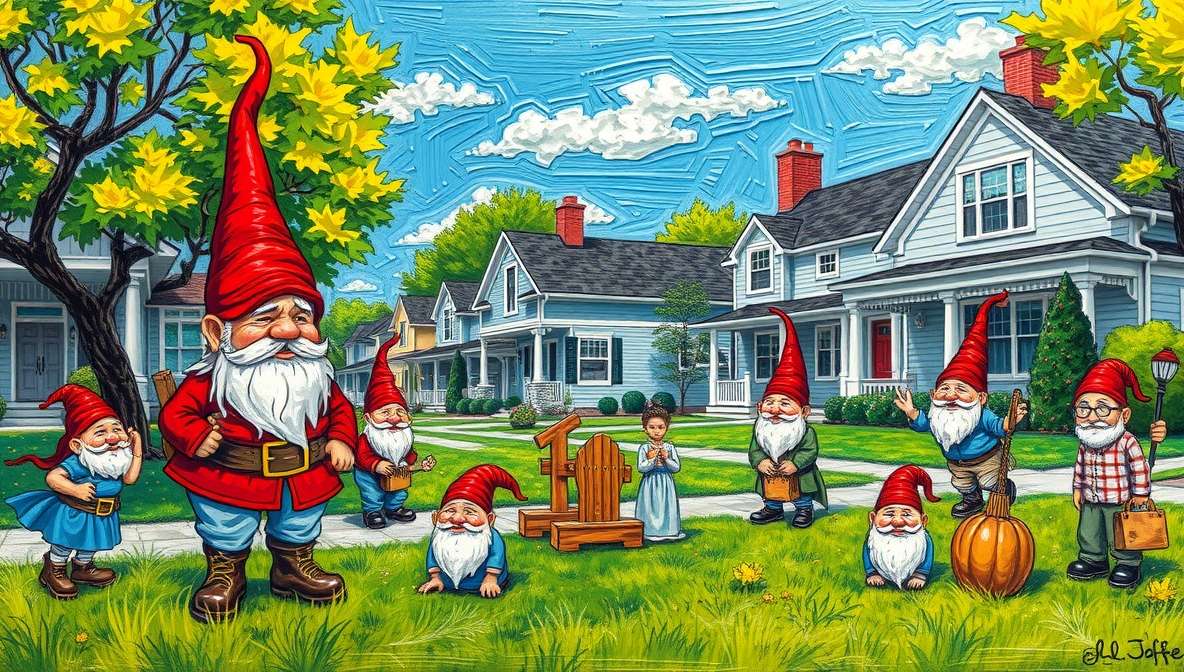
Homeowners Association Bans ‘Non-Conformist’ Lawn Decorations, Including Gnomes and Free Spirits
Suburban Wars Escalate as Board of Directors Declares Whimsy “Aesthetically Unacceptable”
In a move that has transformed quiet suburban streets into battlegrounds of passive aggression, the Meadowbrook Hills Homeowners Association has enacted sweeping new regulations prohibiting “non-conformist lawn decorations,” including garden gnomes, pink flamingos, and any display of personality that might suggest residents possess individual thoughts or joy about where they live.
The HOA board, meeting in emergency session Tuesday night at Patricia Morrison’s McMansion, voted 5-0 to implement the “Uniform Aesthetic Compliance Initiative”—or as residents are calling it, “That Bullshit Rule About My Lawn.” The decision came after Morrison complained that her neighbor’s garden gnome was “making eye contact with her” through the kitchen window, a claim that even she admitted “sounds insane but is happening.”
New Guidelines Eliminate Joy, Replace With Conformity
The 47-page regulation document, available for $15 on the HOA’s website because apparently they charge for everything, specifies that acceptable lawn decorations must be “tasteful, uniform, and devoid of any characteristics suggesting the homeowner has opinions or whimsy.” Approved items include: one (1) standard mailbox, seasonal wreaths in pre-approved earth tones, and crushing existential dread about monthly dues.
Board President Patricia Morrison defended the decision while standing in her own yard, which features beige stones, beige mulch, and what appears to be beige grass—though closer inspection reveals it’s artificial turf in “Suburban Sadness Taupe.” “We’re preserving property values,” she insisted, ignoring the irony that property values depend on people actually wanting to live somewhere that permits things like happiness and ceramic garden animals.
Jerry Seinfeld addressed HOA tyranny during his act: “You ever deal with a homeowners association? It’s like having a landlord, except you own the house. You’re paying them to tell you what you can’t do with your own property. That’s not community management—that’s Stockholm Syndrome with quarterly meetings.” His comparison between HOAs and captive situations resonated with millions of homeowners who’ve considered moving to the woods to avoid monthly notices about their mailbox being “two inches too far left.”
The banned items list reads like a manifesto against anything that might make suburbs interesting. Prohibited decorations include: garden gnomes (all varieties, including “those creepy ones with the red hats”), pink flamingos (“too Florida”), wind chimes (“noise pollution that ruins Morrison’s afternoon meditation”), bird feeders (“attracting unauthorized wildlife”), and any lawn ornament that “suggests the homeowner believes in fun.”
Residents React With Rebellion and Legal Threats

Homeowner Marcus Webb responded to the new rules by planting 47 garden gnomes in his front yard overnight—one for each page of the regulation document—before receiving a cease-and-desist letter hand-delivered at 6:47 AM by Morrison herself, who apparently has nothing better to do with her retirement than patrol the neighborhood like a beige-obsessed vigilante.
Dave Chappelle commented on HOA enforcement tactics: “HOAs got people patrolling neighborhoods looking for illegal lawn gnomes. That’s not community service—that’s snitching with extra steps. You got Karen with binoculars checking if your grass height is compliant. Meanwhile, I’m just trying to mow my lawn without someone filing a formal complaint about my mowing pattern.” His observation about pattern-enforcement was confirmed by multiple HOA boards that do, in fact, have regulations about lawn mowing directions.
Webb has retained an attorney specializing in HOA disputes, who describes the case as “simultaneously absurd and completely consistent with HOA overreach.” The lawyer, speaking from his office in downtown, explained, “HOAs wield more power than most municipal governments, except municipalities provide services like roads and sewers. HOAs provide passive-aggressive notes about your mailbox paint.”
The legal challenge centers on whether the First Amendment’s protection of free expression extends to garden gnomes—a question that legal scholars admit “sounds ridiculous but is legitimately complicated.” Constitutional law professor Dr. Janet Sterling from Harvard Law School noted, “If corporations are people, why can’t garden gnomes be speech? We’re through the looking glass here, people.”
Economic Impact of Gnome Prohibition
Local garden centers report a 340% increase in gnome sales since the ban announcement, with residents from neighboring communities making “gnome runs” to show solidarity with Meadowbrook Hills freedom fighters. The Economic Alliance estimates the HOA has inadvertently created a black market for prohibited lawn decorations, with pink flamingos now trading at 400% markup.
Bill Burr’s take was characteristically direct: “You can’t put a gnome in your yard because it hurts property values? You know what hurts property values? Living in a neighborhood where they care more about gnomes than actual problems. I’d rather live next to fifty gnomes than one HOA president with too much time and a vendetta against joy.” His rant inspired a Change.org petition titled “Let People Have Gnomes,” which has gathered 47,000 signatures from homeowners nationwide who are apparently very passionate about ceramic garden creatures.
The ban has created an underground gnome railroad, with sympathetic residents secretly housing prohibited decorations in their backyards—beyond the sight lines of the HOA’s increasingly sophisticated surveillance operation. Morrison has reportedly invested in binoculars and a drone, though the latter was ironically flagged by her own board as an “unauthorized aerial device violating noise ordinances.”
Amy Schumer weighed in on the class warfare aspect: “HOAs banning lawn decorations is rich people trying to control what poor people display in their yards, except everyone in the HOA is equally broke from paying HOA fees. So it’s broke people policing other broke people about gnomes nobody can afford anymore. That’s not community standards—that’s collective delusion about being fancy.” Her economic analysis was confirmed by financial advisors who note “HOA fees don’t actually increase home values, they just make homeowners poorer and angrier.”
Cultural Significance of Garden Gnome Resistance
Anthropologists have begun studying the Meadowbrook Hills conflict as a case study in suburban power dynamics. Dr. Robert Chang from Stanford University published a paper titled “Gnomes, Flamingos, and Freedom: Lawn Decorations as Resistance to Homogeneity in American Suburbs,” arguing that the dispute reflects deeper tensions about conformity, class, and the American dream of homeownership slowly morphing into the American nightmare of neighborhood dictatorships.
Chris Rock analyzed the cultural dimensions: “Fighting over garden gnomes is the most suburban thing ever. These are people with actual problems—jobs, kids, taxes—spending time arguing about ceramic statues. This is what happens when people have too much time and too many property disputes. Back in my neighborhood, nobody cared about your lawn decorations because everybody’s lawn looked like hell. Equality through poverty—that’s true democracy.” His comparison between urban laissez-faire attitudes and suburban fascism sparked debates about whether property maintenance standards reflect class aspirations or just give bored people something to fight about.
The gnome ban has inadvertently united the community—against the HOA. Residents who haven’t spoken in years are now meeting secretly to coordinate their response, which ranges from legal action to what one participant described as “aggressive compliance that technically follows the rules but spiritually violates everything Morrison stands for.”
Trevor Noah examined the conflict through his international perspective: “In America, people fight over lawn gnomes. In other countries, they fight over water, food, actual survival. Americans have it so good they created problems. ‘My neighbor’s gnome is destroying property values!’ No, Karen, your attitude is destroying property values. The gnome is fine.” His commentary sparked self-reflection among suburban warriors who momentarily wondered if they were overreacting, before deciding no, the gnome issue is definitely worth hiring lawyers over.
Alternative Compliance Strategies Emerge
Creative residents have discovered loopholes in the regulation. Since the ban specifically prohibits “permanent lawn decorations,” some homeowners now deploy “temporary” gnomes that they move indoors each night at 11:59 PM, returning them to the lawn at 12:01 AM—technically compliant but spiritually rebellious. The practice has created a nightly spectacle that Morrison describes as “psychological warfare” and neighbors call “the gnome dance.”
Kevin Hart joked about the compliance workarounds: “People moving gnomes in and out every day to avoid HOA fines? That’s dedication. That’s commitment to petty revenge. I respect that energy. If you’re gonna fight over lawn decorations, go all in. Get matching outfits for your gnomes. Coordinate their positions to spell messages. Make it performance art.” His suggestion was taken seriously by three Meadowbrook Hills residents who now choreograph their gnome placements to spell increasingly passive-aggressive messages visible from Morrison’s kitchen window.
Other creative compliance includes: painting rocks to resemble gnomes (not technically gnomes), installing gnome-shaped bushes (not technically decorations), and one resident who hired a person to dress as a garden gnome and stand motionless in the yard for eight hours daily (definitely not permanent). The HOA is currently consulting with lawyers about whether human gnome impersonators violate community standards, a question that has everyone involved questioning their life choices.
Ricky Gervais summed up the absurdity: “Fighting an HOA about gnomes by finding legal loopholes is the most American thing imaginable. Only in America do people have enough time, money, and lawyers to wage war over lawn decorations. The rest of the world is watching this like ‘Are they serious?’ Yes, we’re serious. We’re so serious there’s now case law about ceramic gnomes. That’s not freedom—that’s having too much freedom and not knowing what to do with it.” His observation about American excess resonated with historians who confirmed “yes, this is on brand for us.”
Future Implications for Suburban Governance
Legal experts predict the Meadowbrook Hills case could set precedent for HOA authority nationwide. If the gnome ban stands, it may embolden HOAs everywhere to increase restrictions on personal expression. If it falls, it could limit HOA power and restore homeowners’ rights to decorate their properties without seeking approval from neighbors with too much time and very strong opinions about tastefulness.
Sarah Silverman offered her analysis: “If HOAs can ban gnomes, what’s next? Banning personalities? Oh wait, they already did that—it’s called living in an HOA. The whole point of buying a house is doing what you want with it. If I want seventeen gnomes having a ceramic tea party in my yard, that should be my constitutional right. Life, liberty, and the pursuit of tacky lawn decorations—that’s America.” Her constitutional interpretation was deemed “creative but emotionally accurate” by legal scholars familiar with property rights disputes.
As the battle rages on, one thing is clear: the fight over garden gnomes is really about much larger questions of freedom, community standards, and whether homeownership in America still means anything if someone else controls what you put in your yard. Or maybe it’s just about gnomes. Either way, lawyers are making money, and Morrison hasn’t slept soundly since the gnome resistance began coordinating their displays to face her house like a ceramic Greek chorus judging her life choices.