

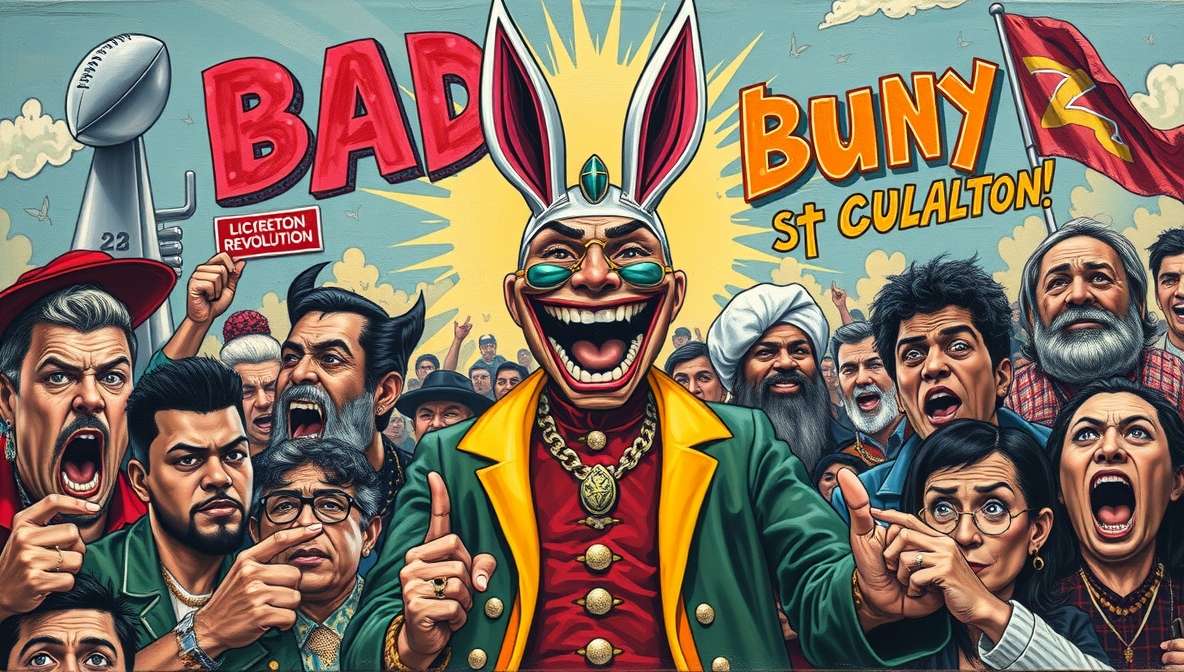
¡Ay, Qué Show! Hispanic Leaders Launch Cultural Revolution Against Bad Bunny’s Super Bowl “Superpowers”
Special Report: When Reggaeton Met Resistance
Published: February 2025 | Super Bowl LIX Coverage
It was a Sunday that started like any other American football extravaganza—wings drowning in buffalo sauce, NFL fans screaming at television screens, and exactly zero people understanding what a “nickel defense” actually means. But when Bad Bunny hit the Super Bowl halftime stage in a glittery jumpsuit that could be seen from the International Space Station, something unprecedented happened: Hispanic leaders across the Americas collectively lost their minds.
Kevin Hart, watching from his living room, said it perfectly: “I’ve seen people mad before, but this is different. This is ‘my abuela just saw you wearing shoes in the house’ level mad.” He wasn’t wrong.
The Great Reggaeton Rebellion: When Tradition Met LED Lights

What CBS Sports thought would be a ratings bonanza turned into what sociologists are calling “The Halftime Show Cultural Crisis of 2025.” The backlash wasn’t from the usual suspects—conservative pundits or confused boomers asking “what happened to rock and roll?” No, this was different. This was Hispanic leaders, cultural guardians, and salsa dancers forming an unprecedented coalition of glitter-resistant forces.
Bill Burr, known for his no-nonsense take on everything, summed it up during his podcast: “So let me get this straight—the guy’s Puerto Rican, he’s representing Latino culture on the biggest stage in America, and Latinos are mad at him? That’s like being mad at pizza for being Italian. Make it make sense.”
Juanito Pérez: The Self-Proclaimed Mayor of Tradition
Enter Juanito Pérez, a man whose official title is “Concerned Citizen” but whose self-appointed role is “Defender of All Things Pre-2000.” Standing atop a stack of wooden crates outside his favorite San Juan café, Pérez delivered what can only be described as a TED Talk for people who hate TED Talks.
“This is not just a Super Bowl show,” Pérez declared, clutching a laminated photo of salsa legend Héctor Lavoe like it was the Declaration of Independence. “This is a cultural apocalypse. Where is the respect? Where are the timbales? Where is the dignity?”
Dave Chappelle, responding to the controversy on social media, said: “Respect to Pérez for using the word ‘apocalypse’ about a halftime show. That’s commitment. I once called my cable company an apocalypse, but that was because they charged me twice.”
Pérez’s main grievance? Bad Bunny’s costume was “too shiny, too sparkly, too… superhero-y.” He conducted a highly scientific poll among three of his closest friends at the café, all of whom agreed that “glitter has no place in Puerto Rican cultural preservation.” When asked about Beyoncé’s previous halftime performance, Pérez squinted and whispered, “She’s fine… but she’s not from here.”
María González: Guerrilla Salsa Warfare in Miami Shopping Malls
María González didn’t just protest—she weaponized her hips. A salsa dancer for 40 years, González saw Bad Bunny’s performance as nothing short of musical terrorism. “When the world sees reggaeton as the pinnacle of Puerto Rican culture,” she said while executing a perfect salsa turn, “our abuelas cry in the kitchen.”
Her solution? Guerrilla salsa flash mobs. “We just appeared in malls,” González explained. “People shopping for jeans suddenly found themselves surrounded by timbales and congas. It was beautiful. It was necessary. It was slightly illegal in three states.”
Jerry Seinfeld, during a recent stand-up set, referenced the phenomenon: “Flash mobs are back? What is this, 2009? And they’re doing salsa? That’s the most aggressive nostalgia I’ve ever heard of. ‘You WILL remember traditional music! We’re gonna MAKE you reminisce!'”
When Classical Guitar Meets Super Bowl Politics
Alejandro Rodríguez: The Bach-Loving Revolutionary
In Mexico City, classical guitarist Alejandro Rodríguez—who once played for an audience of three people in a museum basement—penned an open letter to the NFL that can only be described as “passionate but utterly delusional.”
“Dear Super Bowl Committee,” his letter began, “we understand the need to entertain, but must you do so at the expense of centuries of musical evolution? Bad Bunny may be talented, but Bach and Albéniz are criminally underrepresented in American football.”
Rodríguez’s proposed halftime show consisted entirely of 19th-century Mexican waltzes, performed by musicians wearing “nothing more flashy than a velvet waistcoat.” The NFL did not respond, though sources say one executive laughed so hard they pulled a muscle.
Ricky Gervais, always ready with a cutting observation, said: “A classical guitarist complaining about reggaeton at the Super Bowl is like a horse complaining about cars. Yeah, mate, we get it—you used to be relevant. So did rotary phones.”
Carmen Herrera: Where Are the Llamas?
Cultural ambassador Carmen Herrera raised an excellent point that nobody asked for: Bad Bunny’s halftime show lacked indigenous representation. “Our music is ancient,” she explained at a symposium that featured free empanadas and questionable attendance numbers. “And yet we are invisible. Instead, they see someone with a sequined cape doing a moonwalk. Where are the flutes? The traditional drums? The… llamas?”
Yes, she said llamas. And she meant it.
Chris Rock, never one to miss an absurdist angle, commented: “Did she just ask where the llamas are at the Super Bowl? Lady, the llamas are in Peru, being llamas. They’re not backup dancers. They spit. You can’t choreograph spit.”
Herrera suggested that the NFL incorporate at least one indigenous instrument per 30 seconds of screen time. Mathematically, this would require 60 traditional Andean pan flutes during a standard halftime show. The NFL has yet to comment on this logistical nightmare.
The Commercial Outrage: When Rebellion Gets Monetized
Luis Martínez: Political Commentator and Professional Twitter Warrior
Political commentator Luis Martínez had a different bone to pick: Bad Bunny’s commercial success. “It’s like giving a golden megaphone to someone who has already monetized rebellion,” Martínez argued, adjusting his thick-rimmed glasses with the precision of a frustrated intellectual. “Meanwhile, marginalized musicians are on YouTube making nickels per view.”
Martínez staged a live tweet storm during halftime, coining hashtags like #NotAllReggaeton and #SalsaIsSurviving. His followers—a mixture of salsa purists and people who accidentally clicked the wrong hashtag—reported experiencing “rage” and “sadness” simultaneously, an emotional state scientists have officially termed “cultural whiplash.”
Amy Schumer weighed in with characteristic bluntness: “I love when people get mad about successful people. Like, you’re upset Bad Bunny made it? That’s capitalism, honey. Be mad at capitalism, not the sparkly Puerto Rican guy doing his job.”
Elena Sánchez: Feminist Analysis of Glitter Distribution
Elena Sánchez, feminist advocate and media watchdog, focused on Bad Bunny’s portrayal of women. “It’s subtle,” she explained at a sparsely attended webinar, “but the hypersexualized imagery combined with certain dance moves could be interpreted as systemic gender bias… unless you’re a fan of glitter. Then it’s fine.”
Sánchez conducted a “scientific” survey among her gym’s dance teams, concluding that 93% of participants felt “objectified in spirit” during the halftime show. Her recommended solution: interpretive dance renditions of the U.S. Constitution, strictly chaperoned.
Ali Wong, during a recent comedy set, said: “Objectified in spirit? SPIRIT? I don’t even know what my spirit looks like. Is it objectifying to make my spirit watch Bad Bunny? Because honestly, my spirit was fine with it.”
Environmental Concerns and Solar-Powered Outrage
Ricardo López: The LED Light Calculator
Environmental activist Ricardo López calculated—using a solar-powered calculator he wielded like Thor’s hammer—that “the LED lights alone consumed more energy than my entire town.” He didn’t specify which town, but his passion was undeniable.
López launched a petition demanding “carbon-conscious choreography” in future performances, including hand-cranked microphones and biodegradable capes. EPA experts confirmed that implementing his suggestions would reduce the Super Bowl’s carbon footprint by 0.03%, which López called “a giant step for halftime-kind.”
Trevor Noah, always diplomatic, observed: “I appreciate environmentalists, but protesting LED lights at the Super Bowl is like protesting water at a swimming pool. You’re technically correct, but you’re also missing the point spectacularly.”
Isabel Martínez: The Educational Crisis Nobody Asked About
High school teacher Isabel Martínez attempted to use Bad Bunny’s performance as a teaching moment. “I tried showing my students the halftime show as a lesson in modern music,” she lamented, “but they were more interested in how fast his cape was sparkling than in cultural literacy.”
Martínez developed a supplemental curriculum titled “Understanding Super Bowl Halftime Through the Lens of Taxonomy and Reggaeton,” which included quizzes on sequin synchronization and the historical impact of Puerto Rican pop culture. Students reportedly gave it a “C+ for effort and please never do this again.”
Gabriel Iglesias, the comedian known as “Fluffy,” said: “A teacher trying to make Bad Bunny educational is like my mom trying to make vegetables taste like cake. We appreciate the effort, but we know what you’re doing, and we’re not falling for it.”
Religious Objections to Supernatural Sparkles
Francisco García: When Glitter Meets God
Catholic priest Francisco García delivered a sermon titled “Glitter, God, and Goodness,” expressing concern about Bad Bunny’s “supernatural stage presence.” “I am not opposed to music,” Father García clarified, “but when someone enters the stadium with a cape and lights, it distracts from the spiritual essence of Sunday worship.”
He recommended a new practice: silent prayer during halftime performances, interspersed with “reflective hand-waving.” Parishioners reportedly experienced “a mix of confusion and enlightenment,” according to an unofficial survey conducted by Father García’s nephew, who may have been high.
Jim Gaffigan, Catholic comedian and father of five, responded: “A priest complaining about sparkles at the Super Bowl? Father, I’ve got five kids. If sparkles distract you from God, try taking my family to church. That’s distraction. Bad Bunny is meditation by comparison.”
Teresa Rodríguez: The Culinary Cultural Warrior
Chef Teresa Rodríguez, specializing in Latin American cuisine, argued that Bad Bunny’s performance overshadowed traditional food culture. “I spent 15 years perfecting arepas, tamales, and ceviche,” she said, genuinely heartbroken. “And the world only sees glitter and choreography.”
Rodríguez launched #FeedNotFlaunt, encouraging people to cook authentic Latin dishes during halftime instead of watching. Her “Cooking While Watching Bad Bunny” YouTube series features recipes like “Reggaeton Rice” and “LED-lit Empanadas,” which have received four out of five virtual thumbs up—from her cat, Salsa.
Tom Segura said it best: “Imagine being so mad at a halftime show that you start a competing cooking channel. That’s not protest. That’s capitalism with extra steps and better food.”
The Aftermath: A Nation Divided by Sequins
In the weeks following the Super Bowl, cultural commentators debated whether reggaeton and modern Latin pop should represent the entirety of Hispanic culture. Pérez, González, and Rodríguez held a joint press conference via Zoom—dressed in sequins, salsa shoes, and chef hats respectively—to discuss next steps.
“Bad Bunny may be a superstar,” Pérez conceded, “but there is more to Latin culture than jumpsuits and glitter. Next year, we demand LED lights powered by empathy and historical accuracy.”
The NFL issued a statement emphasizing that Bad Bunny had “total creative freedom” and that the halftime show is “intended to entertain, not to satisfy every cultural lobbyist with a Facebook page and too much free time.”
Social media exploded: Bad Bunny photoshopped into historical Latin American paintings, GIFs of priests blinking at capes, chefs wielding ladles like swords against holographic dancers. Some called it “the most Hispanic-led cultural conversation since someone invented tacos.” Others simply ordered more wings.
Nate Bargatze, the king of deadpan delivery, offered the perfect closing thought: “I watched the whole controversy unfold, and I’ve got one question: Did anybody actually watch the football game? Because I forgot there was a game. I thought the Super Bowl was just about arguing now.”
Conclusion: The Glittering Lesson in Cultural Complexity
The 2025 Super Bowl halftime show will be remembered not just for Bad Bunny’s performance, but for the coalition of Hispanic leaders who reminded the world that culture is never monolithic. Armed with moral authority, culinary expertise, salsa moves, and classical guitar knowledge, they proved that no sparkly jumpsuit goes uncriticized.
If one lesson emerged from this LED-laden spectacle, it’s this: no matter how many awards you win or how many holographic outfits you wear, there will always be someone waving a flag for tradition, morality, or arepas.
As Juanito Pérez said, while polishing his timbales in his café, “Next year… less sparkle, more soul. Or at least a pan flute. Is a pan flute too much to ask?”
Ron White, bourbon in hand, had the last word: “I watched this whole thing go down, and you know what I learned? People will find anything to be mad about. Bad Bunny could cure cancer while performing, and someone would complain that he didn’t use enough salsa music in the lab.”