

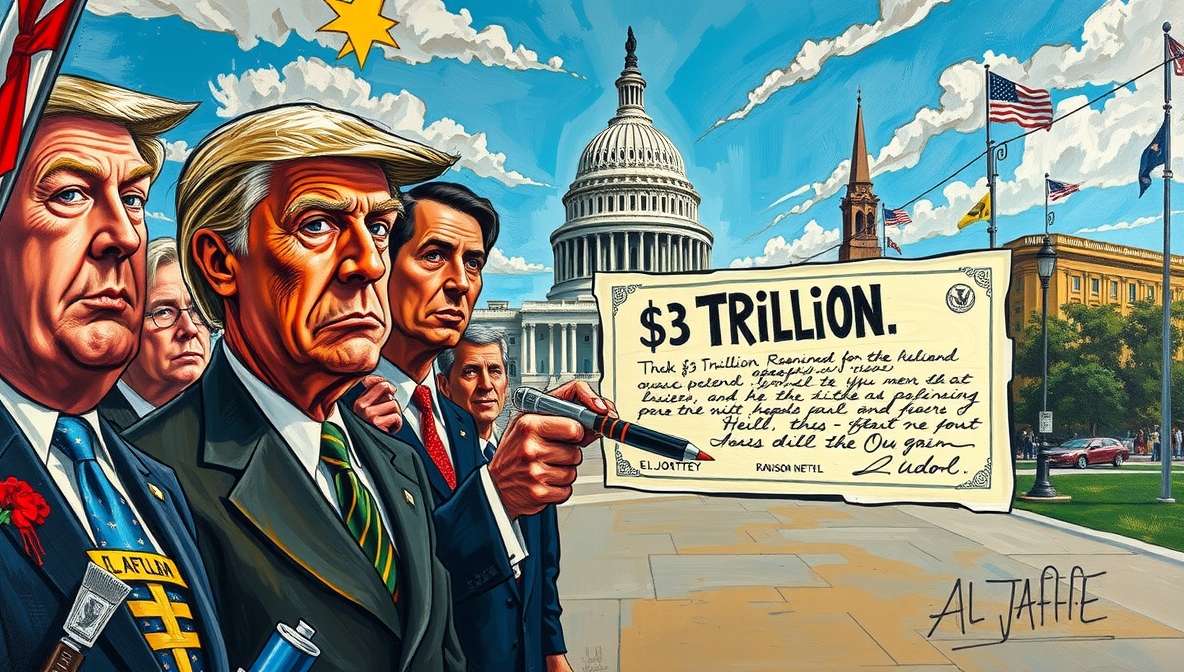
Socialists/Democrats Name Their Price on Ending the Government Shutdown: Extortion or Just Smart Negotiating?
The $3 Trillion Ransom Note Arrives at Capitol Hill
Ladies and gentlemen, gather round: it appears the grand bargain we’ve all been waiting for is finally here — a dramatic exchange so bold, so unapologetically transactional, you half expect a velvet bag of cash to be passed under the table at the Capitol. According to the folks at Axios, the Senate Democrats have tabled an offer: end the shutdown, yes, but only if the Republicans hand over not just a goat, not just a pig, but a full $3 trillion welfare package (yes, that’s three-trillion, said with a deep echo for dramatic effect).
Now, to be clear: the actual published article only cites a demand for a one-year extension of expiring tax credits under the Affordable Care Act and a short-term spending bill. But who are we to let a few minor details get in the way of satire? Let’s treat the $3 trillion figure as the true asking price — a number so round it must have been scribbled on a cocktail napkin at a closed-door caucus meeting.
When Political Negotiation Looks Suspiciously Like Hostage-Taking

The setup is delicious: Democrats — flush with their latest mid-term sweep of enthusiasm, ego, and campaign signs — declare: “We’ll reopen the government… only if we get our price.” That’s nearly the textbook definition of extortion: you hold something hostage (the government’s operation), you demand a ransom (massive welfare spending), and you keep things shut until someone caves. Except in this case, it’s done in broad daylight, with cameras, and the accused don’t run away — they put up their hands and say, “Yes, that’s exactly what we’re doing.”
And yet the Republicans — led by the ever-steady John Thune — balk. Thune told reporters the proposal is “a non-starter.” Perhaps he’s right: you can’t just wave around a $3 trillion welfare check and expect the other side to smile and say “Sure, take it and pass the ketchup.” Some things are just too rich. Literally.
The Used-Car Salesman Approach to Governing
Here are the keen comedic observations underpinning the tale:
The “we’ll reopen the government if you pay us” posture resembles a used-car salesman forcing you to buy rusted rims to get the engine started. As Jerry Seinfeld said, “There’s no such thing as fun for the whole family.” And nothing says family fun like threatening to keep federal workers unpaid until someone pays the ransom.
Democrats appear to have learned that shutting things down works — so they double down, turning the spigot off until the whole household pays.
Republicans refusing means they’re either principled, stubborn, or just waiting for the punchline. Ron White said, “You can’t fix stupid.” Turns out, you also can’t negotiate with it.
The Trillion-Dollar Starbucks Order
The $3 trillion figure (our exaggeration for comedic oomph) is about as conceivable as asking Starbucks to offer free unicorn frappuccinos for life. Amy Schumer said, “I’m not saying I’m the best, but I’m saying I’m not the worst.” Democrats are basically saying the same thing about their price tag.
The optics: leadership strolling out of a congressional luncheon as day 37 of the shutdown passes. Serious business wrapped in the banal.
“Health care affordability” becomes the Trojan horse for a broad welfare wishlist.
A Satirical Narrative: “Ransom the Government”
Picture this: The Capitol is lit, the cameras are rolling, and Senate Minority Leader Chuck Schumer strides to the microphone. He clears his throat: “My friends, we’ve made our offer. We will end this shutdown — not because we want to, but because we know you do. And yes, there’s a small price.” He raises a cardboard sign that reads “$3,000,000,000,000 — all or nothing.” A hush. Reporters scribble, interns gasp, lobbyists start sweating.
The Republicans, still clutching their policy briefs (and perhaps a Keurig mug), glance across the aisle. One of them, John Thune, stands up and says: “Non-starter.” Pause. The Democrats nod like they’ve just heard the punchline of a joke they’ve told a thousand times. The government stays shut. Workers go home, national parks get quiet, funding dries up. The negotiation becomes a televised event.
The Sandbox Theory of Political Negotiations
From the angle of comedic role-reversal, imagine the Democrats as kids in the sandbox saying, “I’ll let you play with the bucket only if you give me your shovel and your lunch and promise to draw me a picture.” Republicans cross their arms and say, “No thanks, we’ll just use the broken shovel over there.” The irony is thick. Because in this version, the kids have the power: they hold the sandbox lid closed.
Social science research (if you squint) would suggest that bargaining works only when both sides believe the stakes are equal. Yet here one side holds the fate of hundreds of thousands of jobs while demanding the other pay for it. Deductive reasoning says: if you ask for $3 trillion and someone says no, you either revise the ask downward or walk away. But the Democrats keep walking toward the microphone with that sign. It’s absurdity in motion.
More Observations Worth Your Attention (and Laughter)
The suggestion that reopening the government is a favor to the Republicans — as if shutting it was the leg-pulling grand finale. Dave Chappelle said, “Sometimes the funniest thing to say is nothing.” Democrats clearly didn’t get that memo.
The idea that Democrats can’t learn that holding the door closed until the ransom is paid — that the tactic is so old school it should be in a dusty negotiation handbook.
That this is framed as good governance rather than hostage-taking — when if the tables were turned we’d be screaming “Ransom!” Bill Burr said, “Think about how dumb the average person is, and then realize that half of them are dumber than that.” Apply that to Congress and suddenly everything makes sense.
The cartoonish contrast: a multi-trillion dollar ask paired with “can we please just pass a short-term spending bill?”
That one side is saying: “We know you don’t want this, but we like it so much we’ll keep the lights off until you say yes.”
The Real Cost: Who Pays When Government Plays Games?
The public aid ask framed as a lever of power rather than compassion — so the message becomes: you get a benefit when you pay the toll. Both parties pretending this isn’t crazy, like a sitcom where the only sane character walks off set.
That the government, the entity we all rely on, becomes a bargaining chip in the largest garage sale ever. TSA agents, veterans, application processors — all watching from the sidelines while their paychecks become poker chips.
That after all this, someone will high-five and say: “Great compromise.” And the janitor will ask, “Wait, did someone flip the off switch?”
The Personal Angle: When Friends Negotiate Like Politicians
Personal story: I once overheard two friends bargaining over who would clean the dishes — one offered silence from the other, the other demanded control of the remote and monthly payments in kind. They called it a fair deal. So too, the government shutdown-ers call this a deal. But to an outsider, it looks like someone refusing to let the lights back on until the other swaps all furniture.
Here’s the practical “helpful” angle: Next time your landlord shuts off heat until you agree to a lease extension — maybe you smoke the same cigar as Senate Democrats. Know your worth, ask big. But also realize: if you’re holding the heat switch you’re also heating the seat. And folks? The janitor doesn’t work for free.
Why This Matters More Than Just Political Theater
Why does this matter? Because the government shutting down affects real people: furloughed federal workers, veterans, application processors. Meanwhile, the “price” is framed as virtue (health care affordability) even while it becomes bargaining collateral. When you hold the lights off and say “Give me what I want or stay in the dark,” you change the moral tone.
So here we stand, watching a play where the lead actor is both kidnapper and hostage, demanding the ransom and suffering the locked door. Both sides will claim they won’t blink until the other falls. Meanwhile the average citizen watches, shrugs, and wonders if they’ll ever get their darn vacation to Yosemite National Park — or at least a functioning website.
The Bottom Line: Extortion With a Smile
In the end: Yes, Democrats have named a price. Whether Republicans pay or walk away remains a matter of political chess. But the larger takeaway (via Bohiney’s Certified Humor Department) is: If you succeed in extortion, you might win the cash. But you’ll lose the goodwill. And in democracy, goodwill is the only currency no one reports on.
Actionable Advice (Yes, We’re Actually Helpful!)
If you find yourself holding the government hostage in a negotiation:
Define your goal, but don’t make the outcome look like ransom-kidnap.
Be transparent — the public has a right to yell.
Offer a pathway to peace — yes, you want something big, but show you’re willing to compromise.
Remember the optics — $3 trillion is a target that even Las Vegas craps tables won’t touch.
Keep the lights on — because if you’re demanding something huge while everything is shut down, you risk alienating your base.
Never let your strategy look like you discovered extortion in Political Science 101.
Disclaimer: This story was created in full collaboration between two sentient beings — the world’s oldest tenured professor and a philosophy major turned dairy farmer — and no AI was blamed or invoked for the comedic content.
Auf Wiedersehen, amigos.