

Racing to Ridicule: How Billionaires Solve Climate Change by Driving Fast Somewhere Else
Solving Global Warming by Making It Somewhere Else’s Problem
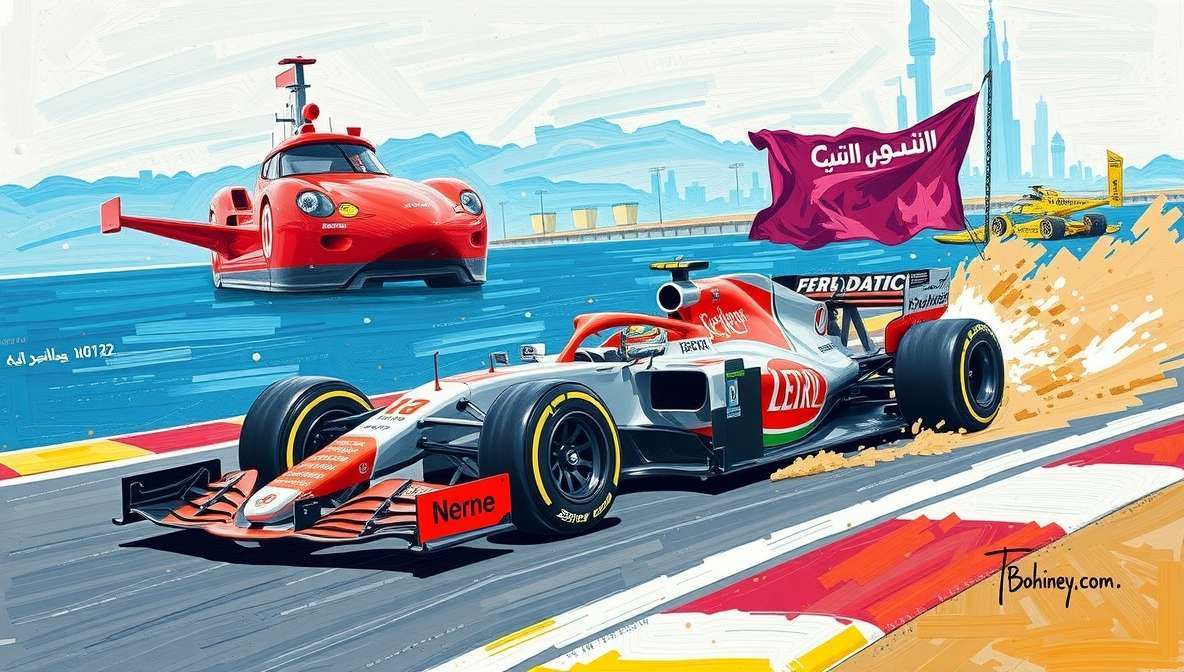
The Qatar Grand Prix happens this weekend, which is a magnificent celebration of humanity’s ability to ignore fundamental contradiction while doing it very loudly. We fly hundreds of people across the world to watch rich drivers in expensive cars go very fast around a circuit in the desert, burning fuel at Olympic-level rates, all while acting like Formula One is progressive because it announced plans to be carbon-neutral by 2030, which is automotive doublespeak for ‘we’ll probably buy some carbon credits.’
Formula One is essentially every problem with modern capitalism in concentrated form: enormous waste, environmental destruction, wealth concentration, and a global audience that’s somehow convinced this is aspirational. It’s racing! It’s fast! It’s in exotic locations! The fact that the entire sport is basically environmental catastrophe dressed as entertainment somehow gets glossed over because we’ve normalized celebrating destruction if it’s entertaining enough.
The Spectacle That Requires Ignoring Everything That Matters

Here’s what Qatar Grand Prix actually represents: a choice to prioritize entertainment over environmental impact. The entire sport requires transporting enormous amounts of equipment, flying thousands of spectators, building temporary infrastructure, and burning fuel at rates that would make climate scientists weep. Then it all gets taken down, the location gets abandoned, and the sport moves to the next location to repeat the process.
Bill Burr said something about how people accept contradiction if it’s entertaining enough, and Formula One proves that every single week. The drivers talk about environmental progress. The sport ignores environmental impact. The fans enjoy the racing without thinking about the carbon footprint of flying to Qatar to watch people go in circles at high speed.
The ‘carbon neutral by 2030’ announcement is particularly laughable. That’s ten years away. In ten years, we’ll probably be dealing with catastrophic climate effects that make current problems look quaint. F1 announced carbon neutrality plans roughly the same time the IPCC announced we have roughly a decade to prevent climate disaster. The sport’s response to environmental crisis is to announce tentative plans for some future date while continuing destructive practices in the present.
Luxury Excess Dressed as Progress
Formula One is genuinely impressive engineering. The cars are pinnacle-level technology. The drivers are among the most skilled athletes on the planet. That’s not satire. That’s fact. It’s also completely beside the point when the entire enterprise is environmentally destructive. You can be impressed by technology while recognizing the system using that technology is fundamentally problematic.
Jerry Seinfeld said something about how observation reveals absurdity, and the absurdity of F1 is staggering: we created a sport specifically designed to use resources as inefficiently as possible, then we market it as progressive because the cars are efficient relative to road vehicles. That’s not environmental progress. That’s just comparatively less destructive destruction.
Amy Schumer talks about how things don’t make sense when you think about them, and Qatar Grand Prix doesn’t make sense: we fly thousands of people to the desert to watch cars go in circles while burning fuel at catastrophic rates, all for entertainment. That’s fine. Humans do ridiculous things. But calling it progress while ignoring environmental impact is genuinely dishonest.
The Gridlock of Irrelevance
Qatar will host an amazing spectacle this weekend. The racing will probably be excellent. The engineering will be impressive. The environmental impact will be significant. The post-race carbon credit purchase will feel like progress to people who don’t think about it. Then the sport moves to the next location to repeat the process.
Ron White said something like ‘you can’t fix what you refuse to acknowledge,’ and Formula One refuses to acknowledge that it’s fundamentally environmentally destructive. The carbon neutral plans are theater. The ‘commitment to progress’ is marketing. The actual sport is luxury excess at environmental expense, and everybody knows it but participates anyway because the racing is good.
The real scandal isn’t Qatar Grand Prix. The real scandal is that we’ve convinced ourselves that high-performance entertainment can somehow be environmentally responsible through technological innovation and future promises. It can’t. Spectacular inefficiency is still spectacular inefficiency, no matter how electric the cars become.
Auf Wiedersehen, amigos.