

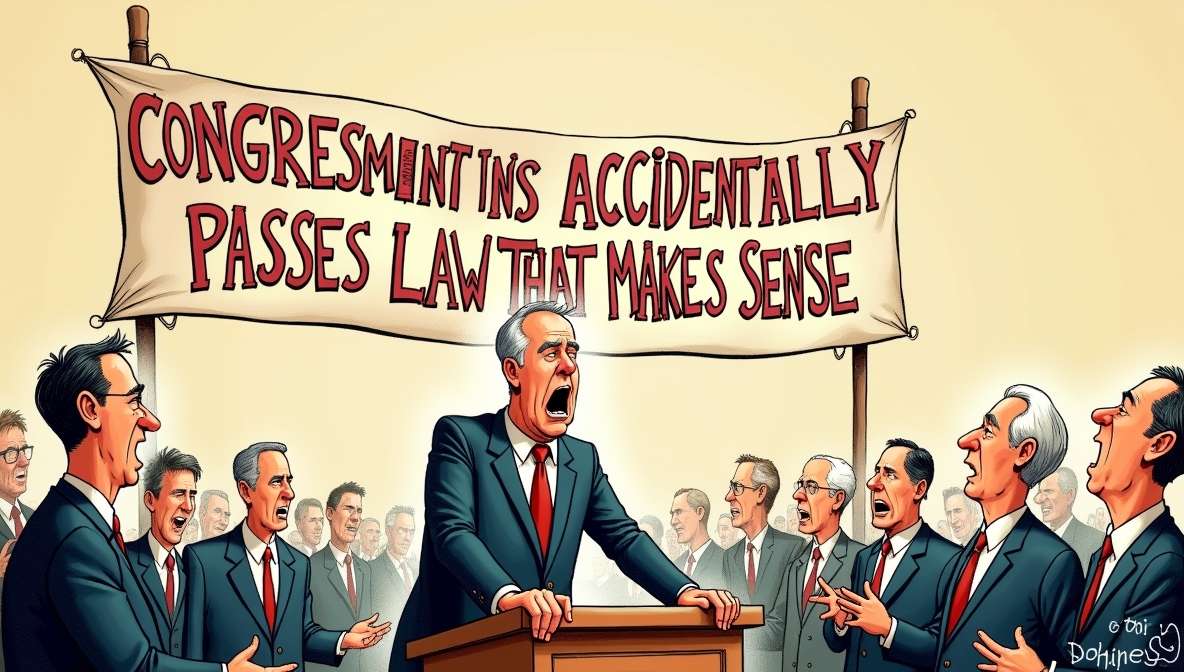
Immediately Repeals Rational Governance Act After Realizing What Happened
Congressional Accident Results in Rational Law, Swift Repeal Within Hours
In what political analysts are calling “the most shocking act of accidental competence in recent history,” a New York congressman briefly passed a law that actually made sensebefore quickly repealing it in a move described as both strategic and humiliating.
The legislation, titled the Rational Governance Act of 2025, aimed to streamline federal bureaucracy, reduce unnecessary paperwork, and provide clear guidelines for public services. Initial reports suggested it would improve efficiency, save taxpayers billions, and possibly even make constituents vaguely happy. “I read the bill,” said policy analyst Dr. Lionel Tweed. “For about 10 minutes, I genuinely believed Congress was capable of rational thought.”
Legislators Panic Upon Recognizing Effective Policy

Reaction among legislators was immediate and intense. “We realized too late that the law, if enforced, might actually fix some problems,” admitted one anonymous representative. “Obviously, that would be politically inconvenient.” Within hours, procedural maneuvers, emergency amendments, and several veiled memos ensured the law’s swift repeal.
Constituents expressed mixed emotions. “I was hopeful for like 15 minutes,” said Sheila Rodriguez, a Brooklyn resident. “Then I remembered that hope in Congress is basically a prank. Still, it was nice while it lasted.” Bill Burr once said, “The reason they call it the American Dream is because you have to be asleep to believe it.”
Social Media Erupts With Memes and Late-Night Satire
Political humorists had a field day. One late-night host quipped, “Congress just passed a law that works. Don’t worry, they fixed it by repealing it. It’s like if someone invented sliced bread and then decided toast was safer.” Social media exploded with memes depicting lawmakers frantically undoing good ideas with captions like “Oops We Fixed It” and “Nope, Not Today, Logic.”
Experts note that the event reveals a structural truth about modern governance: rational legislation is treated as a temporary glitch rather than a sustainable strategy. “Congressional inertia is so strong that any attempt at effective lawmaking triggers a sort of self-correcting absurdity,” said Tweed. “It’s like the universe saying, ‘Nice try, humans.'”
Advocacy Groups Cautiously Optimistic About Future Policy Windows
Meanwhile, advocacy groups are cautiously optimistic that even brief glimpses of sensible policy could inspire citizens. “Maybe one day, someone will pass a law that doesn’t immediately get shredded by lobbyists, procedural errors, or basic human stubbornness,” said Julia Grant, director of the Civic Engagement Foundation. “Or maybe not. It’s really hard to say.” Ron White joked, “You can’t fix stupid. There’s not a pill you can take to fix stupid.”
In the end, the Rational Governance Act of 2025 now exists only in footnotes, academic journals, and memes. Congress continues its usual rhythm of inefficiency, gridlock, and creative mismanagement. For a brief moment, however, Americans saw what it might look like if governance actually workedand then, predictably, watched it unravel in spectacular fashion.