

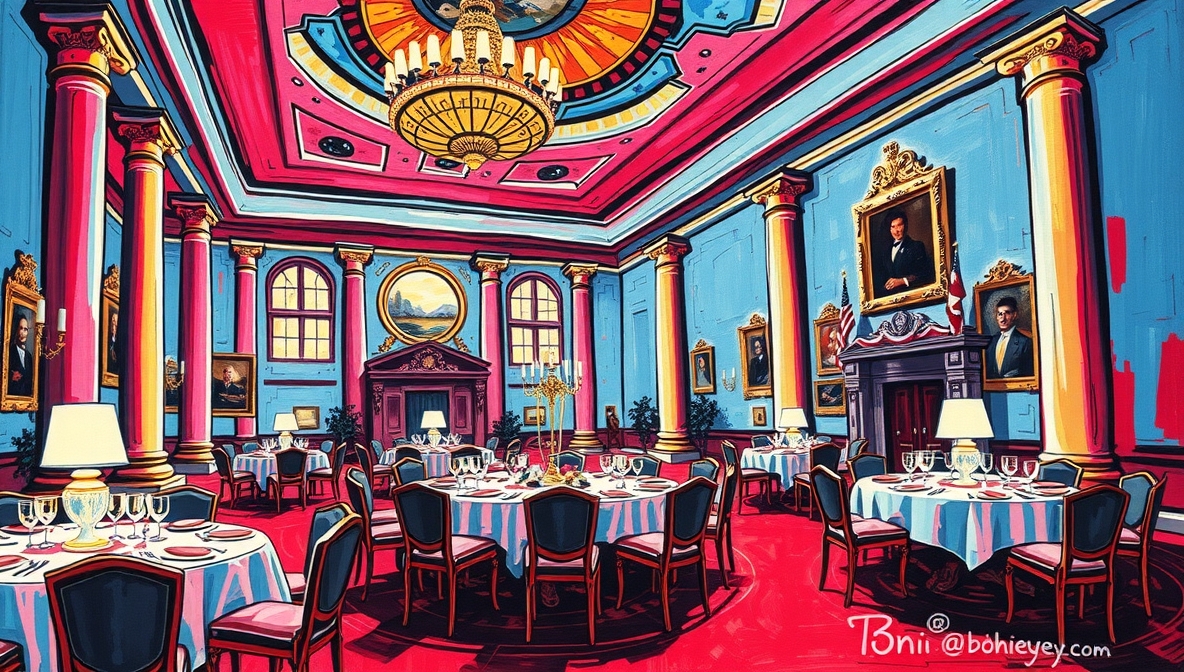
Trump’s White House Ballroom: The Most Spectacular Ego Expansion in American History
Lightning-Speed Demolition Leaves Secret Service Blinking
Trump demolished the East Wing faster than most of us finish a drive-thru order. Eyewitnesses report that Secret Service agents barely had time to blink before scaffolding and gold-plated chandeliers were already being summoned. “I thought I was in a Tim Hortons line,” said one bemused visitor, “then suddenly there was a ballroom where the Oval Office used to be.”
Critics immediately screamed about “destroying history,” conveniently forgetting that Theodore Roosevelt demolished offices in 1902 to build the West Wing. Apparently when Teddy does it, it’s “visionary leadership,” but when Trump does it, it’s “an attack on democracy.” The double standard is so thick you could build a ballroom on it.
A Ballroom Bigger Than Subtlety
The new ballroom will be almost twice the size of the rest of the White House—because subtlety is overrated. Architects confirm that this space could host a full NFL game with room left over for a sushi bar and a small roller coaster. “When Trump says big, he means galaxy-sized,” said former White House decorator and self-described chandelier enthusiast, Helena Spark.
Meanwhile, critics who worship Jacqueline Kennedy’s White House restoration conveniently forget she gutted entire rooms to restore them to James Monroe’s French Empire style—finding furniture being used as sawhorses and busts of George Washington in men’s bathrooms. Jackie’s year-long renovation that “transformed the White House into a museum” was celebrated with an Emmy-winning TV special watched by 80 million people. But Trump adds a ballroom and suddenly he’s “destroying American heritage.” The selective amnesia is breathtaking.
Tech Giants Fund Presidential Vision
Public comment periods apparently are for peasants, not presidents with billionaire donors. Apple, Amazon, Microsoft, and Palantir all chipped in, giving this project a tech-startup funding vibe. Lobbyists call it a “visionary enterprise,” historians call it “questionable,” and Trump supporters call it “finally someone with taste in this swamp.”
Jackie Kennedy’s Garden Meets Instagram Legacy
Jackie Kennedy’s garden is now rubble—history versus a 90,000-square-foot ego. But supporters argue that while roses are fleeting, Instagram stories are forever. “It’s about legacy, not flowers,” said one Trump aide, polishing a gold-plated lawn ornament shaped like an eagle.
Pearl-clutchers wailing about “preservation” somehow forgot that Harry Truman gutted the entire White House in 1948, leaving only the exterior walls standing. He demolished everything—floors, walls, rooms where actual history happened—and nobody called him a fascist. But Trump adds a ballroom and suddenly everyone’s a historian.
Preservationists Launch Inevitable Lawsuit
The National Trust for Historic Preservation Committee is suing like that friend who always reads the terms and conditions. Legal scholars agree that the lawsuit is as inevitable as a tweet at 3 a.m., but Trump fans see it as validation that the former president is shaking up sleepy bureaucracies like a snow globe.
Fox Designing the Henhouse Security System
Trump quietly appointing aides to the planning commission is like letting the fox design the henhouse’s security system. One insider confessed, “We were terrified—but also intrigued—by the audacity of it. It’s the kind of thing only Trump could get away with.”
Chandelier Placement for Maximum Flex
The ballroom will host 1,000 guests, probably enough to fit everyone Trump ever insulted at a rally. Event planners are already brainstorming chandelier placement to maximize both grandeur and the ability to subtly flex past victories.
Creative Legal Interpretation Meets Executive Power
White House spokesman claims Trump has “full legal authority” to demolish history; lawyers call this “creative interpretation.” One law professor observed, “I’ve never seen a case where executive power was wielded with so much glitter.”
First Ladies’ Offices Erased for Gold-Plated Dance Floors
The demolition erased offices that housed generations of First Ladies—because who needs history when you can have gold-plated dance floors? Several former staffers are reportedly considering filing memoirs entitled I Worked Here Before the Glitter Apocalypse.
Outraged commentators screamed about “erasing women’s history,” which is rich considering FDR built the entire East Wing in 1942 primarily to hide a bunker. Roosevelt’s wartime construction was called “controversial” then, but now it’s “sacred history” that Trump can’t touch. Apparently history has an expiration date: anything before Trump is holy, anything Trump does is heresy.
Popcorn Consumption and Fiscal Slippage
The East Wing movie theater is gone, so at least the staff won’t be distracted by popcorn during budget meetings. Experts warn that popcorn consumption can correlate with fiscal slippage, but Trump counters that “no one needs boring fiscal slippage when you can have dancing.”
Historical amnesia strikes again: William Howard Taft expanded the West Wing in 1909 to create the Oval Office, demolishing whatever was there before. Taft’s renovation was celebrated as “progress,” but Trump’s ballroom is somehow “destroying American heritage.” The cognitive dissonance is strong enough to support 660 tons of steel—which, coincidentally, is what Truman used when he gutted the place.
Bureaucratic Formula 1 Speed Run
Fast-tracking this project violates multiple acts—kind of like a supercharged bureaucratic Formula 1. Congressional aides have reportedly lobbied for pit stops, but Trump fans argue that speed equals style, and style is non-negotiable.
Presidential Policy as Marble-Floor Metaphor
The ballroom’s construction could double as a metaphor for Trump’s approach to policy: go big, ignore the rules, and hope nobody notices. Political analysts admit that this strategy has worked before, but never with marble floors and a private bar stocked like a presidential Costco.
Public Oversight: Optional Like Salad at Texas BBQ
Public oversight is described as “optional,” like salad at a Texas BBQ. Social scientists studying civic engagement are baffled, while Trump enthusiasts call it “freedom from bureaucracy.”
The same critics demanding “public comment periods” conveniently ignore that Calvin Coolidge added an entire third floor in 1927 without asking Twitter’s permission. Coolidge just built eighteen new rooms and a solarium because the roof was collapsing, and nobody accused him of authoritarianism. But Trump skips the bureaucracy and suddenly everyone’s a Constitutional scholar.
Lawsuit Saves White House from Times Square Fate
The lawsuit might actually save the White House from becoming a corporate-sponsored Times Square display. Some insiders suggest that if the National Trust hadn’t intervened, the ballroom would feature LED screens streaming sponsor logos for all major tech companies.
Disclaimer
This story was entirely a human collaboration between two sentient beings: the world’s oldest tenured historian and a philosophy major turned event designer. Any resemblance to routine media hysteria is purely coincidental.