

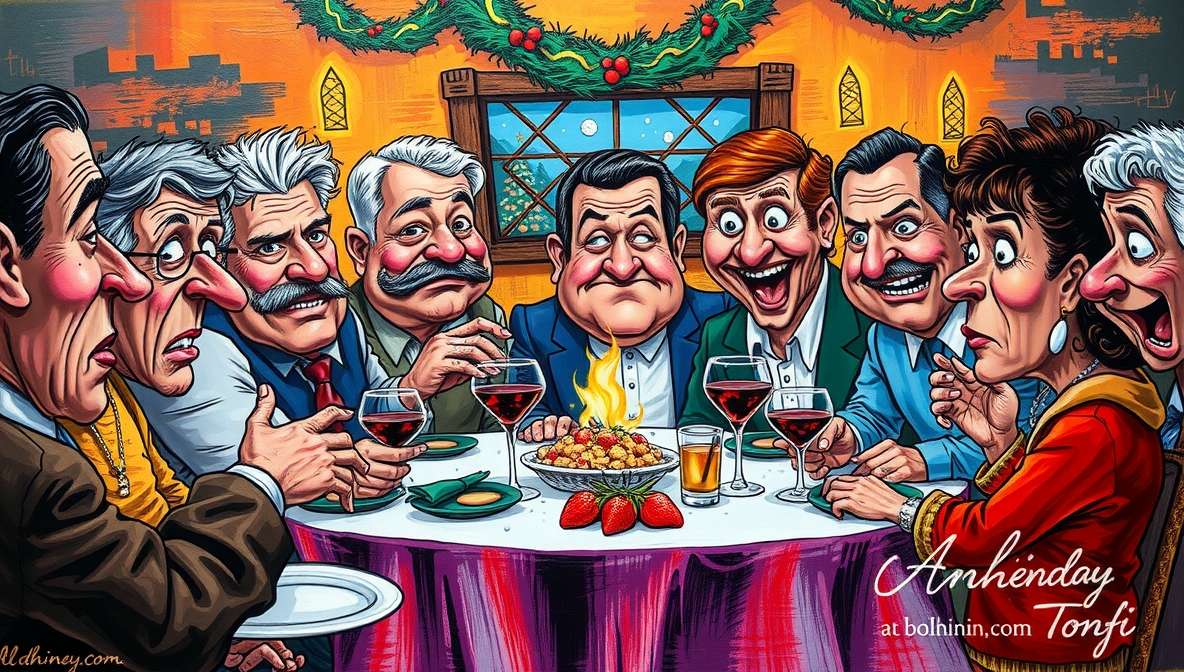
Christmas Dinner Declared Success After Only Two People Storm Out
ATLANTA — Local authorities declared a family’s Christmas dinner “successful” after only two members stormed out, setting a new standard for minimally traumatic holiday gatherings.
The dinner, featuring turkey, stuffing, and a dangerously overcooked green bean casserole, started peacefully but deteriorated when political disagreements emerged. “We’ve officially reached peak dysfunction,” said host Marge Whitfield. “Only two exits were used violently. That’s a victory.”
Family Meals as Societal Microcosms
Sociologists describe family meals as microcosms of society, with escalating arguments mirroring national discourse. “You have limited space, intense sensory input, and a mix of personalities,” said Dr. Peter Larkin. “You can’t help but collide.”
Research on political polarization shows that family gatherings increasingly serve as flashpoints for ideological conflict, particularly during holiday seasons when diverse family members congregate.
Survival Strategies for Non-Storming Participants

Eyewitnesses noted that non-storming participants coped with chocolate, wine, and passive-aggressive commentary. “It’s survival,” said one sibling. “You just nod, smile, and silently calculate who gets the last piece of pie.”
Therapists suggest pre-dinner briefings to outline rules of engagement, but admit that compliance is low. “Tradition is stronger than reason,” Larkin said.
Setting Boundaries for Future Gatherings
The dinner concluded with group hugs, awkward laughter, and several family members swearing they’ll “start Christmas a week later next year.”
Studies on holiday family stress confirm that setting clear expectations and establishing boundaries can reduce conflict, though implementation remains challenging when tradition and family dynamics collide.
Experts recommend boundary-setting strategies for families navigating difficult holiday dynamics, including predetermined topics to avoid and designated safe spaces for retreat.
Here are fifteen humorous observations, because expectations were low and Christmas dinner still tripped over them.
-
Declaring a Christmas dinner a “success” after only two people storm out shows how far the bar has sunk and how comfortably it now lives on the floor.
-
Family gatherings are the only events where losing fewer people than last year is considered growth.
-
Holiday microcosm: Family dinner tension mirroring national political polarization. The phrase “Only two exits were used violently” sounds less like a holiday recap and more like a police report written in cranberry sauce.
-
Political arguments at Christmas dinner always start with “I’m not trying to start anything,” which is how every fire in human history has begun.
-
The green bean casserole is never innocent. It knows what it did and it knows when it did it.
-
Every family has one person who brings up politics like they’re casually asking someone to pass the salt.
-
Storming out is no longer seen as rude behavior but as a valid emotional coping strategy with strong tradition behind it.
-
The host always insists everything is “fine” while mentally drafting an apology text they’ll never send.
-
Non-storming participants develop Olympic-level skills in nodding without listening and smiling without agreeing.
-
Chocolate and wine are not refreshments at Christmas dinner, they are protective equipment.
-
The last piece of pie becomes a silent negotiation involving alliances, grudges, and deep historical grievances.
-
Group hugs at the end are less about affection and more about confirming no one is holding a fork.
-
Therapists suggesting pre-dinner rules underestimate how powerful tradition is and how weak human self-control becomes near stuffing.
-
Saying “We’ll do things differently next year” is a cherished ritual that has never once been honored.
-
By the end of the night, everyone agrees the dinner was a success, not because it went well, but because it finally ended.
Minimal trauma achieved. Expectations adjusted. Memories repressed. Auf Wiedersehen.